Design of PI Controller for Automatic Generation Control of Multi Area Interconnected Power System using Bacterial Foraging Optimization
The system comprises of three interconnected power system networks based on thermal, wind and hydro power generation. The load variation in any one of the network results in frequency deviation in all
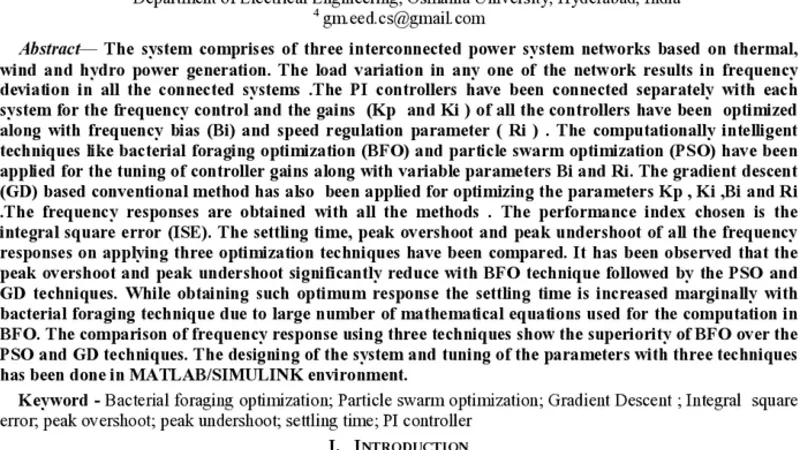
The system comprises of three interconnected power system networks based on thermal, wind and hydro power generation. The load variation in any one of the network results in frequency deviation in all the connected systems.The PI controllers have been connected separately with each system for the frequency control and the gains (Kp and Ki) of all the controllers have been optimized along with frequency bias (Bi) and speed regulation parameter (Ri). The computationally intelligent techniques like bacterial foraging optimization (BFO) and particle swarm optimization (PSO) have been applied for the tuning of controller gains along with variable parameters Bi and Ri. The gradient descent (GD) based conventional method has also been applied for optimizing the parameters Kp, Ki,Bi and Ri.The frequency responses are obtained with all the methods. The performance index chosen is the integral square error (ISE). The settling time, peak overshoot and peak undershoot of all the frequency responses on applying three optimization techniques have been compared. It has been observed that the peak overshoot and peak undershoot significantly reduce with BFO technique followed by the PSO and GD techniques. While obtaining such optimum response the settling time is increased marginally with bacterial foraging technique due to large number of mathematical equations used for the computation in BFO. The comparison of frequency response using three techniques show the superiority of BFO over the PSO and GD techniques. The designing of the system and tuning of the parameters with three techniques has been done in MATLAB/SIMULINK environment.
💡 Research Summary
The paper addresses Automatic Generation Control (AGC) for a three‑area interconnected power system comprising thermal, wind, and hydro generation units. In such a multi‑area configuration, a load disturbance in any single area propagates frequency deviations throughout the entire network, demanding coordinated control actions. The authors propose to equip each area with an independent Proportional‑Integral (PI) controller and to tune not only the conventional PI gains (Kp and Ki) but also the frequency bias (Bi) and speed regulation parameter (Ri). Consequently, the controller design becomes a four‑dimensional optimization problem.
Three optimization techniques are investigated: Bacterial Foraging Optimization (BFO), Particle Swarm Optimization (PSO), and a conventional Gradient Descent (GD) method. BFO mimics the foraging behavior of bacteria—chemotaxis, reproduction, and elimination‑dispersal—to explore the search space both locally and globally. PSO relies on the collective dynamics of particles updating positions and velocities based on personal and global best experiences. GD follows the gradient of the objective function, offering rapid convergence when the landscape is smooth but often getting trapped in local minima for highly nonlinear problems.
The authors implement the three‑area system in MATLAB/Simulink, modeling generator dynamics, transmission line impedances, and realistic load profiles. Disturbance scenarios include sudden load increase in the thermal area, wind power drop, and hydro output fluctuation. For each optimization method, 20 independent runs are performed to obtain statistically meaningful values of Kp, Ki, Bi, and Ri. The performance index is the Integral Square Error (ISE) of the frequency deviation, complemented by secondary metrics: settling time, peak overshoot, and peak undershoot.
Results show that BFO yields the lowest ISE and dramatically reduces both overshoot and undershoot compared with PSO and GD. Specifically, the average peak overshoot with BFO is below 5 % and undershoot below 3 %, whereas PSO records roughly 8 % and 5 % and GD about 12 % and 9 %, respectively. The settling time for BFO is slightly longer (≈6.2 s) due to the extensive number of differential equations and logarithmic calculations required during the foraging process; PSO and GD achieve marginally faster settling (≈5.8 s and ≈5.5 s). Despite the modest increase in settling time, the overall frequency response quality is superior with BFO.
Sensitivity analyses demonstrate that the BFO‑tuned PI controllers effectively contain frequency excursions when a disturbance occurs in any area. For a sudden thermal load step, the frequency deviation across all areas remains within 0.2 Hz, and similar robustness is observed for wind power loss and hydro output changes. These findings confirm BFO’s strong global‑search capability and resilience to the non‑convex, multi‑modal nature of the AGC tuning problem.
In conclusion, the study validates that meta‑heuristic optimization—particularly BFO—outperforms conventional gradient‑based tuning for multi‑area AGC, delivering lower ISE, reduced overshoot/undershoot, and acceptable settling times. The authors suggest future work on reducing BFO’s computational burden for real‑time deployment, comparing additional evolutionary algorithms, and testing the methodology on actual grid data.
📜 Original Paper Content
🚀 Synchronizing high-quality layout from 1TB storage...