Modelling internet based applications for designing multi-device adaptive interfaces
The wide spread of mobile devices in the consumer market has posed a number of new issues in the design of internet applications and their user interfaces. In particular, applications need to adapt their interaction modalities to different portable devices. In this paper we address the problem of defining models and techniques for designing internet based applications that automatically adapt to different mobile devices. First, we define a formal model that allows for specifying the interaction in a way that is abstract enough to be decoupled from the presentation layer, which is to be adapted to different contexts. The model is mainly based on the idea of describing the user interaction in terms of elementary actions. Then, we provide a formal device characterization showing how to effectively implements the AIUs in a multidevice context.
💡 Research Summary
The paper addresses the challenge of designing Internet‑based applications that can automatically adapt their user interfaces to a wide variety of mobile devices. The authors propose a two‑layer solution: (1) a set of Atomic Interaction Units (AIUs) that capture the most elementary user‑system actions in a device‑independent way, and (2) a UML Activity Diagram that connects these AIUs to describe the overall service flow.
AIUs are small, self‑contained interaction primitives such as BrowseImage, InteractImage, BrowseText, BrowseMessage, BrowseTable, InteractTable, FillList, SelectChoice, and SelectMultipleChoice. Each AIU defines its input parameters (e.g., identifiers, descriptions, command sets) and its possible return values (e.g., selected coordinates, chosen list element, or a simple “OK”). All AIUs expose a universal Quit command, allowing the user to leave the unit at any time without side effects. By limiting the interaction vocabulary to this compact set, the authors aim to achieve sufficient expressive power for typical web services (hotel reservation, restaurant search, flight booking) while keeping the model abstract enough to be decoupled from any particular presentation technology.
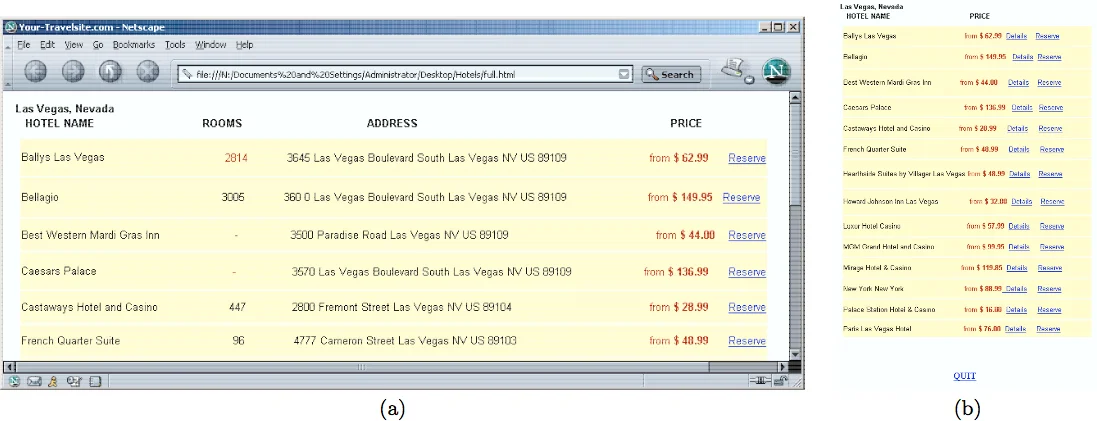
The UML Activity Diagram serves as the glue that assembles AIUs into complete applications. Each diagram node corresponds to a single AIU, and transitions are triggered either by the user completing the AIU or by a server‑side computation. The diagram supports parallelism through fork/join constructs, enabling the representation of tasks that can be performed concurrently (e.g., entering city and reservation dates). The paper illustrates the approach with a detailed hotel‑reservation scenario: city selection (SelectChoice) and date entry (FillList) are modeled as parallel activities; the search result is displayed with InteractTable; the user then chooses an action (reserve, new search, go back) via another SelectChoice, leading to further parallel activities for customer data entry and payment method selection. This example demonstrates that complex service logic can be expressed with a handful of AIUs and a relatively simple activity flow.
To make AIUs render correctly on heterogeneous devices, the authors introduce a set of quantitative device metrics. Functions such as RN(dev) (rows displayable), CN(dev) (columns displayable), boolean flags for continuous/row‑based/page‑based vertical and horizontal scrolling (CVS, RVS, PVS, COHS, PHS, etc.), and capabilities like Wi‑Fi, Java, audio, color depth, and touch screen availability are defined. Corresponding AIU metrics (required rows, columns, character count) allow the system to compute a “degradation level” when an AIU is mapped onto a specific device. The paper provides a concrete calculation for an InteractTable AIU that must show 40 rows × 105 columns on a device capable of only 14 rows × 30 columns, with row‑based vertical scrolling and page‑based vertical scrolling supported, but no horizontal scrolling. Based on these numbers, the system would decide to paginate the rows, truncate or wrap columns, and possibly switch to a simplified layout.
Related work is surveyed, covering plastic interfaces, model‑based UI design, task‑model driven generation, and data‑intensive web modeling (WebML, RMM, HDM). The authors position their contribution as a hybrid: they adopt the abstract interaction unit idea from model‑based UI research while also embracing the data‑centric perspective of WebML. Their AIU set is deliberately small, focusing on text‑ and table‑oriented interactions, which differentiates it from richer multimedia‑oriented models.
The paper concludes by acknowledging that a full systematic implementation and empirical evaluation are outside its scope. It sketches a dynamic adaptation algorithm based on the defined metrics and suggests that future work should address automatic code generation, performance testing on real devices, and extension of AIUs to richer media and gesture‑based interactions.
Overall, the work offers a clear conceptual framework for modular, device‑agnostic UI design and provides a concrete metric‑driven adaptation strategy. However, the lack of a prototype, quantitative performance data, and user‑experience studies limits the immediate applicability of the approach. Further engineering and evaluation are needed to validate the practicality of AIU‑based adaptive interfaces in real‑world multi‑device ecosystems.
Comments & Academic Discussion
Loading comments...
Leave a Comment