A search for near-infrared counterparts of two faint neutron star X-ray transients : XMMU J174716.1-281048 and SAX J1806.5-2215
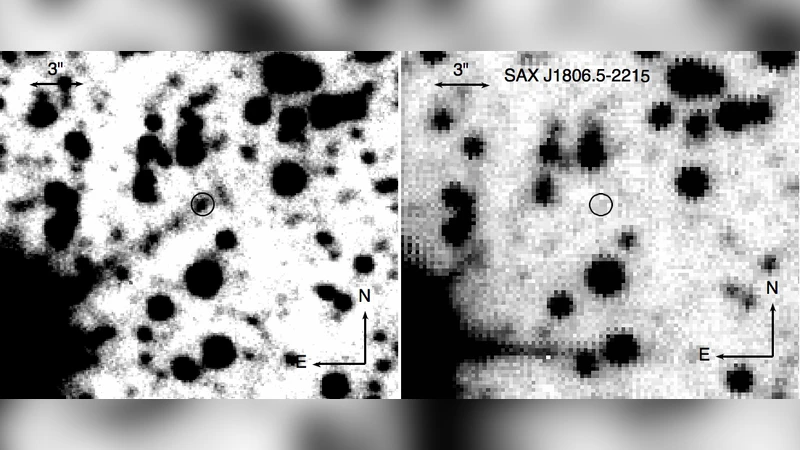
We present our near-infrared (NIR) imaging observations of two neutron star low mass X-ray binaries XMMU J174716.1-281048 and SAX J1806.5-2215 obtained using the PANIC instrument on the 6.5-meter Magellan telescope and the WHIRC instrument on the 3.5-meter WIYN telescope respectively. Both sources are members of the class of faint to very-faint X-ray binaries and undergo very long X-ray outburst, hence classified as `quasi persistent X-ray binaries’. While XMMU J174716.1-281048 was active for almost 12 years between 2003 and 2015, SAX J1806.5-2215 has been active for more than 5 years now since 2011. From our observations, we identify two NIR stars consistent with the Chandra X-ray error circle of XMMU J174716.1-281048. The comparison of our observations with the UKIRT Galactic plane observations taken during the same outburst, color-color diagram analysis and spectral energy distribution suggest that both stars are probably a part of the field population and are likely high mass stars. Hence possibly neither of the two stars is a true NIR counterpart. For the faint X-ray binary SAX J1806.5-2215 during its current outburst, we detected a NIR star in our K band WIYN observations consistent with its Chandra error circle. The identified NIR star was not detected during the UKIRT observations taken during its quiescent state. The comparison of two observations suggest that there was an increase in flux by at least one magnitude of the detected star during our observations, hence suggests the detection of the likely counterpart of SAX J1806.5-2215.
💡 Research Summary
This paper presents near‑infrared (NIR) imaging of two neutron‑star low‑mass X‑ray binaries (LMXBs), XMMU J174716.1‑281048 and SAX J1806.5‑2215, obtained with the PANIC instrument on the 6.5‑m Magellan telescope and the WHIRC instrument on the 3.5‑m WIYN telescope, respectively. Both sources belong to the class of faint‑to‑very‑faint X‑ray binaries that exhibit unusually long outbursts, qualifying them as “quasi‑persistent” systems. XMMU J174716.1‑281048 was active for roughly twelve years (2003–2015), while SAX J1806.5‑2215 has been in outburst for more than five years since 2011.
Using the precise Chandra positions (error radii ≈0.6″), the authors searched for NIR counterparts within the X‑ray error circles. For XMMU J174716.1‑281048, two NIR sources are found inside the Chandra error region. Their J, H, and K photometry, when plotted on a J‑H versus H‑K colour‑colour diagram, aligns with the field population rather than with the expected colours of a low‑mass donor. Spectral energy distribution (SED) fitting suggests that both objects are consistent with high‑mass, heavily reddened field stars at the Galactic centre distance. Consequently, the authors conclude that neither of the two NIR objects is likely the true counterpart of XMMU J174716.1‑281048.
In contrast, for SAX J1806.5‑2215 the WIYN K‑band image reveals a single NIR source that lies within the Chandra error circle. This source was not detected in earlier UKIRT observations taken while the system was in quiescence. Comparing the two epochs shows that the K‑band magnitude has brightened by at least one magnitude during the current outburst, indicating a clear NIR variability associated with the X‑ray activity. The authors therefore identify this variable source as the most plausible NIR counterpart of SAX J1806.5‑2215.
The study highlights several important points for the broader community. First, identifying counterparts of faint LMXBs requires deep, high‑resolution NIR imaging combined with precise X‑ray positions, especially in crowded Galactic‑plane fields. Second, colour‑colour analysis and SED modeling are essential tools to discriminate genuine donors from unrelated field stars, particularly when the donor is expected to be a low‑mass, intrinsically faint object. Third, the detection of NIR brightening concurrent with long‑lasting X‑ray outbursts provides strong evidence for the association and can be used to constrain the donor’s spectral type, distance, and extinction.
The authors suggest that follow‑up NIR spectroscopy of the candidate counterpart to SAX J1806.5‑2215, as well as continued multi‑epoch photometric monitoring of both systems, will be crucial for confirming the nature of the donor, measuring the orbital period, and improving our understanding of mass‑transfer processes in quasi‑persistent, faint X‑ray binaries. The lack of a confirmed counterpart for XMMU J174716.1‑281048 also underscores the difficulty of counterpart identification in heavily reddened regions and points to the need for even deeper observations or alternative techniques such as adaptive‑optics imaging or mid‑infrared surveys. Overall, the paper provides valuable observational constraints on two poorly studied systems and demonstrates a methodological framework that can be applied to other faint, long‑duration X‑ray transients.