Efficient Minimization of Higher Order Submodular Functions using Monotonic Boolean Functions
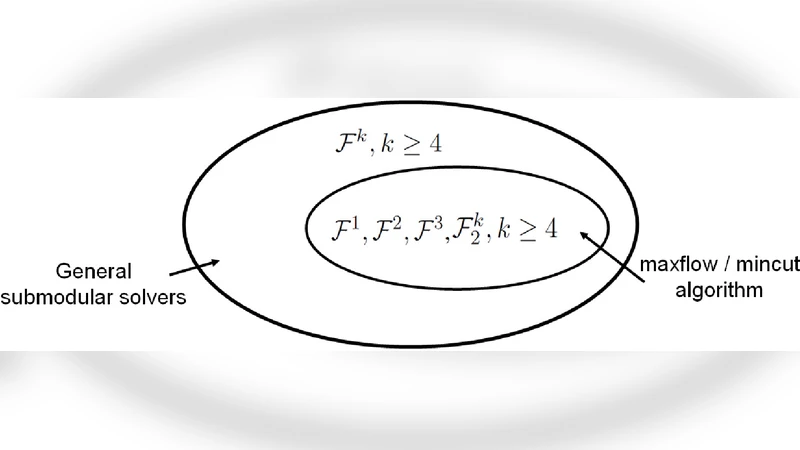
Submodular function minimization is a key problem in a wide variety of applications in machine learning, economics, game theory, computer vision, and many others. The general solver has a complexity of $O(n^3 \log^2 n . E +n^4 {\log}^{O(1)} n)$ where $E$ is the time required to evaluate the function and $n$ is the number of variables \cite{Lee2015}. On the other hand, many computer vision and machine learning problems are defined over special subclasses of submodular functions that can be written as the sum of many submodular cost functions defined over cliques containing few variables. In such functions, the pseudo-Boolean (or polynomial) representation \cite{BorosH02} of these subclasses are of degree (or order, or clique size) $k$ where $k \ll n$. In this work, we develop efficient algorithms for the minimization of this useful subclass of submodular functions. To do this, we define novel mapping that transform submodular functions of order $k$ into quadratic ones. The underlying idea is to use auxiliary variables to model the higher order terms and the transformation is found using a carefully constructed linear program. In particular, we model the auxiliary variables as monotonic Boolean functions, allowing us to obtain a compact transformation using as few auxiliary variables as possible.
💡 Research Summary
The paper addresses the problem of minimizing higher‑order submodular functions, which appear in many machine learning, computer‑vision, economics, and game‑theoretic applications. General submodular minimization algorithms have a worst‑case complexity of O(n³ log² n·E + n⁴ log O(1) n), where n is the number of Boolean variables and E is the cost of evaluating the function. In practice, however, the functions of interest are often expressed as a sum of low‑order terms (cliques) of size k with k ≪ n. The authors propose a systematic method to transform any submodular function of order k into an equivalent quadratic (second‑order) submodular function by introducing auxiliary binary variables (AVs).
The key technical contribution is the use of monotonic Boolean functions (MBFs) to model the state of each AV. An MBF is a Boolean function that never decreases when any input bit flips from 0 to 1. The set of all MBFs over k variables is counted by the Dedekind number D(k). By constraining each AV to be an MBF of the original variables, the authors obtain a tight upper bound on the number of required AVs: instead of the previously known bound 2^{2k}
Comments & Academic Discussion
Loading comments...
Leave a Comment