Initial/boundary-value problems of tumor growth within a host tissue
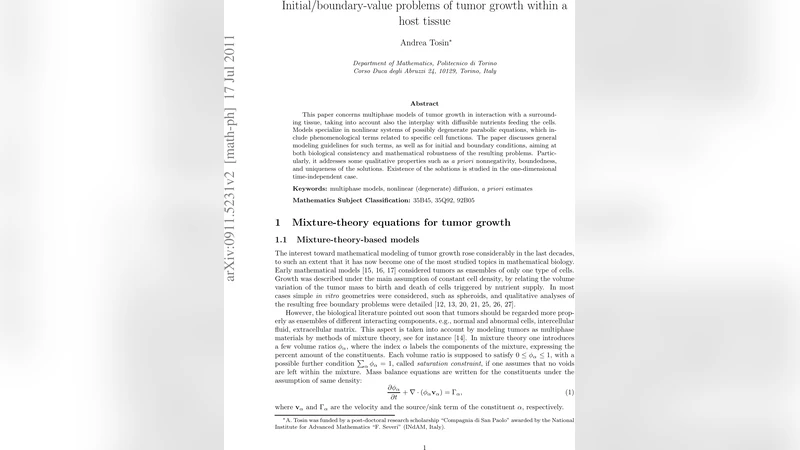
This paper concerns multiphase models of tumor growth in interaction with a surrounding tissue, taking into account also the interplay with diffusible nutrients feeding the cells. Models specialize in nonlinear systems of possibly degenerate parabolic equations, which include phenomenological terms related to specific cell functions. The paper discusses general modeling guidelines for such terms, as well as for initial and boundary conditions, aiming at both biological consistency and mathematical robustness of the resulting problems. Particularly, it addresses some qualitative properties such as a priori nonnegativity, boundedness, and uniqueness of the solutions. Existence of the solutions is studied in the one-dimensional time-independent case.
💡 Research Summary
The paper develops a rigorous multiphase continuum‑mechanics framework for describing the growth of a solid tumor within a host tissue, explicitly accounting for the exchange of diffusible nutrients such as oxygen and glucose. Three material phases are introduced – tumor cells, normal host cells, and the extracellular matrix – each represented by a volume‑fraction field ϕ_i(x,t). Mass conservation for each phase leads to a set of coupled balance equations, while momentum balance is incorporated through nonlinear stress tensors that reflect the viscous and elastic properties of the individual phases.
Nutrient transport is modeled by a separate diffusion‑reaction equation for the concentration c(x,t). The diffusion term uses a constant diffusivity D_c, whereas the consumption term Q_i(ϕ_i,c) follows Michaelis–Menten kinetics, ensuring that nutrient uptake diminishes when c becomes scarce. The reaction terms R_i(ϕ,c) in the volume‑fraction equations encode biologically motivated processes: proliferation, apoptosis, contact inhibition, and matrix remodeling. Importantly, the authors prescribe a systematic set of design principles for these phenomenological terms: (1) non‑negativity of all state variables, (2) boundedness (0 ≤ ϕ_i ≤ 1, 0 ≤ c ≤ c_max), (3) sufficient smoothness for analytical and numerical treatment, and (4) fidelity to experimentally observed cell behavior.
Mathematically the model takes the form of a possibly degenerate parabolic system:
∂_t ϕ_i = ∇·
Comments & Academic Discussion
Loading comments...
Leave a Comment