MOCCA code for star cluster simulations - V. Initial globular cluster conditions influence on blue stragglers
The paper presents an analysis of properties of populations of blue stragglers (BSs) in evolving globular clusters, based on numerical simulations done with the MOCCA code for various initial globular clusters conditions. We find that various populations of BSs strongly depend on the initial semi-major axes distributions. With a significant number of compact binaries, the number of evolutionary BSs can be also significant. In turn, for semi-major axes distributions preferring binaries with wider orbits, dynamical BSs are the dominant ones. Their formation scenario is very distinct: for wide binaries the number of dynamical interactions is significantly larger. Most interactions are weak and increase only slightly the eccentricities. However, due to a large number of such interactions, the eccentricities of a number of binaries finally get so large that the stars collide. We study how larger initial clusters’ concentrations influence the BSs. Besides the expected increase of the number of dynamically created BSs (for denser GCs the probabilities of strong dynamical interactions and collisions are higher), we find that the number of the evolutionary BSs is not affected even by very high initial concentrations. This has a very important implication on observations - it supports the theory that the evolutionary BSs are the result of the unperturbed evolution of the primordial binaries. In addition, the paper presents the evolution of the ratio between the number of BSs in binaries and as single stars R_B/S. For a vast diversity of models, the ratio R_B/S approaches the value ~0.4. Additionally, we identified two subgroups which differ in the initial semi-major axes distributions. The first group starts with a high ratio R_B/S, it decreases with time and settles around 0.4. The second group starts with lower values of the ratio R_B/S … . (etc., abstract continues)
💡 Research Summary
The authors employed the MOCCA Monte‑Carlo Cluster Simulator to explore how the initial conditions of globular clusters affect the formation and evolution of blue straggler stars (BSs). A suite of simulations was run for clusters containing from 10 000 to 200 000 stars, each evolved for 12 Gyr. The parameter space covered four main axes: (i) the primordial binary fraction (5 %–50 %), (ii) the initial binary semi‑major‑axis distribution (log‑uniform, Kroupa‑type, and a distribution favoring wide binaries), (iii) the initial central concentration expressed by King model W₀ values of 5, 7, and 9, and (iv) the initial eccentricity distribution (thermal versus uniform). Stellar evolution for single and binary components was handled by the SSE/BSE routines, while strong dynamical encounters were treated with the Fewbody integrator.
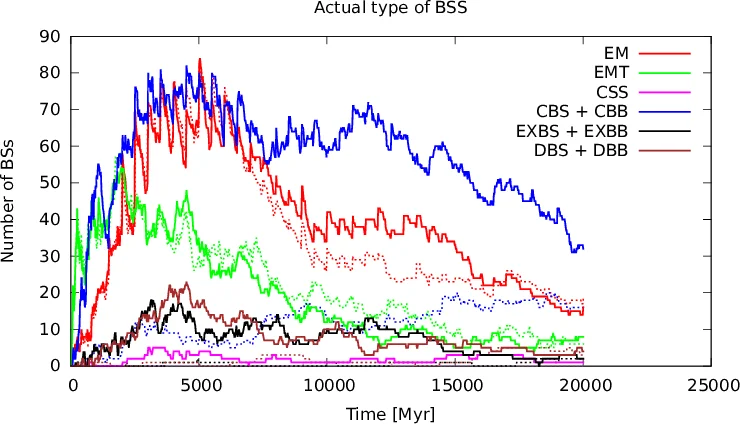
The key findings can be summarized as follows. First, the total number of BSs scales with the primordial binary fraction, confirming earlier observational suggestions that binaries are the primary reservoir for BS production. Second, the shape of the semi‑major‑axis distribution determines which formation channel dominates. Models rich in compact binaries (a ≲ 10 AU) produce a substantial population of “evolutionary” BSs (E‑BS) through mass transfer and binary coalescence; these objects account for roughly 30 %–50 % of all BSs in such clusters. Conversely, models where wide binaries dominate experience a high rate of weak three‑ and four‑body encounters. These encounters gradually pump eccentricities; once the eccentricity exceeds a critical value, a direct collision occurs, creating “dynamical” BSs (D‑BS). In high‑concentration clusters (W₀ ≥ 9) D‑BSs become the majority, comprising up to 70 %–80 % of the BS population.
Third, increasing the initial central concentration boosts the number of D‑BSs but leaves the number of E‑BSs essentially unchanged. This insensitivity of E‑BSs to density supports the hypothesis that they arise from the unperturbed evolution of primordial binaries, whereas D‑BSs are directly linked to the frequency of strong dynamical interactions. Fourth, the ratio of BSs residing in binaries to those that are single (R_B/S) converges to ≈0.4 in virtually all models, regardless of the initial conditions. Two distinct evolutionary tracks are identified: (a) clusters that start with a high R_B/S (≈0.6–0.8) and decline toward 0.4—these are the “E‑BS‑dominated” systems with many compact binaries; and (b) clusters that start with a low R_B/S (≈0.2–0.3) and rise to the same asymptotic value—these are the “D‑BS‑dominated” systems where wide binaries prevail. Fifth, the initial eccentricity distribution exerts only a minor influence on the overall BS counts and on the relative importance of the two channels.
The authors discuss the observational implications of these results. The constancy of the E‑BS population across a wide range of densities explains why the observed BS numbers do not correlate tightly with the theoretical collision rate in many Galactic globular clusters. Moreover, the universal convergence of R_B/S to ~0.4 suggests a self‑regulating balance between binary disruption and formation of new binaries through exchange encounters, a balance that appears to be a generic feature of long‑term cluster evolution.
Overall, the paper demonstrates that the initial binary semi‑major‑axis distribution and the initial concentration are the dominant factors shaping BS demographics. The MOCCA code proves capable of reproducing the complex interplay between stellar evolution and dynamical encounters in realistic globular clusters, providing a robust theoretical framework for interpreting current and future observations of blue straggler populations.
Comments & Academic Discussion
Loading comments...
Leave a Comment