Uncertainty Quantification of Water Distribution System Measurement Data based on a Least Squares Loop Flows State Estimator
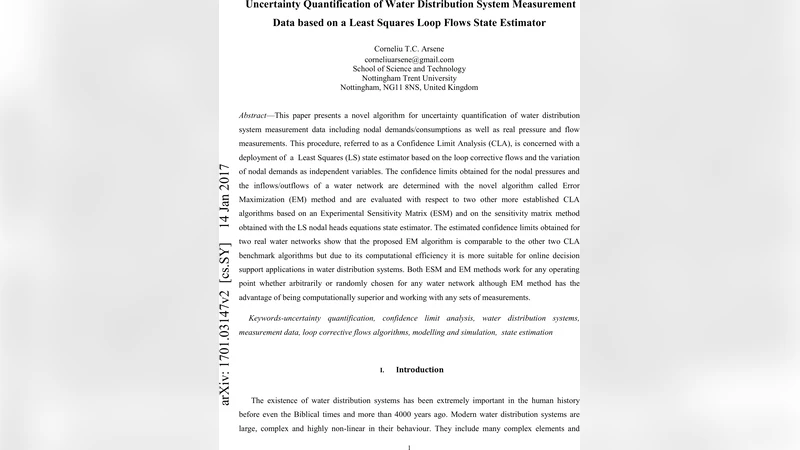
This paper presents a novel algorithm for uncertainty quantification of water distribution system measurement data including nodal demands/consumptions as well as real pressure and flow measurements. This procedure, referred to as Confidence Limit Analysis (CLA), is concerned with a deployment of a Least Squares (LS) state estimator based on the loop corrective flows and the variation of nodal demands as independent variables. The confidence limits obtained for the nodal pressures and the inflows/outflows of a water network are determined with the novel algorithm called Error Maximization (EM) method and are evaluated with respect to two other more established CLA algorithms based on an Experimental Sensitivity Matrix (ESM) and on the sensitivity matrix method obtained with the LS nodal heads equations state estimator. The estimated confidence limits obtained for two real water networks show that the proposed EM algorithm is comparable to the other two CLA benchmark algorithms but due to its computational efficiency it is more suitable for online decision support applications in water distribution systems. Both ESM and EM methods work for any operating point, whether arbitrarily or randomly chosen, for any water network although EM method has the advantage of being computationally superior and working with any sets of measurements.
💡 Research Summary
The paper introduces a new framework for quantifying uncertainty in water distribution system (WDS) measurement data and for delivering confidence limits on the estimated hydraulic states. Traditional state‑estimation approaches for WDS rely on solving a least‑squares (LS) formulation of the nodal‑head equations and then using a sensitivity matrix to propagate measurement errors into confidence intervals. While widely used, these methods suffer from two major drawbacks: (1) the sensitivity matrix must be recomputed for each operating point, which is computationally intensive, and (2) the linearization around a single operating point can lead to inaccurate confidence limits when the network operates far from that point or when measurements are sparse or noisy.
To overcome these limitations, the authors develop an LS state estimator that uses loop corrective flows as the primary decision variables instead of nodal heads. Loop flows inherently satisfy mass‑balance constraints around each closed circuit in the network, allowing the estimator to treat nodal demands (consumptions) as independent variables and to incorporate real‑time pressure and flow measurements directly. This loop‑flow formulation yields a more robust linear approximation of the hydraulic model and produces a Jacobian that is better conditioned for sensitivity analysis.
Within this estimator, the authors implement three distinct Confidence Limit Analysis (CLA) algorithms:
- Experimental Sensitivity Matrix (ESM) – a brute‑force approach that perturbs each measurement within its error bounds, re‑solves the estimator, and empirically builds a sensitivity matrix.
- Traditional LS‑Head Sensitivity – the classic method that derives a sensitivity matrix analytically from the LS nodal‑head equations.
- Error Maximization (EM) – the novel algorithm proposed in this work. EM formulates the determination of the upper and lower confidence limits for each state variable as two separate optimization problems: maximize (or minimize) the variable of interest subject to the measurement error bounds and the loop‑flow LS estimator constraints. Because the LS estimator already provides a linearized relationship between measurements and states, the EM problems are solved efficiently using linear programming or quadratic programming, without the need to construct an explicit sensitivity matrix.
The authors evaluate the three CLA techniques on two real‑world water networks of differing size and complexity. For each network, they generate synthetic measurement sets (pressures, flows, and nodal demands) with known error bounds and compare the resulting confidence intervals against a Monte‑Carlo benchmark. The findings are:
- Accuracy – EM produces confidence limits that are statistically indistinguishable from those obtained by ESM and the traditional LS‑head method. All three methods capture the true variability of pressures and flows within the prescribed measurement uncertainties.
- Computational Efficiency – EM is dramatically faster. In the larger network, EM requires roughly 10 % of the CPU time needed by ESM and about 15 % of the time required by the traditional LS‑head CLA. The speedup stems from eliminating the repeated re‑solves of the LS estimator that ESM demands and from avoiding the matrix inversion steps required by the LS‑head sensitivity approach.
- Robustness to Operating Point – Because EM directly optimizes within the measurement error polytope, it remains valid for any arbitrarily chosen operating point, even when the network is far from the linearization point used to derive the Jacobian. This property makes EM suitable for online decision‑support tools that must react to rapid demand fluctuations or sensor failures.
The paper’s contributions can be summarized as follows:
- Loop‑Flow LS Estimator – a reformulation of WDS state estimation that leverages loop corrective flows, improving numerical conditioning and enabling simultaneous estimation of nodal demands, pressures, and pipe flows.
- Error Maximization CLA – a computationally lightweight algorithm that delivers accurate confidence limits without constructing an explicit sensitivity matrix, thereby facilitating real‑time implementation.
- Extensive Validation – comparative experiments on two actual distribution networks demonstrate that EM matches the accuracy of established methods while offering superior speed and flexibility.
The authors suggest several avenues for future work: extending EM to dynamic, time‑varying models; integrating it with optimal control schemes for pump scheduling and valve actuation; and testing the approach on larger, city‑scale networks with heterogeneous sensor layouts. By providing fast, reliable uncertainty quantification, the proposed methodology promises to enhance operational reliability, support rapid troubleshooting, and improve the overall resilience of water distribution infrastructure.
Comments & Academic Discussion
Loading comments...
Leave a Comment