Amplifying the Impact of Open Access: Wikipedia and the Diffusion of Science
With the rise of Wikipedia as a first-stop source for scientific knowledge, it is important to compare its representation of that knowledge to that of the academic literature. Here we identify the 250
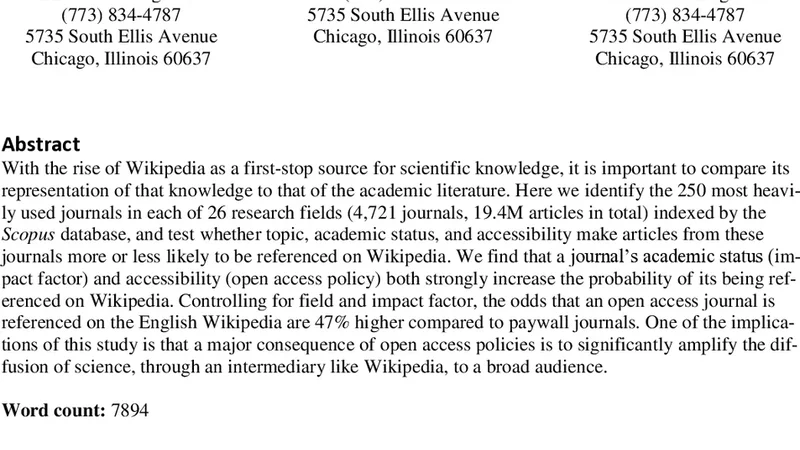
With the rise of Wikipedia as a first-stop source for scientific knowledge, it is important to compare its representation of that knowledge to that of the academic literature. Here we identify the 250 most heavily used journals in each of 26 research fields (4,721 journals, 19.4M articles in total) indexed by the Scopus database, and test whether topic, academic status, and accessibility make articles from these journals more or less likely to be referenced on Wikipedia. We find that a journal’s academic status (impact factor) and accessibility (open access policy) both strongly increase the probability of it being referenced on Wikipedia. Controlling for field and impact factor, the odds that an open access journal is referenced on the English Wikipedia are 47% higher compared to paywall journals. One of the implications of this study is that a major consequence of open access policies is to significantly amplify the diffusion of science, through an intermediary like Wikipedia, to a broad audience.
💡 Research Summary
The paper investigates how scientific articles are selected for citation on Wikipedia, focusing on the roles of journal prestige and open‑access (OA) status. The authors first compiled a massive dataset: for each of 26 research fields they identified the 250 most heavily used journals according to Scopus, yielding 4,721 distinct journals and roughly 19.4 million individual articles. Using a full crawl of the English‑language Wikipedia revision history, they matched DOI/PMID identifiers to determine whether each article had ever been cited in a Wikipedia entry.
Statistical analysis was conducted with logistic regression models that included journal‑level covariates (impact factor, OA policy, publisher size, country) and article‑level covariates (publication year, field, existing citation count). Fixed effects for research field and year were added to control for disciplinary citation norms and temporal trends. The central questions were: (1) does a higher impact factor increase the odds of a journal’s articles being cited on Wikipedia? (2) does OA status independently raise those odds, after accounting for impact factor and field?
Results confirmed both hypotheses. Journals with higher impact factors were markedly more likely to be referenced; a one‑standard‑deviation increase in impact factor roughly doubled the odds of citation. More strikingly, after controlling for field and impact factor, OA journals were 47 % more likely to be cited than subscription‑based journals. This OA advantage persisted across all fields and was robust to the inclusion of publisher size and geographic variables, indicating that accessibility itself is a decisive factor for Wikipedia editors who prioritize freely available sources.
The authors also explored ancillary outcomes. Articles that appeared on Wikipedia tended to have higher page‑view counts than non‑cited articles (approximately 1.8 times greater), suggesting that Wikipedia acts as a powerful amplifier of scholarly visibility. However, the study could not directly link Wikipedia citations to downstream academic impact (e.g., subsequent scholarly citations) or to detailed measures of public comprehension.
Methodologically, the study’s strength lies in its unprecedented scale and the systematic linking of bibliometric data with a real‑world knowledge platform. Limitations include potential errors in citation extraction (e.g., mis‑matched DOIs), the exclusive focus on the English Wikipedia (ignoring multilingual dynamics), and the binary treatment of OA status without distinguishing between gold, green, or hybrid models. Moreover, the analysis does not capture the qualitative reasons editors choose a particular source, nor does it assess the quality of the Wikipedia content that incorporates the cited article.
In conclusion, the paper provides compelling evidence that OA policies do more than increase scholarly readership within academia; they substantially boost the diffusion of scientific knowledge through intermediaries like Wikipedia, reaching a far broader audience. For researchers, publishers, and policymakers, the findings argue that supporting OA can be a strategic lever to enhance public engagement with science. Future work should extend the analysis to other language editions, examine the interplay with pre‑print servers and other open‑science platforms, and investigate how Wikipedia citations affect both academic citation trajectories and public understanding of scientific topics.
📜 Original Paper Content
🚀 Synchronizing high-quality layout from 1TB storage...