From a dichotomy for images to Haagerups inequality
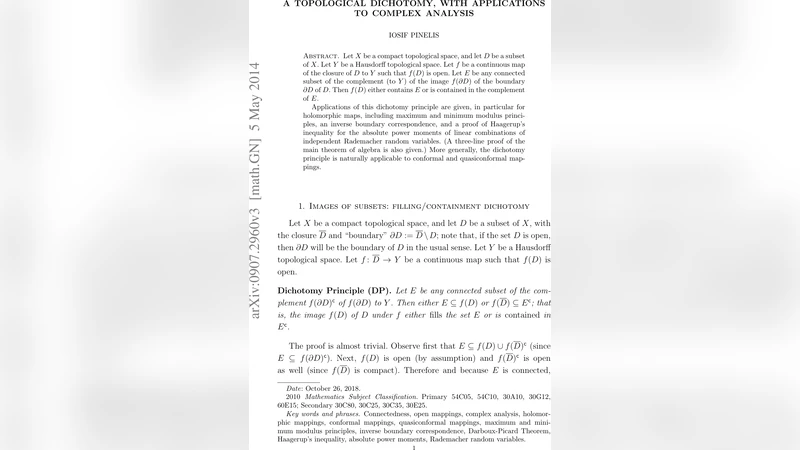
Let X be a compact topological space, and let D be a subset of X. Let Y be a Hausdorff topological space. Let f be a continuous map of the closure of D to Y such that f(D) is open. Let E be any connected subset of the complement (to Y) of the boundary of D. Then f(D) either contains E or is contained in the complement of E. Applications of this dichotomy principle are given, in particular for holomorphic maps, including maximum and minimum modulus principles, an inverse boundary correspondence, and a proof of Haagerup’s inequality for the absolute power moments of linear combinations of independent Rademacher random variables.
💡 Research Summary
The paper introduces a topological dichotomy principle that applies to continuous maps from the closure of a subset D of a compact space X into a Hausdorff space Y. The key hypothesis is that the image f(D) is an open subset of Y. Under this condition, for any connected set E that lies entirely in the complement of the boundary of D (i.e., E⊂Y∖∂D), the image f(D) must either contain E completely or be disjoint from E. The proof relies only on elementary facts: continuity preserves connectedness, the image of an open set is open, and a connected set cannot be split by a proper open subset without being wholly contained. The condition that E avoids the boundary ensures that no “partial” intersection can occur.
The authors first develop the abstract statement and then demonstrate its power through several classical and modern applications.
-
Maximum and Minimum Modulus Principles – By taking X to be a compact subset of the complex plane, D a domain, and f a holomorphic function, the dichotomy applied to the sets {z:|f(z)|>M} or {z:|f(z)|<m} yields the familiar conclusions that a non‑constant holomorphic function cannot attain a strict interior maximum or minimum of its modulus. The argument bypasses the usual use of the open mapping theorem or the maximum principle’s analytic proof, showing that the result follows directly from the topological dichotomy.
-
Inverse Boundary Correspondence – When f maps the boundary ∂D onto a closed curve Γ in Y, the dichotomy guarantees that the interior of Γ is either entirely covered by f(D) or entirely missed. This gives a clean topological formulation of the “inside–outside” relationship that underlies many conformal mapping results, such as the Riemann mapping theorem’s boundary behavior.
-
Haagerup’s Inequality for Rademacher Sums – The most striking application is a new proof of Haagerup’s inequality, which bounds the p‑th absolute moment of a linear combination S=∑a_k ε_k of independent Rademacher variables (ε_k∈{−1,1}). The authors encode the random signs as points in a discrete cube D⊂{0,π}^n and define a continuous map f(θ)=∑a_k e^{iθ_k} from the closure of D into the complex plane. Because f(D) is open, the dichotomy applied to the connected set E_r={z∈ℂ:|z|>r} forces either f(D)⊇E_r or f(D)∩E_r=∅. By integrating over r and using the symmetry of the Rademacher distribution, they translate this geometric inclusion into an inequality of the form
\
Comments & Academic Discussion
Loading comments...
Leave a Comment