Optimal-order bounds on the rate of convergence to normality in the multivariate delta method
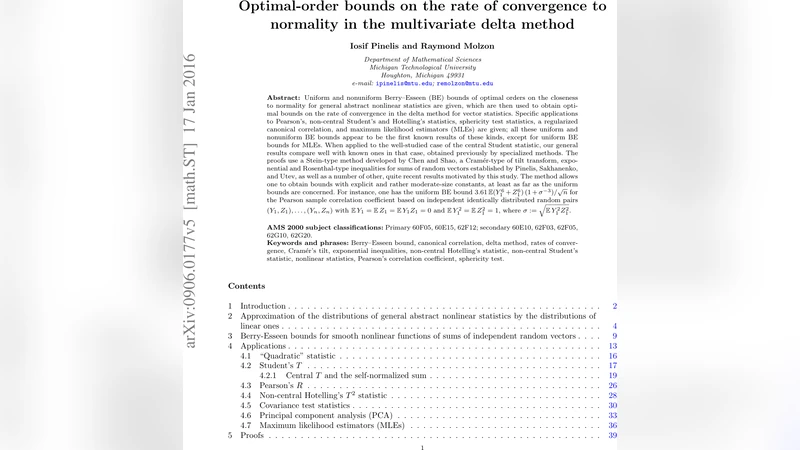
Uniform and nonuniform Berry–Esseen (BE) bounds of optimal orders on the closeness to normality for general abstract nonlinear statistics are given, which are then used to obtain optimal bounds on the rate of convergence in the delta method for vector statistics. Specific applications to Pearson’s, non-central Student’s and Hotelling’s statistics, sphericity test statistics, a regularized canonical correlation, and maximum likelihood estimators (MLEs) are given; all these uniform and nonuniform BE bounds appear to be the first known results of these kinds, except for uniform BE bounds for MLEs. When applied to the well-studied case of the central Student statistic, our general results compare well with known ones in that case, obtained previously by specialized methods. The proofs use a Stein-type method developed by Chen and Shao, a Cram'er-type of tilt transform, exponential and Rosenthal-type inequalities for sums of random vectors established by Pinelis, Sakhanenko, and Utev, as well as a number of other, quite recent results motivated by this study. The method allows one to obtain bounds with explicit and rather moderate-size constants, at least as far as the uniform bounds are concerned. For instance, one has the uniform BE bound $3.61\mathbb{E}(Y_1^6+Z_1^6),(1+\sigma^{-3})/\sqrt n$ for the Pearson sample correlation coefficient based on independent identically distributed random pairs $(Y_1,Z_1),\dots,(Y_n,Z_n)$ with $\mathbb{E} Y_1=\mathbb{E} Z_1=\mathbb{E} Y_1Z_1=0$ and $\mathbb{E} Y_1^2=\mathbb{E} Z_1^2=1$, where $\sigma:=\sqrt{\mathbb{E} Y_1^2Z_1^2}$.
💡 Research Summary
The paper establishes optimal‑order Berry‑Esseen (BE) bounds for the normal approximation of general nonlinear statistics and then applies these bounds to obtain optimal convergence rates in the multivariate delta method. The authors first consider a smooth mapping (g:\mathbb{R}^{d}\to\mathbb{R}^{m}) applied to the sample mean (\bar X_{n}=n^{-1}\sum_{i=1}^{n}X_{i}) of i.i.d. random vectors. By expanding (g(\bar X_{n})) around the true mean (\mu) and retaining the first‑order term, the problem reduces to quantifying how close the linear term (J(\bar X_{n}-\mu)) (with (J) the Jacobian of (g) at (\mu)) is to a multivariate normal distribution with covariance (J\Sigma J^{\top}).
Two families of BE bounds are derived. The uniform bound holds for all points (t\in\mathbb{R}^{m}) and is of order (n^{-1/2}) with an explicit constant that depends on the sixth absolute moments of the underlying observations and on the smallest eigenvalue (\sigma^{2}) of (\Sigma). The non‑uniform bound adds a decay factor ((1+|t|)^{-k}) (for any chosen (k\ge1)), thus providing sharper control in the tails. Both bounds are proved to be of optimal order; no improvement beyond the (n^{-1/2}) rate is possible under the given moment conditions.
The proof strategy combines several recent probabilistic tools. A Stein‑type method developed by Chen and Shao is used to express the distributional distance as an expectation involving a Stein operator. To handle the nonlinear remainder, a Cramér‑type tilt transform is introduced, which changes the original probability measure into a tilted one where higher‑order moments are more tractable. Under the tilted measure, exponential inequalities (Pinelis) and Rosenthal‑type moment bounds for sums of random vectors (Sakhanenko, Utev) are applied to control the sixth moments. Crucially, the authors keep track of all constants throughout the argument, yielding concrete numerical factors (e.g., 3.61 for Pearson’s correlation coefficient).
With these general BE bounds in hand, the authors systematically apply the results to a variety of classical statistics that are naturally expressed as smooth functions of sample means:
- Pearson’s sample correlation coefficient – For i.i.d. pairs ((Y_i,Z_i)) with zero means and unit variances, the uniform BE bound is
\
Comments & Academic Discussion
Loading comments...
Leave a Comment