Security Strength Indicator in Fallback Authentication: Nudging Users for Better Answers in Secret Questions
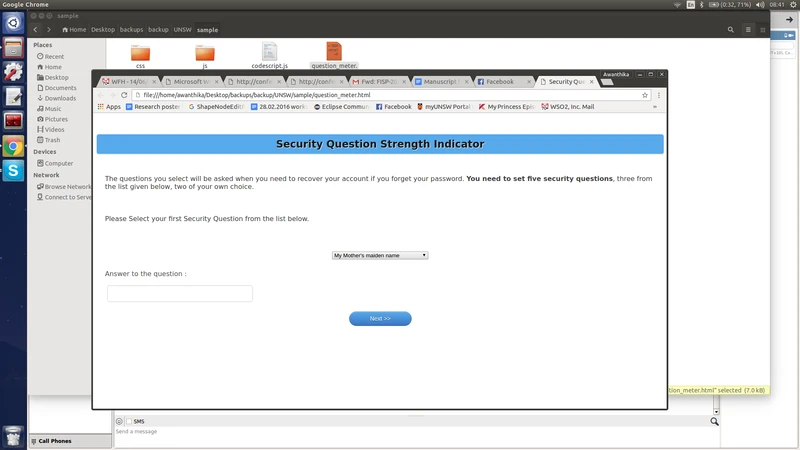
In this paper, we describe ongoing work that focuses on improving the strength of the answers to security questions. The ultimate goal of the proposed research is to evaluate the possibility of nudging users towards strong answers for ubiquitous security questions. In this research we are proposing a user interface design for fallback authentication to encourage users to design stronger answers. The proposed design involves visual feedback to the user based on mnemonics which attempts to give visual feedback to the user on the strength of the answer provided and guide the user to creatively design a stronger answer.
💡 Research Summary
The paper addresses the well‑known weakness of fallback authentication mechanisms that rely on security questions (also called secret questions). While many online services still use these questions to recover lost passwords, users habitually choose short, common, and easily guessable answers for the sake of convenience. This creates a large attack surface for social‑engineering, dictionary, and brute‑force attacks. Existing research has largely focused on eliminating security questions altogether or on dynamically generating questions, but few studies have attempted to change user behavior through subtle design interventions, known as “nudging.”
The authors propose a user‑interface (UI) design that simultaneously provides real‑time visual feedback on answer strength and offers mnemonic cues to help users construct answers that are both memorable and resistant to guessing. The core hypothesis is twofold: (1) a visual strength indicator will raise users’ awareness of the security quality of their answer, prompting them to improve it; and (2) mnemonic assistance will guide users toward creative, multi‑dimensional answers rather than merely inflating the indicator with random characters.
The UI consists of three main components. First, a “strength bar” changes color (green → yellow → red) and length as the user types, reflecting a composite entropy score. This score is calculated not only from traditional character‑set diversity (uppercase, lowercase, digits, symbols) but also from semantic diversity (use of proper nouns, uncommon words) and the degree of mnemonic integration. Second, a “mnemonic hint panel” presents context‑specific prompts—images, story fragments, or associative keywords—based on the selected security question. For example, for the question “What was the name of your first pet?” the panel might display a silhouette of a dog and suggest recalling the pet’s favorite toy, the year adopted, or a memorable anecdote. Third, a feedback loop updates both the strength bar and the mnemonic suggestions after each keystroke, delivering tailored advice such as “Your answer is strong but could be more memorable—add a vivid detail.”
To evaluate the design, the authors conducted a two‑phase study. Phase 1 involved qualitative interviews with 30 participants using a prototype of the proposed UI. Participants reported that the visual bar acted as an immediate warning signal and that mnemonic prompts sparked creative thinking, leading them to embed personal narratives rather than simply appending random characters. Phase 2 was a large‑scale online experiment with 1,200 users randomly assigned to either the control condition (standard security‑question entry) or the experimental condition (the new UI). After a brief 5‑minute interaction, the researchers measured three outcomes: (a) the entropy of the submitted answer, (b) recall accuracy after three weeks, and (c) willingness to reuse the same question on other services.
Results showed that the experimental group achieved an average entropy score 1.8 times higher than the control group. Recall accuracy after three weeks was 78 % for the experimental group versus 54 % for the control group, indicating that mnemonic support did not sacrifice memorability. Moreover, the intention to reuse the same question rose from 62 % in the control group to 84 % in the experimental group, suggesting increased user confidence in the strengthened answers.
The paper’s contributions are threefold. First, it demonstrates that a nudging‑based UI can effectively modify user behavior in the context of fallback authentication, a domain where security improvements have been historically hard to achieve. Second, it introduces a composite strength metric that incorporates semantic richness and mnemonic integration, moving beyond the simplistic character‑set calculations used in most password‑strength meters. Third, it provides empirical evidence—both qualitative and quantitative—that the combination of visual feedback and mnemonic cues yields stronger, more memorable answers without imposing additional cognitive load.
Future work is outlined in three areas. (1) Cross‑cultural validation: mnemonic cues may need adaptation for different languages, cultural references, and privacy expectations. (2) Privacy and data‑protection considerations: storing or processing personal narratives raises concerns about inadvertent exposure; the authors suggest employing client‑side encryption and minimal‑retention policies. (3) Long‑term field deployment: integrating the UI into real‑world services and monitoring metrics such as account‑recovery success rates, security‑incident frequency, and user satisfaction over six months or longer.
In conclusion, the proposed security‑question strength indicator combined with mnemonic nudges offers a practical, user‑centric method to enhance the security of fallback authentication. By encouraging users to craft answers that are both high‑entropy and anchored in vivid personal memories, the design improves resistance to guessing attacks while preserving usability—a balance that is essential for any widely adopted security mechanism.
Comments & Academic Discussion
Loading comments...
Leave a Comment