Just an Update on PMING Distance for Web-based Semantic Similarity in Artificial Intelligence and Data Mining
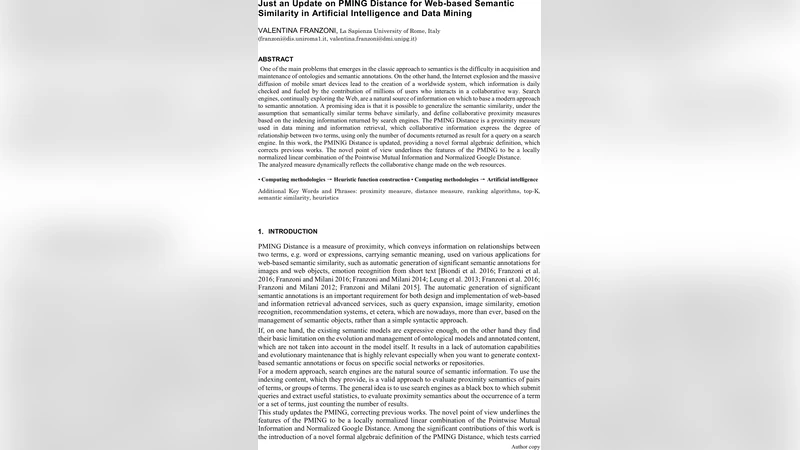
One of the main problems that emerges in the classic approach to semantics is the difficulty in acquisition and maintenance of ontologies and semantic annotations. On the other hand, the Internet explosion and the massive diffusion of mobile smart devices lead to the creation of a worldwide system, which information is daily checked and fueled by the contribution of millions of users who interacts in a collaborative way. Search engines, continually exploring the Web, are a natural source of information on which to base a modern approach to semantic annotation. A promising idea is that it is possible to generalize the semantic similarity, under the assumption that semantically similar terms behave similarly, and define collaborative proximity measures based on the indexing information returned by search engines. The PMING Distance is a proximity measure used in data mining and information retrieval, which collaborative information express the degree of relationship between two terms, using only the number of documents returned as result for a query on a search engine. In this work, the PMINIG Distance is updated, providing a novel formal algebraic definition, which corrects previous works. The novel point of view underlines the features of the PMING to be a locally normalized linear combination of the Pointwise Mutual Information and Normalized Google Distance. The analyzed measure dynamically reflects the collaborative change made on the web resources.
💡 Research Summary
The paper addresses a fundamental limitation of classic ontology‑driven semantic similarity: the high cost of building and maintaining comprehensive lexical resources. In the era of ubiquitous web search engines and massive user‑generated content, the authors propose to exploit the only information that is universally available from any search engine—the number of documents returned for a query—as a collaborative signal of term relatedness. This signal underlies the PMING (Pointwise Mutual Information and Normalized Google) Distance, a proximity measure originally introduced as a heuristic combination of Pointwise Mutual Information (PMI) and Normalized Google Distance (NGD). The authors demonstrate that earlier formulations of PMING suffer from ambiguous normalization and undocumented weighting, which hampers reproducibility and theoretical clarity.
The core contribution is a rigorous algebraic definition that corrects these flaws. PMING is expressed as a locally normalized linear combination:
PMING(x, y) = α·PMI_norm(x, y) + (1 − α)·NGD_norm(x, y),
where α ∈
Comments & Academic Discussion
Loading comments...
Leave a Comment