On the system CL12 of computability logic
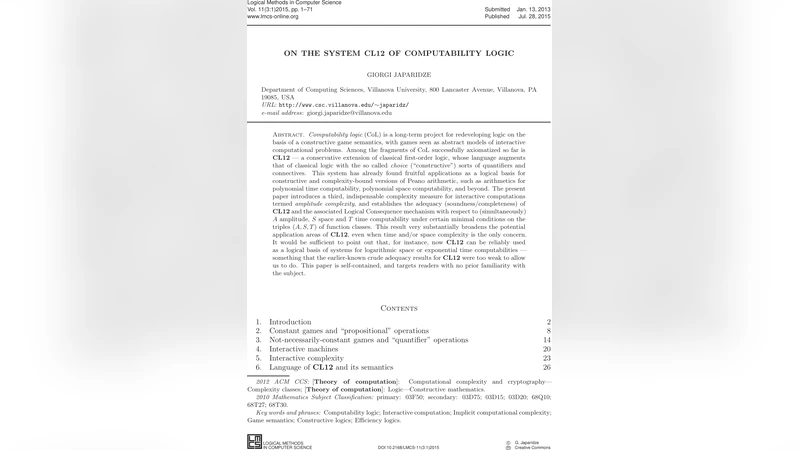
Computability logic (see http://www.csc.villanova.edu/~japaridz/CL/) is a long-term project for redeveloping logic on the basis of a constructive game semantics, with games seen as abstract models of interactive computational problems. Among the fragments of this logic successfully axiomatized so far is CL12 — a conservative extension of classical first-order logic, whose language augments that of classical logic with the so called choice sorts of quantifiers and connectives. This system has already found fruitful applications as a logical basis for constructive and complexity-oriented versions of Peano arithmetic, such as arithmetics for polynomial time computability, polynomial space computability, and beyond. The present paper introduces a third, indispensable complexity measure for interactive computations termed amplitude complexity, and establishes the adequacy of CL12 with respect to A-amplitude, S-space and T-time computability under certain minimal conditions on the triples (A,S,T) of function classes. This result very substantially broadens the potential application areas of CL12. The paper is self-contained, and targets readers with no prior familiarity with the subject.
💡 Research Summary
The paper investigates the CL12 proof system of Computability Logic (CL) and extends its adequacy from the traditional time‑space framework to a three‑dimensional resource model that also incorporates a newly introduced measure called amplitude complexity. CL treats logical formulas as interactive games between a machine (the “player”) and its environment (the “opponent”), and a proof in CL corresponds to a winning strategy for the player. CL12 is a conservative extension of classical first‑order logic: it adds choice quantifiers (⎕, ⊓) and choice connectives (⊔, ⎕) that explicitly encode the player’s ability to make selections during a game. Earlier work established that CL12 is sound and complete with respect to polynomial‑time (T‑time) and polynomial‑space (S‑space) computability, providing the logical foundation for several constructive arithmetics (e.g., PTIME‑CL, PSPACE‑CL).
The novelty of the present work is the definition of amplitude complexity (A‑amplitude). While time measures the number of interaction rounds and space measures the amount of memory used, amplitude quantifies the amount of information that can be transmitted or chosen in a single round—essentially the “bandwidth” of a move. This notion is crucial for modeling interactive computations where the size of a single message (e.g., a packet in a network protocol, a batch of streamed data, or a parallel fork) is a limiting resource. The authors formalize amplitude as a function class A, analogous to the usual classes for time (T) and space (S).
To integrate amplitude with time and space, the paper introduces a triple of function classes (A, S, T) and imposes minimal closure conditions: (i) A and S are closed under pointwise maximum and composition; (ii) T dominates the product A·S (i.e., there exists a function t∈T such that t(n) ≥ a(n)·s(n) for all a∈A, s∈S); and (iii) all three classes contain the zero function and are monotone. Under these assumptions, a computation is said to be A‑amplitude, S‑space, T‑time computable if there exists a winning strategy whose each round respects the amplitude bound a∈A, whose total memory never exceeds s∈S, and whose total number of rounds never exceeds t∈T.
The core technical contribution consists of two completeness theorems. The first, “negative completeness,” shows that every formula provable in CL12 has a corresponding A‑S‑T‑bounded winning strategy. The proof adapts the existing proof‑transition system for CL12, adding a new rule—Amplitude‑Restriction—that checks that each application of a choice quantifier or connective does not exceed the prescribed amplitude bound. By systematically annotating derivations with resource witnesses (a, s, t), the authors construct an explicit strategy that respects the triple (A, S, T).
The second theorem, “positive completeness,” establishes the converse: any interactive problem that is solvable within the given amplitude, space, and time limits can be expressed as a CL12‑provable formula. The construction proceeds by encoding the bounded strategy into a logical sentence using the choice operators. A refined “strategy extraction” lemma demonstrates how to translate an A‑S‑T‑bounded machine into a finite CL12 proof, ensuring that each move of the machine corresponds to an application of a choice rule whose amplitude annotation matches the original bound.
Beyond the theoretical results, the paper discusses several implications. First, it shows that previously studied fragments such as PTIME‑CL and PSPACE‑CL are special cases where A is taken to be the class of constant functions (i.e., amplitude = 1). By allowing non‑constant A, CL12 can capture polynomial‑amplitude computations, thereby modeling algorithms that exchange polynomial‑size messages while still operating in polynomial time and space. Second, the authors illustrate how amplitude‑aware CL12 can serve as a formal verification tool for cryptographic protocols, where the size of transmitted ciphertexts is a security‑relevant resource. Third, they argue that streaming and real‑time data‑processing systems, which are naturally constrained by bandwidth, fit neatly into the A‑S‑T framework, opening a path for complexity‑theoretic analysis of such systems using logical methods.
In conclusion, the paper significantly broadens the applicability of CL12 by proving its adequacy for the triple of amplitude, space, and time complexities under mild closure conditions on the underlying function classes. This advancement not only enriches the theoretical landscape of Computability Logic but also paves the way for practical applications in areas where bandwidth, memory, and time are jointly critical resources.
Comments & Academic Discussion
Loading comments...
Leave a Comment