Around Average Behavior: 3-lambda Network Model
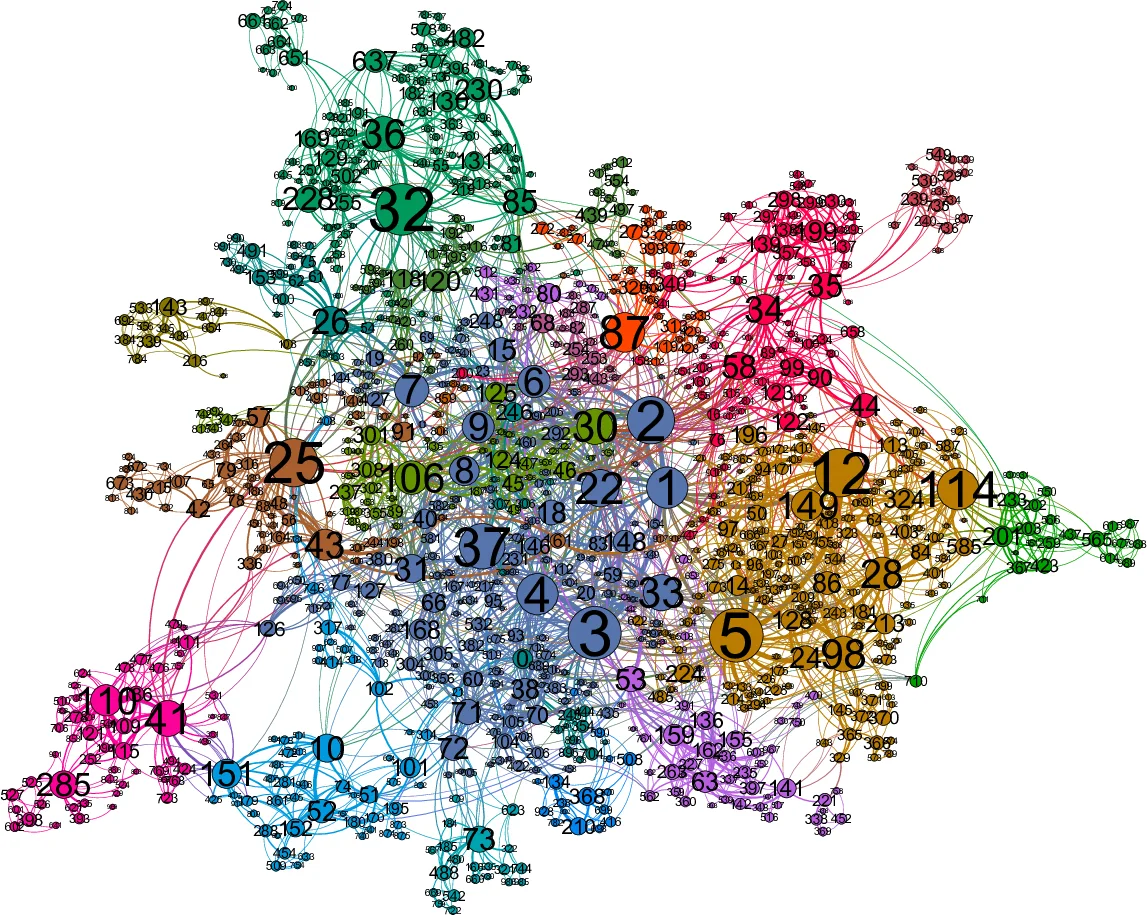
The analysis of networks affects the research of many real phenomena. The complex network structure can be viewed as a network’s state at the time of the analysis or as a result of the process through which the network arises. Research activities focus on both and, thanks to them, we know not only many measurable properties of networks but also the essence of some phenomena that occur during the evolution of networks. One typical research area is the analysis of co-authorship networks and their evolution. In our paper, the analysis of one real-world co-authorship network and inspiration from existing models form the basis of the hypothesis from which we derive new 3-lambda network model. This hypothesis works with the assumption that regular behavior of nodes revolves around an average. However, some anomalies may occur. The 3-lambda model is stochastic and uses the three parameters associated with the average behavior of the nodes. The growth of the network based on this model assumes that one step of the growth is an interaction in which both new and existing nodes are participating. In the paper we present the results of the analysis of a co-authorship network and formulate a hypothesis and a model based on this hypothesis. Later in the paper, we examine the outputs from the network generator based on the 3-lambda model and show that generated networks have characteristics known from the environment of real-world networks.
💡 Research Summary
The paper investigates the structure and evolution of collaboration networks by analyzing a large DBLP co‑authorship dataset and proposing a novel stochastic growth model called the 3‑lambda model. Initial analysis shows that the number of co‑authors per paper follows a Poisson distribution with mean ≈1.99. From this observation the authors hypothesize that the co‑author count can be decomposed into three independent Poisson‑distributed components: (i) existing neighbors of a “key” author, (ii) completely new authors entering the network, and (iii) authors who are not neighbors of the key author but become connected during the interaction.
The 3‑lambda model formalizes these ideas. At each discrete time step an existing node is randomly chosen as the proactive (key) node. Three Poisson random variables with parameters λ₁, λ₂, and λ₃ are sampled to determine the numbers of (a) neighbor nodes, (b) new nodes, and (c) “new‑connection” nodes that are not adjacent to the key node. All selected nodes are then fully linked, forming a clique; edges that already exist are simply reinforced. Nodes and edges never disappear, so the network grows monotonically.
The authors conduct three experiments. First, they generate networks of various sizes using different λ settings and compare structural metrics—degree distribution, average clustering coefficient, assortativity, average path length, and community structure (via Louvain detection)—to those of the empirical DBLP network. The generated graphs closely match the real network across most metrics, and varying λ₁, λ₂, λ₃ allows controlled manipulation of density, clustering, and inter‑community connectivity. Second, they track how these metrics evolve during growth, observing an early phase of high clustering and short paths that stabilizes as the network expands. Third, they scale the model to hundreds of thousands of nodes and demonstrate that degree‑distribution tails and modularity are comparable to the full DBLP graph, confirming scalability.
The study concludes that a simple three‑parameter Poisson‑based model can reproduce key characteristics of real‑world collaboration networks, offering an interpretable and computationally inexpensive alternative to preferential‑attachment or triadic‑closure models. Limitations include the assumption of uniformly random key‑node selection and the absence of node/edge aging or deletion. Future work is suggested to incorporate author influence measures for key‑node choice and to model lifespan of nodes and edges, thereby extending the applicability of the 3‑lambda framework to broader social and biological networks.
Comments & Academic Discussion
Loading comments...
Leave a Comment