Misrepair accumulation theory: a theory for understanding aging, cancer development, longevity, and adaptation
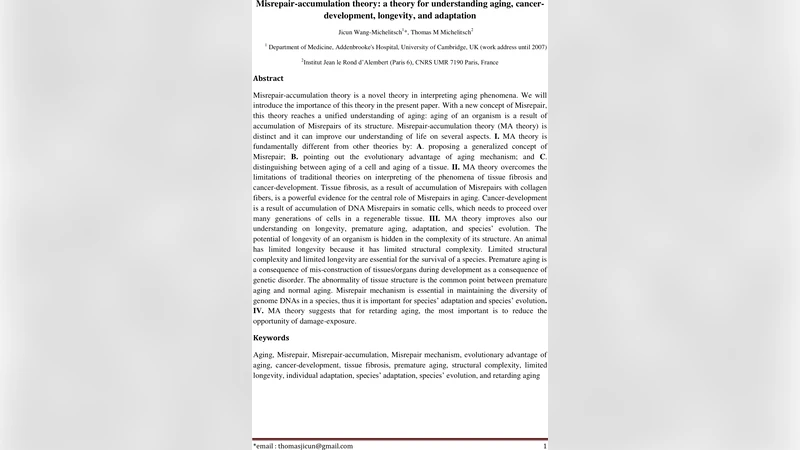
Misrepair accumulation theory is a novel theory in interpreting aging phenomena. With a new concept of Misrepair, this theory reaches a unified understanding of aging: aging of an organism is a result of accumulation of Misrepairs of its structure. Misrepair accumulation theory (MA theory) is distinct and it can improve our understanding of life on several aspects. I. MA theory is fundamentally different from other theories by: A. proposing a generalized concept of Misrepair; B. pointing out the evolutionary advantage of aging mechanism; and C. distinguishing between aging of a cell and aging of a tissue. II. MA theory overcomes the limitations of traditional theories on interpreting the phenomena of tissue fibrosis and cancer development. Tissue fibrosis, as a result of accumulation of Misrepairs with collagen fibers, is a powerful evidence for demonstrating the central role of Misrepairs in aging. Cancer development is a result of accumulation of DNA Misrepairs in somatic cells, which needs to proceed over many generations of cells in a regenerable tissue. III. MA theory improves also our understanding on longevity, premature aging, adaptation, and species evolution. The potential of longevity of an organism is hidden in the complexity of its structure. IV. MA theory suggests that for retarding aging, the most important is to reduce the opportunity of damage-exposure.
💡 Research Summary
The paper introduces the “Misrepair Accumulation Theory” (MA theory) as a unifying framework for understanding aging, cancer development, longevity, adaptation, and species evolution. Central to the theory is the concept of Misrepair – an imperfect or alternative repair that occurs when a biological structure (DNA, cell membrane, extracellular matrix, etc.) cannot be restored to its original state after damage. While Misrepair preserves short‑term survival, it introduces structural alterations that accumulate over time, leading to functional decline at the cellular, tissue, and organ levels.
The author first critiques existing aging theories—damage‑accumulation, free‑radical, programmed aging—and argues that they focus on the occurrence of damage rather than on the consequences of the repair process. By generalizing Misrepair to all forms of damage response, the theory bridges the gap between molecular lesions and macroscopic phenotypes. Two evolutionary premises underpin the model: (1) organisms have been selected to favor rapid, albeit imperfect, repair that ensures immediate survival, and (2) aging is therefore an adaptive by‑product rather than a maladaptive flaw.
A key distinction is made between cellular aging and tissue aging. The author contends that tissue‑level dysfunction arises primarily from the cumulative misrepair of inter‑cellular architecture and extracellular matrix, not merely from the senescence of individual cells. This perspective explains why many age‑related pathologies manifest as tissue remodeling rather than isolated cellular defects.
Tissue Fibrosis as Evidence of Misrepair
The paper uses fibrosis to illustrate the theory. When tissue is injured by trauma, inflammation, or toxic exposure, fibroblasts deposit excess collagen to close the wound. This collagen‑based Misrepair replaces the original matrix but reduces elasticity, impairs diffusion, and predisposes the organ to further injury. The progressive buildup of collagen fibers exemplifies how a single misrepair event can seed a cascade of structural changes that culminate in age‑related organ failure (e.g., arterial stiffening, pulmonary fibrosis, hepatic cirrhosis).
Cancer as Accumulated DNA Misrepair
Cancer is framed as the outcome of sequential DNA Misrepairs in somatic cells. DNA double‑strand breaks, oxidative lesions, or chemical adducts are often repaired by error‑prone pathways (non‑homologous end joining, translesion synthesis). Each erroneous repair fixes the immediate lesion but introduces a mutation. In highly regenerative tissues, repeated cell divisions propagate these mutations across many generations, eventually producing a clone with oncogenic hallmarks. Thus, carcinogenesis is not simply “mutation accumulation” but “misrepair accumulation” driven by the necessity to survive acute DNA damage.
Longevity Linked to Structural Complexity
The author proposes that an organism’s latent lifespan correlates with the complexity of its structural organization. Highly intricate systems (numerous cell types, redundant pathways, elaborate extracellular matrices) can distribute the functional impact of any single misrepair, delaying systemic collapse. Conversely, simpler organisms or tissues with limited regenerative capacity experience rapid functional loss when misrepair accumulates. This hypothesis aligns with observations that long‑lived species (e.g., elephants, whales) possess sophisticated DNA repair networks, abundant stem cell niches, and robust anti‑fibrotic mechanisms.
Adaptation and Premature Aging
Premature aging syndromes (e.g., progeria, xeroderma pigmentosum) are interpreted as cases where the rate of Misrepair far exceeds the organism’s capacity to tolerate structural change, often due to genetic defects in repair enzymes or chronic environmental stressors. Adaptive responses, on the other hand, involve calibrated misrepair: for instance, high‑altitude mammals modulate vascular remodeling rather than allowing unchecked fibrosis, thereby maintaining oxygen delivery despite hypoxic damage.
Practical Implications for Anti‑Aging
From a translational standpoint, the MA theory emphasizes prevention of initial damage as the most effective anti‑aging strategy. Reducing exposure to UV radiation, pollutants, mechanical stress, and caloric excess minimizes the number of repair events required, thereby limiting Misrepair opportunities. When damage is unavoidable, interventions that promote high‑fidelity repair (e.g., NAD⁺ boosters, sirtuin activators, DNA‑repair‑enhancing compounds) or that mitigate the consequences of misrepair (anti‑fibrotic drugs, senolytics) become valuable. Early detection of misrepair signatures—collagen cross‑linking, circulating DNA fragments with characteristic error patterns—could guide personalized preventive regimens.
Critical Evaluation and Future Directions
The theory offers a compelling synthesis that connects molecular biology, tissue pathology, and evolutionary theory. However, it currently lacks quantitative models that predict the rate of Misrepair accumulation across different tissues and species. Empirical validation will require longitudinal studies employing high‑resolution imaging, single‑cell genomics, and proteomics to track misrepair events in vivo. Moreover, distinguishing Misrepair from normal adaptive remodeling poses methodological challenges. Future research should aim to (1) define molecular biomarkers of Misrepair, (2) develop computational frameworks to simulate misrepair dynamics, and (3) test interventions that specifically reduce misrepair frequency or its downstream effects.
In summary, the Misrepair Accumulation Theory reframes aging and related diseases as inevitable consequences of an evolutionarily conserved trade‑off: imperfect repair ensures immediate survival but gradually erodes structural integrity. By shifting focus from damage prevention alone to the quality of repair processes, the theory opens new avenues for understanding longevity, designing anti‑aging therapies, and appreciating the adaptive significance of senescence.
Comments & Academic Discussion
Loading comments...
Leave a Comment