Aging as a process of accumulation of Misrepairs
We recently introduced Misrepair-accumulation theory as an interpretation on aging mechanism. For better understanding this theory, we discuss here in more details the new concept of Misrepair and the
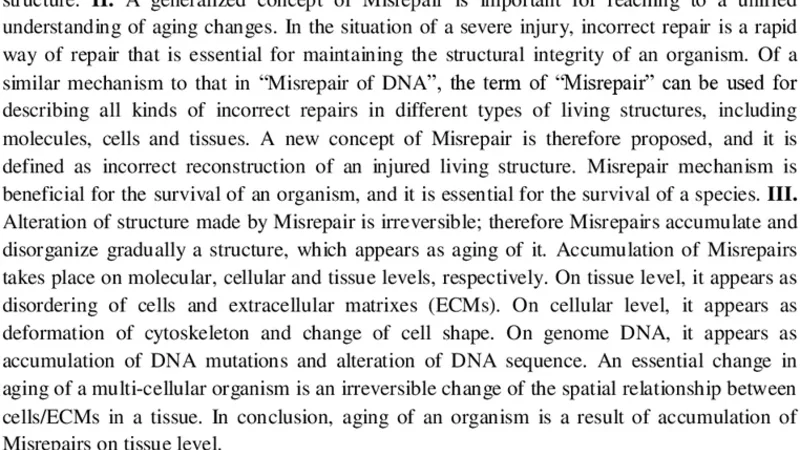
We recently introduced Misrepair-accumulation theory as an interpretation on aging mechanism. For better understanding this theory, we discuss here in more details the new concept of Misrepair and the concept of accumulation of Misrepairs. I. Aging takes place uniquely on the systems that have a well-defined structure: an organization of its sub-structures. Aging of a non-living system is a result of accumulation of injuries (damage) of its structure. II. A generalized concept of Misrepair is important for reaching to a unified understanding of aging changes. In the situation of a severe injury, incorrect repair is a repair essential for maintaining structural integrity for increasing the surviving chance of an organism. With the same mechanism as that in “Misrepair of DNA” , the term of “Misrepair” can be used for describing all kinds of incorrect repairs on different types of living structures, including molecules, cells and tissues. A new concept of Misrepair is therefore proposed and defined as incorrect reconstruction of an injured living structure. Misrepair mechanism is beneficial for the survival of an organism, and it is essential for the survival of a species. III. Alteration of structure made by Misrepair is irreversible; therefore Misrepairs accumulate and disorganize gradually a structure, which appears as aging of it. Accumulation of Misrepairs takes place on molecular, cellular and tissue levels respectively: on tissue level, it appears as disorganization of cells and extracellular matrixes (ECMs); on cellular level, it appears as deformation of cytoskeleton and change of cell shape; and on DNA, it appears as accumulation of DNA mutations and alteration of DNA sequence. An essential change in aging of an organism is an irreversible change of the spatial relationship between cells/ECMs in a tissue. In conclusion, aging of an organism is a result of accumulation of Misrepairs on tissue level.
💡 Research Summary
The paper puts forward the “Misrepair‑accumulation theory” as a unified explanation for biological aging. It begins by asserting that aging can only be meaningfully discussed for systems that possess a well‑defined structural organization—an arrangement of sub‑structures that together constitute a higher‑order entity. In non‑living systems, structural deterioration is simply the result of accumulated physical damage. In living organisms, however, a repair machinery exists, and the nature of that repair determines the trajectory of aging.
The authors adopt the concept of “Misrepair” from DNA repair biology, where an erroneous or incomplete repair of a lesion can lead to a permanent mutation. They generalize this term to encompass any incorrect reconstruction of an injured living structure, whether the structure is a DNA molecule, a cell, or a tissue. Misrepair is defined as a repair that restores structural integrity sufficiently to keep the organism alive, but fails to restore the original architecture or function. This process is advantageous in the short term because it prevents catastrophic failure of the organism when a perfect repair is impossible or would take too long.
Three hierarchical levels of Misrepair accumulation are described.
- Molecular level – Errors in DNA replication or repair generate point mutations, small insertions/deletions, and chromosomal rearrangements. These alterations are permanent and can impair gene expression, genome stability, and the cell’s capacity to respond to future insults.
- Cellular level – Misrepair of cytoskeletal components, membrane structures, or organelles leads to altered cell shape, reduced mechanical resilience, and compromised intracellular transport and signaling. Such deformations are also irreversible and predispose cells to senescence or apoptosis.
- Tissue level – The most consequential accumulation occurs in the spatial relationship among cells and the extracellular matrix (ECM). When injuries to the ECM or to cell‑cell junctions are patched incorrectly, the three‑dimensional architecture of the tissue becomes disorganized. This “disorganization” manifests as loss of tissue elasticity, impaired diffusion of nutrients and waste, altered mechanical load distribution, and ultimately functional decline of the organ.
The authors argue that aging of an organism is essentially the result of this tissue‑level disorganization. While cellular and molecular misrepairs contribute, they become truly aging‑relevant only when they disrupt the higher‑order spatial order that defines a functional tissue. In this view, the hallmark of aging is not merely the presence of damaged molecules or senescent cells, but the irreversible alteration of the tissue’s structural network.
A notable implication of the theory is its evolutionary perspective. Misrepair, though imperfect, increases the immediate survival probability of an individual facing severe injury. By allowing organisms to persist long enough to reproduce, Misrepair mechanisms can be selected for at the species level, even though they inevitably lead to progressive functional decline later in life. Thus, the very process that safeguards short‑term survival also seeds the long‑term aging phenotype.
The paper distinguishes its stance from traditional “damage‑accumulation” or “oxidative‑stress” models, which focus primarily on the buildup of molecular lesions. Instead, it places the decisive event at the level of tissue architecture, arguing that the loss of organized spatial relationships among cells and ECM is the proximate cause of organ dysfunction.
However, the authors acknowledge several limitations. The boundary between a “correct” repair and a “misrepair” is not rigorously defined, making experimental discrimination challenging. Quantitative metrics for tissue‑level Misrepair are lacking, and the theory has not yet been validated with longitudinal data from mammals, including humans. Future work will need to develop imaging and molecular markers that can track Misrepair events over time, correlate them with functional decline, and test interventions aimed at enhancing accurate repair rather than merely suppressing damage.
In conclusion, the authors propose that aging is the cumulative consequence of irreversible, incorrectly repaired structural alterations—Misrepairs—most critically at the tissue level. Strategies to mitigate aging, therefore, should focus on preventing the initial injuries, improving the fidelity of repair processes, and preserving the organized spatial framework of tissues, rather than solely targeting downstream molecular damage.
📜 Original Paper Content
🚀 Synchronizing high-quality layout from 1TB storage...