Fundamental structures of dynamic social networks
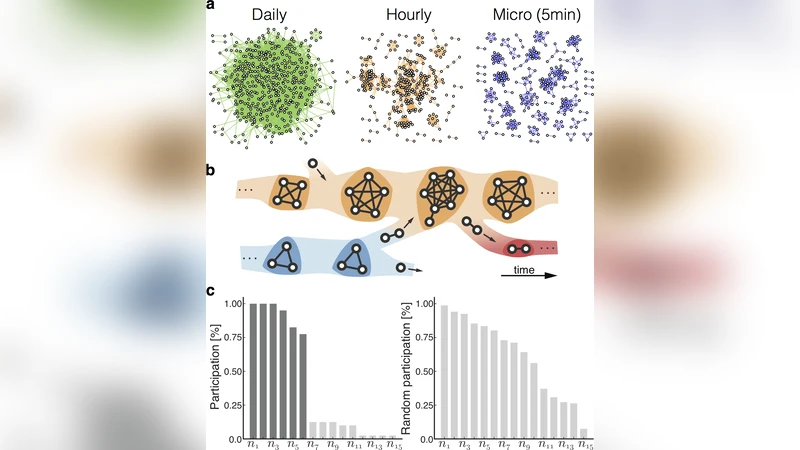
Social systems are in a constant state of flux with dynamics spanning from minute-by-minute changes to patterns present on the timescale of years. Accurate models of social dynamics are important for understanding spreading of influence or diseases, formation of friendships, and the productivity of teams. While there has been much progress on understanding complex networks over the past decade, little is known about the regularities governing the micro-dynamics of social networks. Here we explore the dynamic social network of a densely-connected population of approximately 1000 individuals and their interactions in the network of real-world person-to-person proximity measured via Bluetooth, as well as their telecommunication networks, online social media contacts, geo-location, and demographic data. These high-resolution data allow us to observe social groups directly, rendering community detection unnecessary. Starting from 5-minute time slices we uncover dynamic social structures expressed on multiple timescales. On the hourly timescale, we find that gatherings are fluid, with members coming and going, but organized via a stable core of individuals. Each core represents a social context. Cores exhibit a pattern of recurring meetings across weeks and months, each with varying degrees of regularity. Taken together, these findings provide a powerful simplification of the social network, where cores represent fundamental structures expressed with strong temporal and spatial regularity. Using this framework, we explore the complex interplay between social and geospatial behavior, documenting how the formation of cores are preceded by coordination behavior in the communication networks, and demonstrating that social behavior can be predicted with high precision.
💡 Research Summary
The paper investigates the micro‑dynamics of a densely‑connected population of roughly one thousand university freshmen over a 36‑month period, using a multimodal dataset that includes Bluetooth‑based physical proximity, phone call and text logs, Facebook interactions, GPS traces, and demographic information. By slicing the data into 5‑minute intervals, the authors avoid the need for conventional community‑detection algorithms: each time slice yields a graph whose connected components directly correspond to “gatherings,” i.e., groups of individuals who are physically co‑located at that moment. Because the slice duration is shorter than the typical rate at which group composition changes, a person can belong to at most one gathering per slice, allowing an unambiguous observation of group structure.
Gatherings display broad distributions in size and duration. Using GPS, the authors separate “work” gatherings (primarily on‑campus, often class‑related) from “recreational” gatherings (off‑campus). Work gatherings tend to be larger but shorter, whereas recreational gatherings are smaller yet persist longer. Within each gathering, a participation profile is constructed: for each member the fraction of time spent in that gathering relative to its total lifetime. The profile typically shows a pronounced gap separating a stable “core” of high‑participation members from peripheral participants. Statistical testing against a null model of uniformly random participation confirms that 97.6 % of observed gatherings possess a significant core‑peripheral gap.
The authors then track the recurrence of gatherings that involve the same set of individuals across days, weeks, and months. They define a “core” as the collection of all gatherings generated by the same group of individuals, interpreting a core as a lasting social context (e.g., a friend group, study group, or sports team). Core appearances follow a heavy‑tailed distribution: most cores appear only a few times, while a few are observed multiple times per day. The analysis focuses on cores of size three or more that appear on average more than once per month. Work cores average 2.74 ± 1.85 per person, reflecting scheduled classes and study groups; recreational cores are more varied, with many individuals belonging to only one or two such cores.
A key finding is that core formation is preceded by heightened communication among its members. The authors define a coordination metric as the average increase in call/text activity of core members relative to each individual’s baseline for the corresponding hour of the week. Coordination spikes in the hours leading up to a meeting, especially on weekends, indicating that unscheduled gatherings require explicit coordination, whereas the per‑person coordination cost does not scale with group size—suggesting an optimization process that balances the quadratic growth of potential social ties with limited coordination effort.
To contextualize the empirical results, the authors construct a dynamic random geometric graph (RGG) model in which nodes perform random walks and edges appear when nodes are within a spatial radius. The model reproduces the observed distributions of gathering size and lifetime but fails to generate recurring gatherings, and thus cannot capture cores. This contrast highlights that real social networks contain long‑range correlations and memory beyond simple spatial proximity.
The most striking contribution is the demonstration that cores behave as “social units.” Because core members tend to be present together, observing a subset of a core at a location strongly predicts that the remaining members will arrive shortly. The authors test this by measuring, for cores of size three, the probability that the third member appears within one hour after two members are co‑located. They restrict analysis to non‑scheduled times (weekends and weekday evenings) and to a held‑out month not used for core identification. Two null models are employed: a random model that selects three unrelated individuals, and a breadth‑first‑search (BFS) model that selects three individuals connected through pairwise friendships in the aggregated daily graph. Neither null model yields predictive power, whereas the empirical cores show a markedly higher arrival probability, confirming the “social unit” property.
In sum, the study provides a novel methodological framework for extracting temporally resolved social structures directly from high‑frequency proximity data, identifies stable cores as fundamental mesoscopic units with strong temporal and spatial regularities, links core activation to pre‑meeting communication coordination, and demonstrates that cores enable accurate short‑term prediction of individual movement. These insights advance our understanding of dynamic social networks, offering practical implications for epidemic modeling, information diffusion, and the design of interventions that leverage the predictable nature of human social organization.
Comments & Academic Discussion
Loading comments...
Leave a Comment