A Comprehensive Survey of Potential Game Approaches to Wireless Networks
Potential games form a class of non-cooperative games where unilateral improvement dynamics are guaranteed to converge in many practical cases. The potential game approach has been applied to a wide range of wireless network problems, particularly to a variety of channel assignment problems. In this paper, the properties of potential games are introduced, and games in wireless networks that have been proven to be potential games are comprehensively discussed.
💡 Research Summary
The paper presents a comprehensive survey of potential‑game approaches applied to wireless networks. It begins by motivating the use of game theory in wireless communications: the broadcast nature of radio signals creates mutual interference and channel contention, which can be naturally modeled as interactions among autonomous decision makers (e.g., base stations, mobile terminals, sensors). While many game‑theoretic formulations exist (e.g., power control for CDMA, cognitive‑radio spectrum sharing), the authors focus on a particular subclass—potential games—because they guarantee the existence of Nash equilibria and possess the finite improvement property (FIP), which ensures convergence of unilateral improvement dynamics in a finite number of steps.
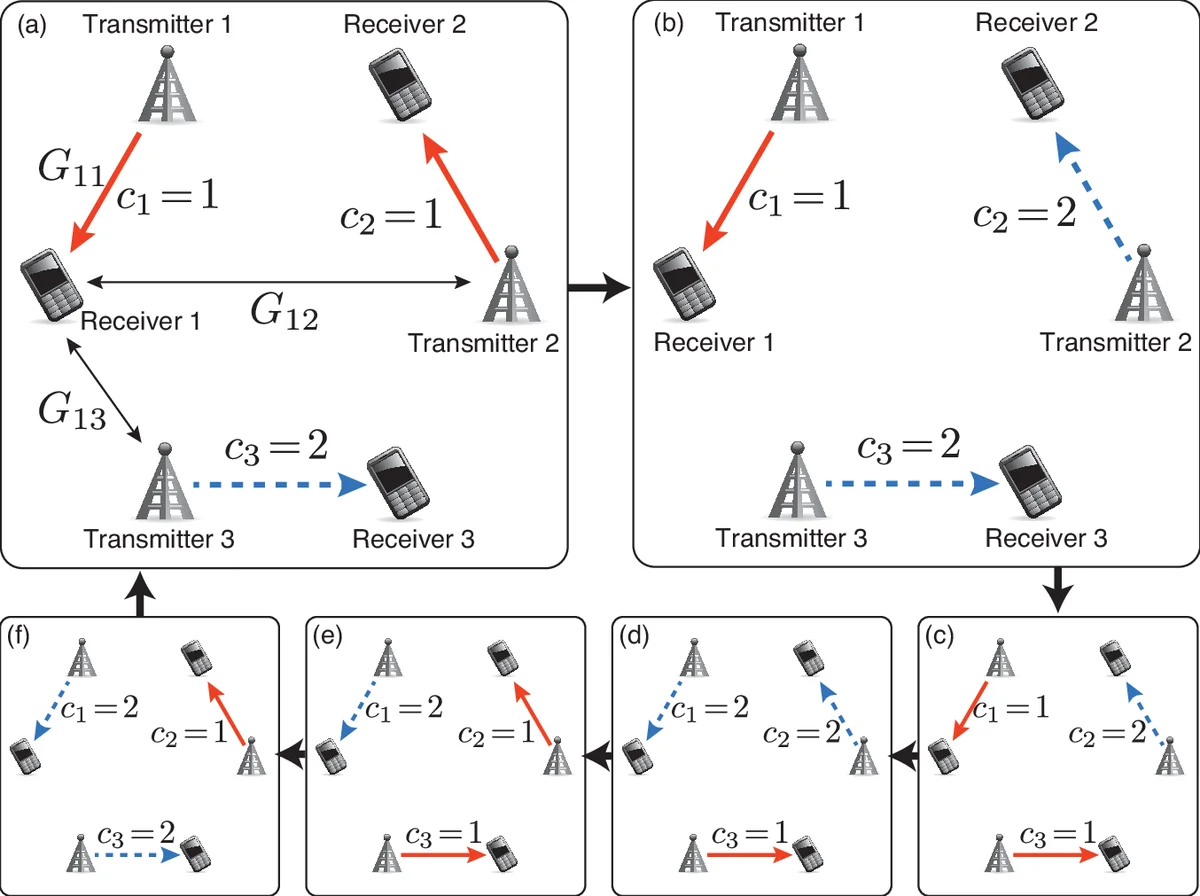
The authors first review the standard strategic‑form game model, defining players, strategy sets, payoff functions, best‑response correspondences, and Nash equilibrium. An illustrative channel‑selection example (Game G₁) demonstrates that a naïve best‑response process can generate cycles and may lack any equilibrium, highlighting the need for stronger structural properties.
Potential games are then introduced in three increasingly general forms:
- Exact Potential Games (EPG) – a single scalar potential function φ such that any unilateral deviation changes a player’s payoff by exactly the same amount as φ.
- Weighted Potential Games (WPG) – each player’s payoff change equals a positive weight αᵢ times the change in φ.
- Ordinal Potential Games (OPG) – only the sign of the payoff change must match the sign of the change in φ.
Key theoretical results are summarized:
- Every OPG with finite strategy sets possesses at least one pure‑strategy Nash equilibrium (Theorem 1).
- OPGs with compact, continuous strategy spaces also guarantee equilibrium existence (Theorem 2).
- If the potential function is strictly concave over a convex compact set, the equilibrium is unique (Theorem 3).
- All OPGs enjoy the finite improvement property, i.e., any sequence of unilateral improvements terminates at an equilibrium (Theorem 4).
The paper provides practical criteria for identifying potential games. For continuous strategies, Theorem 5 states that a game is an EPG iff mixed second‑order partial derivatives of all players’ payoffs are symmetric (∂²uᵢ/∂aᵢ∂aⱼ = ∂²uⱼ/∂aᵢ∂aⱼ). Theorem 6 shows that linear combinations of EPGs remain EPGs, facilitating modular design. Theorem 7 introduces the “coordination‑dummy” structure: if each player’s payoff can be decomposed into a common coordination term u(a) plus a dummy term that depends only on opponents’ actions, the game is automatically an EPG with φ = u.
Armed with these tools, the authors catalog 18 distinct wireless‑network problems that have been cast as potential games (Table I). Each entry lists the system model (e.g., multiple‑access channel, TX‑RX pair, canonical network, interference graph), the strategic variables (channel choice, transmission power, node location, traffic rate), and the associated potential function (total interference power, aggregate Shannon capacity, number of interfering signals, successful access probability, congestion cost, etc.). Representative cases include:
- Channel selection (G₁): Players choose channels to minimize received interference; the total interference power serves as the exact potential.
- Power control: Players adjust transmit power to meet SINR targets while minimizing total power; often modeled as a weighted potential game.
- Sensor‑network connectivity: Nodes select positions to maximize coverage or connectivity; the global coverage area acts as the potential.
- Queue‑based traffic management: Nodes tune arrival rates to balance throughput and delay; the sum of queueing delays forms the potential.
For each case the paper explains why the game satisfies the potential‑game conditions, often by constructing an explicit φ or by invoking the coordination‑dummy theorem. The authors also discuss a counterexample (Example 2) where the channel‑selection game lacks a Nash equilibrium, illustrating that not all wireless games are potential.
The final technical section touches on learning algorithms. Because potential games guarantee FIP, simple distributed dynamics—best‑response updates, log‑linear learning, or stochastic fictitious play—converge to a Nash equilibrium without requiring centralized coordination. The authors note practical considerations such as switching costs, power constraints, and limited information, suggesting that these can be incorporated into the payoff design while preserving the potential structure.
In conclusion, the survey demonstrates that potential‑game theory offers a powerful, mathematically rigorous framework for designing decentralized resource‑allocation mechanisms in wireless networks. It ensures equilibrium existence, often uniqueness, and provable convergence of lightweight learning rules. The paper also outlines future research directions: extending potential‑game models to highly dynamic environments, handling multiple conflicting objectives, and developing real‑time estimation of potential functions for adaptive networks.
Comments & Academic Discussion
Loading comments...
Leave a Comment