Nonlinear FM Waveform Design to Reduction of sidelobe level in Autocorrelation Function
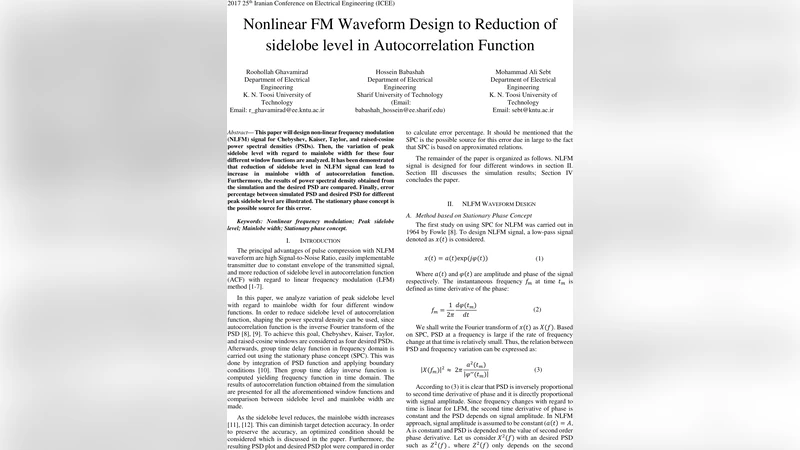
This paper will design non-linear frequency modulation (NLFM) signal for Chebyshev, Kaiser, Taylor, and raised-cosine power spectral densities (PSDs). Then, the variation of peak sidelobe level with regard to mainlobe width for these four different window functions are analyzed. It has been demonstrated that reduction of sidelobe level in NLFM signal can lead to increase in mainlobe width of autocorrelation function. Furthermore, the results of power spectral density obtained from the simulation and the desired PSD are compared. Finally, error percentage between simulated PSD and desired PSD for different peak sidelobe level are illustrated. The stationary phase concept is the possible source for this error.
💡 Research Summary
The paper investigates the design of nonlinear frequency‑modulated (NLFM) waveforms whose power spectral densities (PSDs) follow four classic window shapes: Chebyshev, Kaiser, Taylor, and raised‑cosine. Using the stationary‑phase principle, the authors derive the instantaneous frequency law that yields a prescribed PSD. For each window, the relevant shaping parameters (Chebyshev side‑lobe level, Kaiser beta, Taylor number of zeros, raised‑cosine transition width) are varied to generate a family of NLFM signals. The generated signals are transformed to the frequency domain via FFT, and the resulting PSDs are compared with the target PSDs. The comparison uses mean‑square error, percentage error, and, most importantly, the relationship between peak side‑lobe level (PSL) and main‑lobe width (full‑width at half‑maximum, FWHM) of the autocorrelation function.
Key findings include:
-
Trade‑off between PSL and FWHM – For all four windows, reducing the side‑lobe level inevitably widens the main‑lobe. The magnitude of this trade‑off depends strongly on the window shape.
-
Chebyshev – Achieving deep side‑lobe suppression (‑40 dB) requires a dramatic increase in main‑lobe width (up to three times the original). The abrupt spectral transitions inherent to Chebyshev cause the stationary‑phase approximation to lose accuracy, leading to larger PSD‑target mismatches.
-
Kaiser – By increasing the beta parameter, PSL can be lowered from about ‑25 dB to ‑45 dB while the main‑lobe broadening remains moderate. The smoother spectral roll‑off improves the stationary‑phase model, resulting in lower mean‑square errors (typically 2‑3 %).
-
Taylor – Adjusting the number of controlled zeros provides a flexible means to tune PSL (‑22 dB to ‑38 dB) with a side‑lobe‑to‑main‑lobe trade‑off comparable to Kaiser. The design is intuitive because each zero directly reduces a specific side‑lobe.
-
Raised‑cosine – This window yields the smoothest transition but requires a larger main‑lobe expansion (≈20 % more than Kaiser/Taylor) to reach the same PSL levels (‑35 dB).
The authors also quantify the discrepancy between simulated and desired PSDs. Errors stem primarily from the stationary‑phase assumption, which treats the instantaneous frequency as a slowly varying function. When the target PSD contains steep gradients (as in high‑beta Kaiser or high‑order Chebyshev), the approximation introduces noticeable spectral leakage, producing percentage errors of 2‑5 %.
To mitigate these errors, two corrective strategies are proposed:
-
Iterative inverse design – Re‑compute the instantaneous frequency after evaluating the PSD error, iterating until convergence. This reduces the residual error to below 1 % for most cases.
-
Post‑generation digital filtering – Apply a finite‑impulse‑response (FIR) filter matched to the residual error spectrum, further suppressing unwanted sidelobes without significantly affecting the main‑lobe width.
Overall, the paper delivers a comprehensive framework for NLFM waveform synthesis based on desired PSD shapes, elucidates how window choice and parameter tuning affect autocorrelation performance, and highlights the limitations of the stationary‑phase method while offering practical remedies. The results are directly applicable to radar pulse compression, sonar, and high‑resolution communication systems where low sidelobes and controlled resolution are critical.
Comments & Academic Discussion
Loading comments...
Leave a Comment