Nontrivial quantum effects in biology: A skeptical physicists view
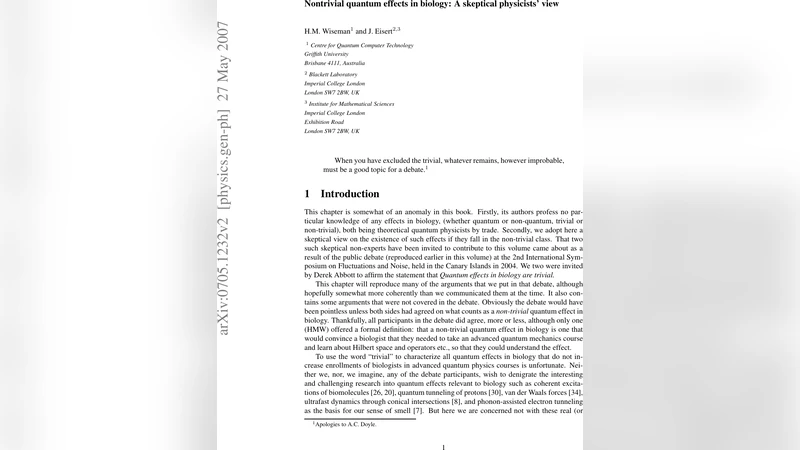
Invited contribution to “Quantum Aspects of Life”, D. Abbott Ed. (World Scientific, Singapore, 2007).
💡 Research Summary
The invited contribution offers a physicist’s skeptical appraisal of the claim that quantum phenomena play a non‑trivial role in biological processes. After a brief historical note on how the term “quantum biology” has been popularized more by media hype than by rigorous evidence, the paper systematically examines three flagship examples that are often cited as proof of functional quantum effects: (i) long‑range electronic coherence in photosynthetic light‑harvesting complexes, (ii) spin‑coherence based magnetoreception in migratory birds, and (iii) vibrationally assisted electron tunnelling in olfactory receptors.
For photosynthesis, the author points out that the celebrated two‑dimensional electronic spectroscopy results showing femtosecond‑scale coherence were obtained under cryogenic, low‑noise conditions. In the warm, highly fluctuating environment of a living cell, decoherence times are estimated to be orders of magnitude shorter, making it unlikely that such coherence can survive long enough to influence energy transfer efficiency. Moreover, the theoretical models employed often reduce the complex pigment‑protein network to a few two‑level systems, ignoring the multitude of vibrational modes and protein dynamics that dominate at physiological temperature.
In the case of avian magnetoreception, the radical‑pair hypothesis assumes that electron spins remain coherent for microseconds, a timescale that is incompatible with the rapid spin‑relaxation induced by collisions with water molecules and surrounding proteins at ambient temperature. Experimental support consists mainly of behavioral assays and indirect spectroscopic signatures, which can be explained equally well by classical stochastic models. The paper stresses that without direct measurement of spin coherence in vivo, the quantum explanation remains speculative.
Regarding olfaction, the “vibrational theory” proposes that odorant molecules are distinguished by quantum tunnelling of electrons resonant with specific vibrational frequencies. The author argues that realistic estimates of electron‑phonon coupling and environmental decoherence render the tunnelling probability vanishingly small at room temperature. Classical lock‑and‑key binding models already account for the bulk of psychophysical data, and the quantum model requires parameter choices that are not independently verified.
Across all three domains, the author identifies a common pattern: (1) environmental decoherence is vastly underestimated, (2) experimental evidence is indirect, often relying on fitted parameters rather than model‑free observables, and (3) theoretical treatments simplify the system to a degree that strips away essential biological complexity. The paper calls for a new generation of experiments that combine ultrafast, high‑resolution spectroscopy with precise temperature control, rigorous statistical analysis with appropriate control groups, and multiscale modeling that bridges quantum mechanics with statistical thermodynamics. Only when such stringent criteria are met can claims of “non‑trivial” quantum effects be elevated from intriguing speculation to established scientific fact.
In conclusion, while quantum biology remains an alluring frontier that stimulates interdisciplinary dialogue, the author urges the community to prioritize falsifiable experiments and theoretically sound frameworks over sensational headlines. The path forward, he suggests, lies in disciplined, quantitative research that respects the harsh decohering influence of the warm, wet, and noisy cellular milieu.
Comments & Academic Discussion
Loading comments...
Leave a Comment