Peeling the Grid
Consider the set of points formed by the integer $n \times n$ grid, and the process that in each iteration removes from the point set the vertices of its convex-hull. Here, we prove that the number of iterations of this process is O(n^{4/3}); that is, the number of convex layers of the $n\times n$ grid is \Theta(n^{4/3}).
💡 Research Summary
The paper studies a natural geometric peeling process on the integer lattice Gₙ = {1,…,n}². Starting with the full n×n grid, at each iteration the vertices of the convex hull of the current point set are removed; the process repeats until no points remain. The number of iterations required, denoted τ(n), is called the number of convex layers or the “onion depth” of the grid. The authors prove that τ(n) grows as Θ(n^{4/3}).
Lower bound (Ω(n^{4/3})).
A classical result (Lemma 2.1) states that any convex polygon whose vertices belong to Gₙ can have at most O(n^{2/3}) vertices. The proof splits edges into “long” (length ≥ μ) and “short” (length < μ). There are at most 4n/μ long edges because the total perimeter is bounded by 4n, and at most O(μ²) short edges because the number of integer points within distance μ of the origin is O(μ²). Choosing μ = Θ(n^{1/3}) balances the two terms and yields the O(n^{2/3}) bound. Consequently each layer removes at most c·n^{2/3} points, so τ(n) ≥ n² / (c·n^{2/3}) = Ω(n^{4/3}).
Upper bound (O(n^{4/3})).
The upper bound is more involved and relies on number‑theoretic properties of primitive integer vectors. A vector v = (x, y) with gcd(x, y)=1 and 0 ≤ y < x ≤ μ is called primitive; the set of all such vectors is V_μ. Lemma 2.2 shows |V_μ| = Ω(μ²) because the sum of Euler’s totient function φ(i) for i ≤ μ grows quadratically.
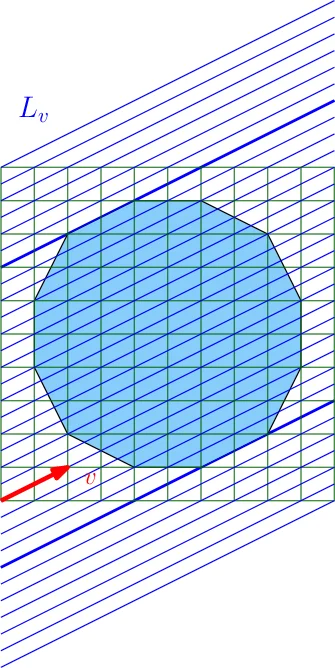
For each primitive direction v, consider the family L_v of all lines of direction v that intersect the grid. Each line in L_v contains roughly (n / v_x) grid points, and the total number of such lines is at most 4n/μ (Claim 2.3). A direction v is called active at iteration i if the two tangent lines from L_v to the current convex hull C_i intersect C_i along an edge (rather than at a single vertex). If v is inactive, both tangent lines touch C_i only at vertices; those vertices are removed in the next iteration, so the number of lines from L_v intersecting the hull drops by two (Claim 2.4). Hence a given direction can be inactive at most |L_v|/2 ≤ 2n/μ times (Claim 2.5).
Assume, for contradiction, that the process lasts more than M = 4nμ iterations. Then each primitive direction would be active in at least half of those iterations. Let n_i be the number of active directions at iteration i. Since each active direction contributes at least two edges to the hull, the hull C_i must have at least 2n_i vertices. Summing over the first M iterations gives a total of at least 2·(M·|V_μ|/2) = M·|V_μ| vertices removed. Substituting |V_μ| = Ω(μ²) and M = 4nμ yields a total of Ω(n·μ³) vertices. Choosing μ = Θ(n^{1/3}) makes this quantity Ω(n²), which exceeds the total number of points n² – a contradiction. Therefore the process must terminate after at most O(n·μ) = O(n^{4/3}) iterations.
Combining the lower and upper bounds gives τ(n) = Θ(n^{4/3}).
Non‑uniform grid example.
The authors also construct a point set M of size n² for which the peeling process requires Ω(n²) steps. They take k = log₂ n squares centered at the origin with side lengths 3^i (i = 1,…,k) and extend each side to a line, obtaining 4k lines. The set M consists of all pairwise intersections of these lines. Each convex layer lies entirely inside one of the squares, and because a convex polygon inside a square can have at most eight vertices, each layer removes at most eight points. Hence at least n²/8 layers are needed, establishing the Ω(n²) lower bound for non‑uniform configurations.
Conclusions and open problems.
The paper closes by noting that extending the Θ(n^{4/3}) result to higher dimensions remains an open and challenging problem. Empirical observations suggest that as the peeling proceeds, the convex layers become increasingly circular.
Overall, the work provides a tight asymptotic analysis of convex‑layer peeling on the integer lattice, bridging a gap between random‑point results (which also yield Θ(n^{4/3}) layers) and deterministic grid structures, and highlights the delicate interplay between combinatorial geometry and elementary number theory.
Comments & Academic Discussion
Loading comments...
Leave a Comment