A Logical Approach to Generating Test Plans
During the execution of a test plan, a test manager may decide to drop a test case if its result can be inferred from already executed test cases. We show that it is possible to automatically generate a test plan to exploit the potential to justifiably drop a test case and thus reduce the number of test cases. Our approach uses Boolean formulas to model the mutual dependencies between test results. The algorithm to generate a test plan comes with the formal guarantee of optimality with regards to the inference of the result of a test case from already executed test cases.
💡 Research Summary
The paper addresses the practical problem of reducing the number of test cases that must be executed in complex system testing environments, such as automotive development, by automatically identifying when a test case’s result can be inferred from previously executed tests. The authors propose a logical framework that models three sources of information as Boolean formulas: (1) the requirements specification (R), which captures hierarchical and type‑based dependencies among requirements; (2) the test suite (T), which links each test case to the set of requirements it validates via equivalence constraints; and (3) the test platforms (P), which encode cross‑level implications (e.g., a requirement satisfied on a higher‑level platform implies satisfaction on a lower‑level platform).
Each test case is represented by a Boolean variable whose truth value denotes a passing result. The current execution status S records which tests have already succeeded or failed, fixing the corresponding variables to true or false. A test case is considered redundant if, under the conjunction R ∧ T ∧ P ∧ S, its Boolean variable is forced to a single value in every model. This condition can be checked with an off‑the‑shelf SAT solver by testing the unsatisfiability of R ∧ T ∧ P ∧ S ∧ test and of R ∧ T ∧ P ∧ S ∧ ¬test.
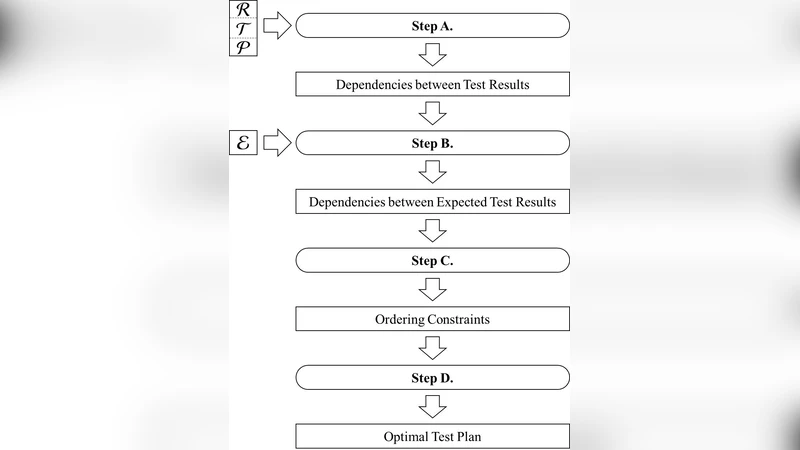
The core contribution is an algorithm that, given (a) the logical dependencies between test results derived from R, T, and P, and (b) a test manager’s expectation about the outcome of each test (E), produces an optimal test execution order that maximizes the number of redundant tests that can be dropped. The algorithm proceeds in four steps:
A. Compute all dependencies between test results that are logically entailed by R, T, and P (e.g., test₀ ⇒ test₁).
B. Incorporate the manager’s expectations by introducing expectation variables (xpctd_i) and deriving expectation‑based dependencies (e.g., ¬xpctd₀ ⇒ ¬xpctd₁).
C. Combine the two sets of dependencies to infer which test result becomes redundant from which expected result, and generate ordering constraints (e.g., “execute test₀ before test₁”).
D. Resolve the ordering constraints using a topological sort to produce a concrete test plan.
The authors prove a completeness property: if there exists any ordering that makes a test redundant under the expected outcomes, the algorithm will discover it. They also discuss optimality with respect to the defined criterion—maximizing the number of ordering constraints that lead to redundancy.
An empirical evaluation on automotive test scenarios (including Hardware‑in‑the‑Loop and Software‑in‑the‑Loop platforms) demonstrates that the automatically generated plans can eliminate a substantial fraction of test cases (often more than 30 % of the original suite) and reduce overall execution time and manual effort.
Limitations are acknowledged. The SAT‑based reasoning may become computationally intensive for very large specifications, suggesting the need for incremental or modular SAT techniques. Moreover, the quality of the generated plan depends on the accuracy of the manager’s expectations; incorrect or missing expectations may lead to sub‑optimal ordering, though the algorithm still guarantees optimality with respect to the information it has.
In summary, the paper presents a novel integration of requirement‑level logical dependencies, test‑suite mappings, and platform hierarchies into a unified Boolean model, leverages SAT solving to detect test redundancy, and automatically synthesizes an execution order that is provably optimal under the manager’s expected outcomes. This approach offers a systematic, tool‑supported means to alleviate the combinatorial burden of test planning in safety‑critical and cost‑sensitive domains.
Comments & Academic Discussion
Loading comments...
Leave a Comment