Towards the Modeling of Behavioral Trajectories of Users in Online Social Media
In this paper, we introduce a methodology that allows to model behavioral trajectories of users in online social media. First, we illustrate how to leverage the probabilistic framework provided by Hidden Markov Models (HMMs) to represent users by emb…
Authors: Aless, ro Bessi
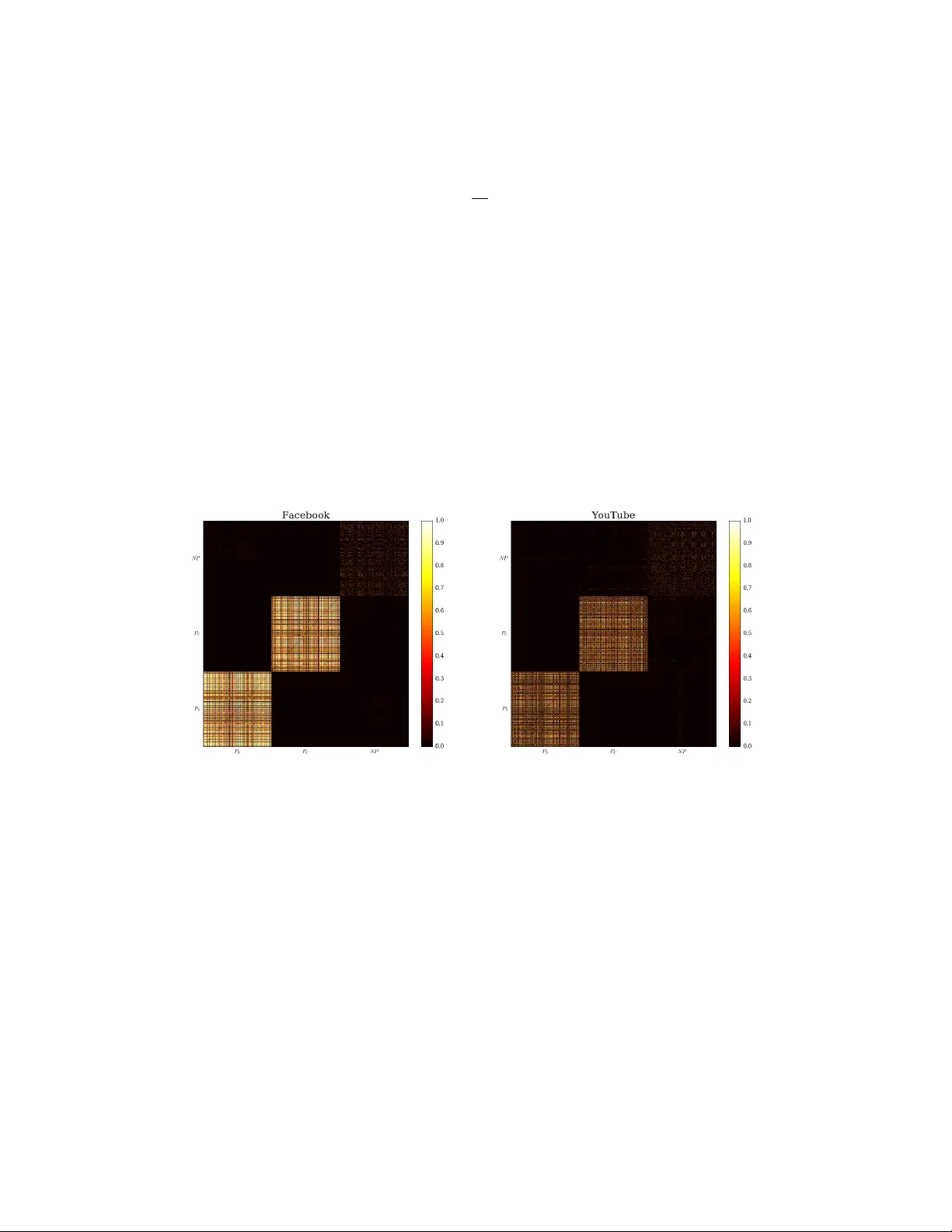
T o w ards the Mo deling of Beha vioral T ra jectories of Users in Online So cial Media Alessandro Bessi ∗ a University of Southern California, Information Scienc e Institute, Marina del R ey, CA (USA) Abstract In this pap er, we in troduce a metho dology that allows to mo del b eha vioral tra jectories of users in online so cial media. First, we illustrate how to leverage the probabilistic framework pro vided by Hidden Marko v Mo dels (HMMs) to represent users b y embedding the temp oral sequences of actions they p erformed online. W e then deriv e a mo del-based distance b et ween trained HMMs, and w e use spectral clustering to find homogeneous clusters of users showing similar b eha vioral tra jectories. T o provide platform-agnostic results, we apply the prop osed approach to t wo different online social media — i.e. F aceb ook and Y ouT ub e. W e conclude discussing merits and limitations of our approac h as well as future and promising research directions. In tro duction Ov er the last decade, the rise of online so cial media has caused a h uge shift in the wa y people find information, interpret facts, and shap e their opinions. F aceb o ok news feeds, Twitter timelines, and blogs are replacing morning newspap ers and nightly news. Now ada ys every one can pro duce and consume information without an y filter or restriction. Suc h a disin termediated environmen t has prov ed to b e a fiasco for the public’s understanding of current affairs: clic kbait news that pander to readers’ w orst instincts are proliferating on blogs [1]; conspiracy theories that simplify causation and reduce the complexity of realit y are spreading more than stories that are balanced and thoroughly rep orted [2, 3]; F aceb o ok is flo o ded by fake news fabricated by fringe websites [4, 5, 6, 7]; Twitter is sw amp ed by b ots [8] — algorithmically driven en tities that on the surface app ear as legitimate users — distorting the political debate [9]; the emergence of virtual ec ho cham bers — non- in teracting p olarized communities cen tered on differen t narratives wherein enclav es of like-minded people reinforce their preexisting b eliefs [10, 11, 12, 13, 14] — is reducing viewp oint div ersit y and flattening debates [15, 16, 17, 18, 19, 20, 21]. What is happ ening in online so cial media is worsening the p olitical p olarization, jeopardizing the qual- it y of demo cratic discourse, influencing p olicy preferences, and encouraging b ehaviors strongly div ergent from recommended practices. F or these reasons, a b etter understanding of the b eha vioral, cognitive, and psyc hological pro cesses underlying the observ ed dynamics is a matter that Science has to address. In this work, w e propose a methodology that leverages Hidden Mark ov Mo dels [22, 23, 24] to represent b eha vioral tra jectories of users in online so cial media. A Hidden Marko v Mo del (HMM) is a probabilistic mo del in which the system b eing mo deled is assumed to b e a Marko v pro cess with unobserved ( hidden ) states. HMMs extend the framework provided by Marko v chains in order to mo del systems in which the states (or ev ents) we are interested in are not directly observ able. HMMs are traditionally known for their application in temporal pattern recognition suc h as sp eec h, gesture recognition, and bioinformatics [25, 26, 27]. Recen tly , the application of HMMs has be en successfully extended to computational so cial science — e.g. in [28] the author pro vides nov el evidence for the existence of an epo ch-lik e structure of conflict and co op eration on Wikip edia, distinguished by b eha vioral motifs. The fundamental idea behind the approac h that we are introducing is the follo wing. In so cial netw ork analysis, w e can observ e actions p erformed by users — e.g. lik es, commen ts, shares, retw eets, etc. —, but ∗ Corresponding author Email addr ess: bessi@isi.edu (Alessandro Bessi) Pr eprint submitte d to Elsevier De c emb er 9, 2016 the worldviews, inclinations, and orien tations driving those actions remain hidden. It follows that Hidden Mark ov Mo dels — wherein the hidden states are supp osed to cause observ ables outputs — might pro vide an appropriate and conv enien t probabilistic framework for the mo deling of behavioral tra jectories of users in online social media. In this pap er, w e sho w that HMMs can embed time series of differen t length represen ting the comments left b y users supp orting conflicting narratives. F or the sak e of generalization and to pro vide platform-agnostic results, we apply our methodology to tw o different online so cial media: F acebo ok and Y ouT ub e. Our results show that Hidden Mark ov Mo dels are able to mo del b ehavioral tra jectories of users by em b edding their visible actions in online so cial media. Besides the soundness of the intuition and the straigh tforward idea motiv ating the use of HMMs in this context, the main strength of our approach is that it allows to compare users that performed a different n umber of actions — i.e. users that are represen ted b y time series of differen t length. Indeed, we can compare users by using a mo del-b ase d distance b et w een their HMMs, and then apply sp ectral clustering to disco ver homogeneous clusters of users showing similar tra jectories. Materials and methods Data Col le ction T o test the proposed metho dology , w e rely on a dataset already used in [29]. In particular, we use data a v ailable for tw o random samples of 1 . 2 K users that left at least 100 commen ts either on F aceb o ok p osts or Y ouT ub e videos supporting differen t and conflicting narrativ es. Indeed, b oth the p osts and videos considered ha ve b een published by pages and channels disseminating either Conspiracy or Science news. The first category (Conspiracy) includes pages and channels diffusing alternative and contro versial infor- mation, usually lac king supp orting evidence and most often contradictory of the official news. The second category (Science) includes scientific institutions and scientific press having the main mission of diffusing scien tific kno wledge. Suc h a space of inv estigation is defined with the same approach as in [2], with the supp ort of differen t F aceb ook groups v ery active in monitoring the conspiracy narrativ es. Both pages and c hannels were accurately selected and verified according to their self description. The data collection started with the download of all the F acebo ok p osts — and their resp ective users’ in teractions — published by 419 US F aceb ook pages supp orting either Science or Conspiracy . Then, we col- lected metadata related to Y ouT ub e videos linked b y such posts, as well as the asso ciated users’ interactions. The entire data collection pro cess has b een carried out exclusiv ely through the F aceb o ok Graph API and the Y ouT ub e Data API, which are b oth publicly av ailable, and for the analysis w e used only public av ailable data (users with priv acy restrictions are not included in the dataset). The pages from which we download data are public F aceb o ok and Y ouT ub e en tities. User con tent contributing to such entities is also public unless the users priv acy settings sp ecify otherwise and in that case it is not av ailable to us. W e abided by the terms, conditions, and priv acy p olicies of the w ebsites (F aceb ook and Y outub e). Hidden Markov Mo dels A Hidden Marko v Mo del (HMM) is a probabilistic mo del in which the system b eing mo delled is assumed to b e a Marko v pro cess with unobserved ( hidden ) states. HMMs extend the framework provided by Marko v c hains in order to mo del systems in which the states (or even ts) we are interested in are not directly observ able. The basic structure of a HMM consists of a set of hidden states, each of which pro duces an observ able output ( observation ). A first-order HMM instantiates tw o simplifying assumptions: 1. The probabilit y of a particular state dep ends only on the previous state: Pr ( x t | x 1 , . . . , x t − 1 ) = Pr ( x t | x t − 1 ) . 2. The probability of an observ ation o t dep ends only on the state that pro duced the observ ation — not on an y other states or any other observ ations — that is: Pr ( o t | x 1 , . . . , x t , . . . , x T , o 1 , . . . , o t , . . . , o T ) = Pr ( o t | x t ) . Figure 1 pro vides a graphical representation of a first-order HMM. 2 x 1 x t − 1 x t x T o 1 o t − 1 o t o T Figure 1: Graphical representation of a first-order HHM. Gra y shaded no des represen t the hidden states of the system. The probability of a particular state of the system at time t dep ends only on the state of the system at time t − 1. White no des represent the observ ations pro duced b y the hidden states of the system. The probability of an observ ation at time t dep ends only on the (hidden) state of the system at time t . F ormally , a first-order HMM is defined by: 1. A set of hidden states X = { X 1 , . . . , X | X | } . 2. A set of visible states ( observations ) O = { O 1 , . . . , O | O | } . 3. A state transition probabilit y matrix A = { a ij } , where a ij = Pr ( x t = X j | x t − 1 = X i ), 1 ≤ i, j ≤ | X | . 4. An observ ation probability matrix B = { b ki } , where b ki = Pr ( o k | X i ), 1 ≤ k ≤ | O | , 1 ≤ i ≤ | X | . Results Mo deling b ehavior al tr aje ctories of users using HMMs In this work, we show that is p ossible to use first-order discrete HMMs to mo del the b ehavioral tra jectories of users in online social media. The intuition supp orting this approac h is the following. In so cial netw ork analysis, w e cannot observe the actual orien tations of users tow ards a sp ecific kind of conten t. Indeed, the only things that we can observe are temporally ordered sequences of actions that users p erform — e.g. t weets, commen ts, likes, shares, etc. In this context, HMMs pro vide a con venien t as w ell as intuitiv e probabilistic framew ork to mo del the unobserv ed ( hidden states ) orientation of users by leveraging their observed ( visible states ) actions in online so cial media. Here we illustrate ho w to use the prop osed methodology to mo del behavioral tra jectories of users con- suming con ten ts supp orting conflicting narrativ es — i.e. Science and Conspiracy (see Data Collection for additional information). F or the sak e of generalization as w ell as to provide platform-agnostic results, w e apply our approac h to different online so cial media — i.e. F aceb o ok and Y ouT ub e. F or both F aceb o ok and Y ouT ub e w e fo cus on a random sample of 1 . 2 K users with at least 100 commen ts. Both samples are comp osed as follows. A first batch of 400 users with more than 95% of their comments on p osts (videos) supp orting Science; a second batch of 400 users with more than 95% of their commen ts on p osts (videos) supp orting Conspiracy; a third batch of 400 users with no more than 95% of their comments on p osts (videos) supp orting either Science or Conspiracy . The users in the first and the second batches are considered polarized tow ards either Science ( P S ) or Conspiracy ( P C ), whereas the users in the third batch are not p olarized ( N P ). W e choose to consider three balanced batches of users with different orien tations to obtain nice and in terpretable results. Still, our approach do es not need balanced data. Similarly , the choice of considering users with at least 100 comments is arbitrary , since HMMs can be fitted with sequences of shorter length — ev en if the longer the sequence the b etter the estimation of the HMMs parameters. Since F acebo ok and Y ouT ub e data share the same structure, hereafter we make no distinction b et w een the tw o and w e refer generically to users and their behavioral tra jectories while in tro ducing our prop osed metho dology . F or eac h user w e instantiate a HMM, λ , with three hidden states and t w o visible states. The three hidden states represen t the orientation of the user: polarized tow ards Science ( S ), uncertain ( U ), and p olarized 3 to wards Conspiracy ( C ). The t wo visible states (observ ations) are comments on scientific con tents ( s ) and conspiracy con tents ( c ). In these settings, each user is represented by a time series Y of visible even ts as Y = { s s s c s c s c c s c c } . Notice that while the num ber of the visible states is fixed and determined by the a v ailable data, the num- b er of hidden states has to b e specified using prior information or common kno wledge about the phenomenon under in vestigation. F ormally , eac h HMM λ is defined as follows: 1. A set of hidden states X = {S , U , C } . 2. A set of visible states ( observations ) O = { s, c } . 3. A state transition probability matrix A = { a ij } , where a ij = Pr ( x t = X j | x t − 1 = X i ), i, j ∈ {S , U , C } . 4. An observ ation probability matrix B = { b ki } , where b ki = Pr ( O k | X i ), k ∈ { s, c } , i ∈ {S , U , C } . Figure 2 pro vides a graphical representation of the state transition probability matrix. Notice that there is a non-zero probabilit y of transitioning b etw een an y t wo states. Suc h a HMM is called a fully connected or ergo dic HMM. W e set A to b e an uninformativ e state transition probability matrix, so that a ij = 1 / 3 for eac h i, j ∈ {S , U , C } . Similarly , w e set B to b e an uninformative observ ation probability matrix, so that b ki = 1 / 2 for eac h k ∈ { s, c } and i ∈ {S , U , C } . Notice that one might consider to explicitly define different transition or emission probabilities according to prior kno wledge. S U C Figure 2: Graphical representation of the state transition probabilit y matrix A. Each node represents a hidden state, whereas each edge indicates a transition probability p = 1 / 3. Eac h user i ∈ { 1 , . . . , N } is represen ted by a temp oral sequence Y i of comments left in resp onse to scien tific ( s ) or conspiracy ( c ) conten ts. F or eac h user, w e estimate the HMM parameters maximizing the lik eliho o d of the observ ations sequence Pr ( Y i | λ i ) by means of the Baum-W elch algorithm [30]. In the end, eac h user i is asso ciated with a trained HMM λ i , wherein the estimated parameters go vern the transitions b et w een hidden states and the probability to observe a sequence of comments given the hidden states of the users. Constructing a similarity matrix No w that each user i is asso ciated to a trained HMM λ i , w e can construct a N × N mo del-b ase d distance matrix L by computing the log-likelihoo d v alue for eac h pair of sequences and trained HMMs via forward- bac kward algorithm [31]: L = { ` ij } = { log Pr ( Y j | λ i ) } , i, j ∈ { 1 , . . . , N } . Since such a distance matrix is not symmetric, we need to define a new symmetric distance matrix D by lev eraging the information contained in L : D = { d ij } = { | ` ii + ` j j − ` ij − ` j i | } , i, j ∈ { 1 , . . . , N } . 4 The symmetric distance matrix D represents the cross-go o dness-of-fit of tw o sequences to the resp ectiv e HMMs. Finally , we construct a similarit y matrix S = { s ij } b y applying the following radial basis function k ernel to each element of D : s ij = ( exp − d ij 2 i 6 = j 0 i = j Figure 3 provides a graphical representation of the similarity matrices obtained for F aceb ook (left panel) and Y ouT ub e (right panel) users. Such illustrations conv ey tw o interesting messages. First, by means of the mo del-b ase d distance defined b efore, we are able to iden tify tw o large clusters of users characterized by homogeneous b eha vioral tra jectories. Suc h a result holds in both F aceb ook and Y ouT ub e, and it makes sense since the strongest similarities are observed betw een users supp orting the same narrativ e — i.e. users supp orting Science ( P S ) show similar b ehavioral tra jectories, and the same apply for users supp orting Conspiracy ( P C ). Second, in both F acebo ok and Y ouT ub e, the similarities b et ween not p olarized users ( N P ) are w eaker than the ones b et ween p olarized users ( P S and P C ). In particular, we notice the absence of a unique homogeneous cluster of not p olarized users. T o address this last observ ation, in the next section we apply sp ectral clustering metho ds [32, 33, 34] to the similarit y matrices. Figure 3: Graphical represen tation of similarity matrices. In b oth F acebo ok and Y ouT ube, by means of the mo del- b ase d distance defined in the previous section, we are able to iden tify tw o large clusters of users characterized by homogeneous behavioral tra jectories. Applying sp e ctr al clustering Giv en a N × N similarity matrix S , each elements s ij can b e viewed as the similarity b et ween no des v i and v j . F or an undirected graph G with no des v i and edges s ij , where i, j ∈ 1 , . . . , N , the symmetric matrix S is considered as the adjacency matrix for G . Let k i = P j ∈ V s ij b e the degree of v ertex v i , and let K b e a diagonal matrix with k i b eing its diagonal elemen t. W e can obtain a normalized sto c hastic matrix: M = SK − 1 . Based on the definition of a Marko v c hain, m ij represen ts the transition probability of mo ving from v i to v j . In practice, w e consider a matrix Z = K − 1 / 2 MK 1 / 2 = K − 1 / 2 SK − 1 / 2 , 5 where Z is symmetric and stable in eigendecomp osition. Then, the symmetric matrix Z can b e decom- p osed into the following form: Z = XΛX T , where X is a matrix obtained by stacking the eigenv ectors of Z in columns, while Λ = diag ( λ 1 , . . . , λ N ) is a diagonal matrix with the nonnegative singular eigen v alues in descending order along the diagonal — that is, λ 1 ≥ λ 2 ≥ · · · ≥ λ N ≥ 0. Since the top E eigenv ectors, E ≤ N , can capture a significan t amount of information on the original data, we can map the original data into the E dimensional vectors in the sp ectral domain, and then apply standard clustering algorithms based on the Euclidean distance such as the K-means algorithm. The next tw o figures illustrate the application of sp ectral clustering to the similarity matrices obtained in the previous section. Figure 4 provides a graphical representation of original data mapp ed in the sp ectral domain. The eigen v ectors associated with the first t w o eigen v alues contain enough information to let us visualize three clusters: tw o almost orthogonal lines of p oin ts represen ting users polarized to w ards conflicting narrativ es, and a cloudy shap e of p oin ts situated at the in tersection of the lines, that is representing not p olarized users. Figure 5 supp orts such an intuition by showing that the K-means algorithm applied to p olarized users mapp ed in the sp ectral domain clearly identifies tw o well separated clusters. Figure 4: Original data mapp ed in the spectral domain. In b oth F acebo ok and Y ouT ube, the eigenv ectors asso ciated with the first tw o eigenv alues contain enough information to let us visualize three clusters: tw o lines of p oints represen ting users polarized tow ards conflicting narratives, and a cloudy shap e of p oin ts representing not p olarized users. Discussion The rise of online so cial media has b een found resp onsible for distorting the collective grasp on the truth. F ak e news, lies, and conspiracy theories are spreading faster than ever on F aceb o ok, while Twitter is flo oded with b ots manipulating the p olitical discussion and influencing p olicy preferences. Meanwhile, the natural tendency of individuals to search for information consisten t with their preexisting b eliefs — c onfirmation bias — is driving the emergence of echo cham b ers, i.e. virtual comm unities wherein like-minded p eople reinforce their b eliefs and a void dissenting information. The concept of truth itself is b ecoming more and more blurred, and someone suggests that we are en tering in to a p ost-fact age [35], with obvious catastrophic consequences for demo cracy and so ciet y . In this dramatic scenario, Science has to provide a b etter understanding of the b eha vioral, cognitive, and psyc hological pro cesses b ehind the observ ed dynamics, as w ell as develop mo dels able to approximate and describ e such pro cesses. In this paper, we prop ose a metho dology that leverages Hidden Marko v Mo dels to represen t b ehavioral tra jectories of users in online social media. The intuition supporting this approach can b e summarized as 6 Figure 5: K-means clustering. In both F aceb ook and Y ouT ub e, K-means algorithm applied to p olarized users mapp ed in the spectral domain clearly identifies t wo well separated clusters representing users polarized tow ards Science and users p olarized tow ards Conspiracy . follo ws. In so cial net w ork analysis, w e cannot observe the actual orien tations of individuals to wards a specific kind of conten t. Indeed, the only things that w e can observe are temp orally ordered sequences of actions that individuals p erform — e.g. tw eets, commen ts, likes, shares, etc. Having said that, HMMs provide a con venien t as well as intuitiv e probabilistic framework to mo del the unobserv ed ( hidden states ) orien tation of individuals b y taking into account their observed ( visible states ) actions in online so cial media. T o pro vide platform-agnostic results, we apply our metho dology to t w o differen t online social media — F aceb ook and Y ouT ub e — sho wing that our approac h is able to disco ver homogeneous clusters of individuals sho wing similar b eha vioral tra jectories in b oth the platforms considered. Clearly , w e hav e to p oin t out some limitations of the presen t w ork. First, giv en the complexit y of h uman b eha vior, any attempt to infer the actual orientation of individuals as well as their motiv ations is out of the scop e of the prop osed metho dology . Nevertheless, we think that our approach yields a useful approximation and representation of b eha vioral tra jectories that can be exploited to identify homogeneous clusters of users. Then, we ha ve to emphasize that our dataset is a particular dataset, and thus w e cannot v enture an y general claims. Context matters, and far more research would b e necessary to support an y suc h general claims. A further limitation of the present study is the computational time required to train HMMs for a large n umber of individuals. Still, we believe that the prop osed metho dology is straightforw ard to implement, and supp orted by sound and intuitiv e theoretical foundations. Moreov er, HMMs pro vide a flexible probabilistic framew ork that can adapt to different contexts. In particular, w e think that our metho dology could b e used to inv estigate the effectiveness of fact-c hec king [36, 37] and debunking of false information proliferating in online so cial media. Some studies p ointed out the inefficacy of debunking and the concrete risk of a bac kfire effect from the most committed partisans [38, 39, 40, 41, 42, 43]. Differen tly , recent studies found that individuals heed factual information, ev en when suc h information challenges their partisan and ideological attac hmen ts [44, 45, 46]. In this scenario, w e think that our approach might help in the iden tification of homogeneous clusters of individuals sho wing similar reactions and b eha viors with resp ect to debunking and fact-chec king. References References [1] J. N. Blom, K. R. Hansen, Clic k bait: F orward-reference as lure in online news headlines, Journal of Pragmatics 76 (2015) 87–100. [2] M. Del Vicario, A. Bessi, F. Zollo, F. Petroni, A. Scala, G. Caldarelli, H. E. Stanley , W. Quattro cio cc hi, The spreading of misinformation online, Pro ceedings of the National Academ y of Sciences 113 (3) (2016) 554–559. 7 [3] F. Menczer, The spread of misinformation in so cial media, in: Pro ceedings of the 25th In ternational Conference Companion on W orld Wide W eb, In ternational W orld Wide W eb Conferences Steering Committee, 2016, pp. 717–717. [4] A. Bessi, M. Coletto, G. A. Davidescu, A. Scala, G. Caldarelli, W. Quattro cio cc hi, Science vs conspiracy: Collectiv e narratives in the age of misinformation, PloS one 10 (2) (2015) e0118093. [5] A. Bessi, F. Zollo, M. Del Vicario, A. Scala, G. Caldarelli, W. Quattro ciocchi, T rend of narrativ es in the age of misinformation, PloS one 10 (8) (2015) e0134641. [6] A. Bessi, On the statistical properties of viral misinformation in online so cial media, arXiv preprint [7] C. Shao, G. L. Ciampaglia, A. Flammini, F. Menczer, Hoaxy: A platform for tracking online mis- information, in: Proceedings of the 25th In ternational Conference Companion on W orld Wide W eb, In ternational W orld Wide W eb Conferences Steering Committee, 2016, pp. 745–750. [8] E. F errara, O. V arol, C. Da vis, F. Menczer, A. Flammini, The rise of so cial b ots, arXiv preprint [9] A. Bessi, E. F errara, So cial bots distort the 2016 us presidential election online discussion, First Monda y 21 (11). [10] A. Bessi, P ersonality traits and ec ho c hambers on faceb ook, Computers in Human Behavior 65 (2016) 319–324. [11] F. Zollo, P . K. No v ak, M. Del Vicario, A. Bessi, I. Mozetiˇ c, A. Scala, G. Caldarelli, W. Quattro ciocchi, Emotional dynamics in the age of misinformation, PloS one 10 (9) (2015) e0138740. [12] A. Bessi, F. P etroni, M. Del Vicario, F. Zollo, A. Anagnostop oulos, A. Scala, G. Caldarelli, W. Quat- tro ciocchi, Homophily and p olarization in the age of misinformation, The Europ ean Physical Journal Sp ecial T opics 225 (10) (2016) 2047–2059. [13] M. Del Vicario, F. Zollo, G. Caldarelli, A. Scala, W. Quattrocio cchi, The anatomy of brexit debate on faceb ook, arXiv preprint [14] M. Del Vicario, G. Viv aldo, A. Bessi, F. Zollo, A. Scala, G. Caldarelli, W. Quattro cio cc hi, Echo cham- b ers: Emotional contagion and group p olarization on faceb ook, arXiv preprint [15] W. Quattro ciocchi, A. Scala, C. R. Sunstein, Echo cham bers on faceb o ok. [16] J. Dewey , M. L. Rogers, The public and its problems: An essay in p olitical inquiry , P enn State Press, 2012. [17] J. Hab ermas, Betw een facts and norms: Con tributions to a discourse theory of law and democracy , John Wiley & Sons, 2015. [18] S. Flaxman, S. Go el, J. Rao, Filter bubbles, echo c hambers, and online news consumption, Public Opinion Quarterly (2016) nfw006. [19] M. Starnini, M. F rasca, A. Baronc helli, Emergence of metap opulations and echo cham bers in mobile agen ts, arXiv preprint [20] J. Bright, Explaining the emergence of echo cham bers on so cial media: the role of ideology and extrem- ism. [21] S. Galam, M. A. Jav arone, Mo deling radicalization phenomena in heterogeneous p opulations, PloS one 11 (5) (2016) e0155407. [22] S. R. Eddy , Hidden mark ov mo dels, Current opinion in structural biology 6 (3) (1996) 361–365. 8 [23] P . Blunsom, Hidden mark ov mo dels, Lecture notes, August 15 (2004) 18–19. [24] L. Rabiner, B. Juang, An introduction to hidden marko v mo dels, ieee assp magazine 3 (1) (1986) 4–16. [25] A. Krogh, B. Larsson, G. V on Heijne, E. L. Sonnhammer, Predicting transmembrane protein top ology with a hidden marko v mo del: application to complete genomes, Journal of molecular biology 305 (3) (2001) 567–580. [26] L. Bahl, P . F. Bro wn, P . V. De Souza, R. L. Mercer, Maximum mutual information estimation of hidden mark ov mo del parameters for sp eech recognition, in: pro c. icassp, V ol. 86, 1986, pp. 49–52. [27] J. Y amato, J. Oh ya, K. Ishii, Recognizing human action in time-sequential images using hidden marko v mo del, in: Computer Vision and P attern Recognition, 1992. Proceedings CVPR’92., 1992 IEEE Com- puter So ciet y Conference on, IEEE, 1992, pp. 379–385. [28] S. DeDeo, Conflict and computation on wikipedia: a finite-state mac hine analysis of editor interactions, arXiv preprin t [29] A. Bessi, F. Zollo, M. Del Vicario, M. Puliga, A. Scala, G. Caldarelli, B. Uzzi, W. Quattro ciocchi, Users p olarization on faceb o ok and youtube, arXiv preprint [30] L. R. W elc h, Hidden marko v mo dels and the baum-welc h algorithm, IEEE Information Theory So ciet y Newsletter 53 (4) (2003) 10–13. [31] P . A. Devijver, Baum’s forward-bac kward algorithm revisited, Pattern Recognition Letters 3 (6) (1985) 369–373. [32] J. Yin, Q. Y ang, Integrating hidden marko v mo dels and sp ectral analysis for sensory time series clus- tering, in: Fifth IEEE In ternational Conference on Data Mining (ICDM’05), IEEE, 2005, pp. 8–pp. [33] P . Sm yth, et al., Clustering sequences with hidden marko v mo dels, Adv ances in neural information pro cessing systems (1997) 648–654. [34] S. Ghassemp our, F. Girosi, A. Maeder, Clustering multiv ariate time series using hidden marko v models, In ternational journal of environmen tal research and public health 11 (3) (2014) 2741–2763. [35] F. Manjo o, T rue enough: Learning to live in a p ost-fact so ciet y , John Wiley & Sons, 2011. [36] G. L. Ciampaglia, P . Shiralk ar, L. M. Ro cha, J. Bollen, F. Menczer, A. Flammini, Computational fact c hecking from knowledge netw orks, PloS one 10 (6) (2015) e0128193. [37] M. T am buscio, D. F. Oliveira, G. L. Ciampaglia, G. Ruffo, Netw ork segregation in a mo del of misinfor- mation and fact c hecking, arXiv preprint [38] B. Nyhan, J. Reifler, When corrections fail: The p ersistence of p olitical misp erceptions, Political Be- ha vior 32 (2) (2010) 303–330. [39] F. Zollo, A. Bessi, M. Del Vicario, A. Scala, G. Caldarelli, L. Shekhtman, S. Havlin, W. Quattro cio cc hi, Debunking in a w orld of trib es, arXiv preprin t [40] D. P . Redlawsk, Hot cognition or co ol consideration? testing the effects of motiv ated reasoning on p olitical decision making, The Journal of Politics 64 (04) (2002) 1021–1044. [41] S. E. Gollust, P . M. Lan tz, P . A. Ub el, The polarizing effect of news media messages ab out the so cial determinan ts of health, American Journal of Public Health 99 (12) (2009) 2160–2167. [42] B. Nyhan, J. Reifler, P . A. Ub el, The hazards of correcting myths ab out health care reform, Medical care 51 (2) (2013) 127–132. [43] B. F. Schaffner, C. Ro che, Misinformation and motiv ated reasoning: Resp onses to economic news in a p oliticized environmen t. 9 [44] T. W o od, E. Porter, The elusive backfire effect: Mass attitudes’ steadfast factual adherence. [45] B. E. W eeks, Emotions, partisanship, and misp erceptions: how anger and anxiety mo derate the effect of partisan bias on susceptibilit y to p olitical misinformation, Journal of Communication 65 (4) (2015) 699–719. [46] B. Nyhan, J. Reifler, Nda do p eople actually learn from fact-c hec king? evidence from a longitudinal study during the 2014 campaign., Unpublished man uscript. 10
Original Paper
Loading high-quality paper...
Comments & Academic Discussion
Loading comments...
Leave a Comment