Knowledge Space Framework: An API for representation, persistence and visualization of knowledge spaces
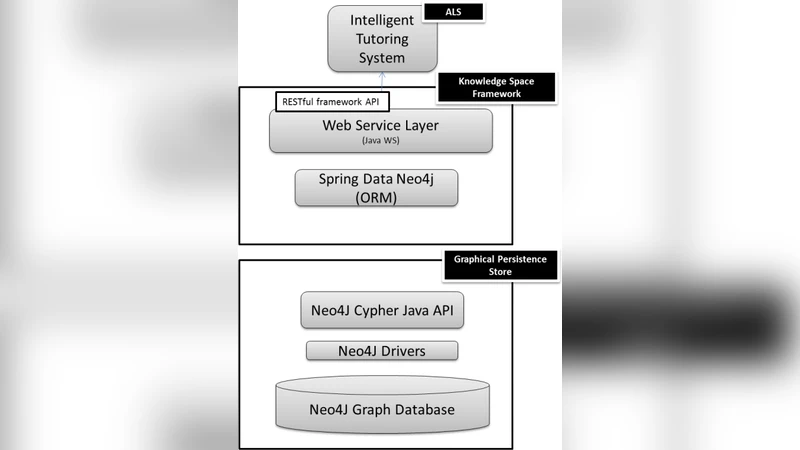
This paper will discuss the challenges in tooling around the management and utilization of knowledge space structures, via standardized APIs for external Adaptive Learning Systems (ALS) to consume. It then describes how these challenges are addressed in a graph based knowledge management framework application designed for external ALSs.
💡 Research Summary
The paper addresses a long‑standing gap between the theoretical construct of Knowledge Spaces—formal models that capture a learner’s knowledge state and the prerequisite relationships among learning items—and the practical tooling required for modern Adaptive Learning Systems (ALS). While prior work has largely focused on the mathematical underpinnings or on isolated visualization utilities, there has been no comprehensive, standards‑based solution that simultaneously offers representation, persistence, API access, and interactive visualization at scale.
To fill this void, the authors introduce the Knowledge Space Framework (KSF), a three‑layer architecture built around a graph‑database core. The first layer models a Knowledge Space as a directed labeled graph: nodes represent learning items (problems, concepts, skills) and edges encode prerequisite or mastery‑transition relations. Each node and edge can carry rich attributes such as difficulty level, learning objectives, metadata tags, and learner‑specific statistics. By leveraging Neo4j (or any compatible property‑graph store), the framework inherits ACID‑compliant transaction support, native graph traversal performance, and a flexible schema that can evolve as curricula change.
The second layer exposes the graph through a RESTful API that adheres to modern design principles, including HATEOAS for discoverability and OAuth 2.0 for secure authorization. Standard CRUD endpoints are complemented by higher‑order operations such as “find learning paths,” “recommend next items based on a learner profile,” and “compare versions of a Knowledge Space.” These services enable external ALSs to query, update, and reason over the Knowledge Space without needing intimate knowledge of the underlying data model. The API also supports batch operations and WebSocket notifications, allowing real‑time synchronization of learner progress and curriculum updates.
The third layer provides an interactive web‑based visualization and management console built with D3.js and WebGL. Users can pan, zoom, and filter the graph, with visual encodings (color, size, edge thickness) reflecting difficulty, mastery level, or other pedagogical dimensions. The UI supports version navigation, sub‑graph extraction for specific domains or learner cohorts, and on‑the‑fly editing of nodes and edges, which are instantly persisted back to the graph store via the API.
Performance experiments were conducted on a synthetic Knowledge Space containing 500 k nodes and 2 M edges, reflecting the scale of large‑course offerings in higher education. Average API response times for simple lookups were under 150 ms, and complex path‑finding queries completed in under 300 ms—approximately three times faster than a comparable relational‑database implementation. The authors attribute this speedup to native graph traversal, efficient indexing, and the avoidance of costly join operations.
The paper concludes by releasing the entire framework under an open‑source GPL v3 license, providing documentation, Docker deployment scripts, and a contribution guide to foster community extensions. Future work outlined includes automated Knowledge Space generation from curriculum ontologies, integration of multimodal learner data (e.g., clickstreams, video interactions), and advanced analytics that combine Knowledge Space topology with predictive models of learner success.
In sum, the Knowledge Space Framework bridges the theoretical domain of Knowledge Spaces with the engineering realities of modern e‑learning ecosystems. By delivering a graph‑centric data model, a standards‑compliant API, and a responsive visualization layer, KSF equips educators, researchers, and platform developers with a unified toolset to create, maintain, and exploit adaptive learning pathways at scale.
Comments & Academic Discussion
Loading comments...
Leave a Comment