Once referred to as the missing circuit component, memristor has come long way across to be recognized and taken as important to future circuit designs. The memristor due to its ability to memorize the state, switch between different resistance level, smaller size and low leakage currents makes it useful for a wide range of intelligent memory and computing applications. This overview paper highlights broadly provides the uses of memristor in the implementation of cognitive cells for different imaging and pattern matching applications.
Deep Dive into Memristor Threshold Logic: An Overview to Challenges and Applications.
Once referred to as the missing circuit component, memristor has come long way across to be recognized and taken as important to future circuit designs. The memristor due to its ability to memorize the state, switch between different resistance level, smaller size and low leakage currents makes it useful for a wide range of intelligent memory and computing applications. This overview paper highlights broadly provides the uses of memristor in the implementation of cognitive cells for different imaging and pattern matching applications.
Memristor is one of the basic electronic device that completes the relationship between the basic parameter of flux and charge [1]. The capability of remembering or storing data in terms of resistance values is the main characteristic feature of memristors. This feature contributes to the development of non-volatile memories [2]. A summary of memristor devices and its applications is provided in the survey papers [3]- [5]. The use of threshold logic with memristors can help develop newer designs that integrate the concept of memories with that of computing [3]. The aim of the paper is to provide a targeted bibliographic overview on memristor circuits with a focus on threshold logic systems.
Memristors can switch between its resistive states by application of different levels of voltage across it. Since switches forms the basic idea of digital gates, they find application in development of logic gates. Further the ability to retain a resistance state even when the power is off enables the use of memristors as memories.
The behavior of the memristors resemble the principle of firing of neurons, and give indications of early learning mechanisms. The ability to update the weights and the resemblance with synaptic potentiation makes it a good candidate to be considered for mimicking biological neural circuits.
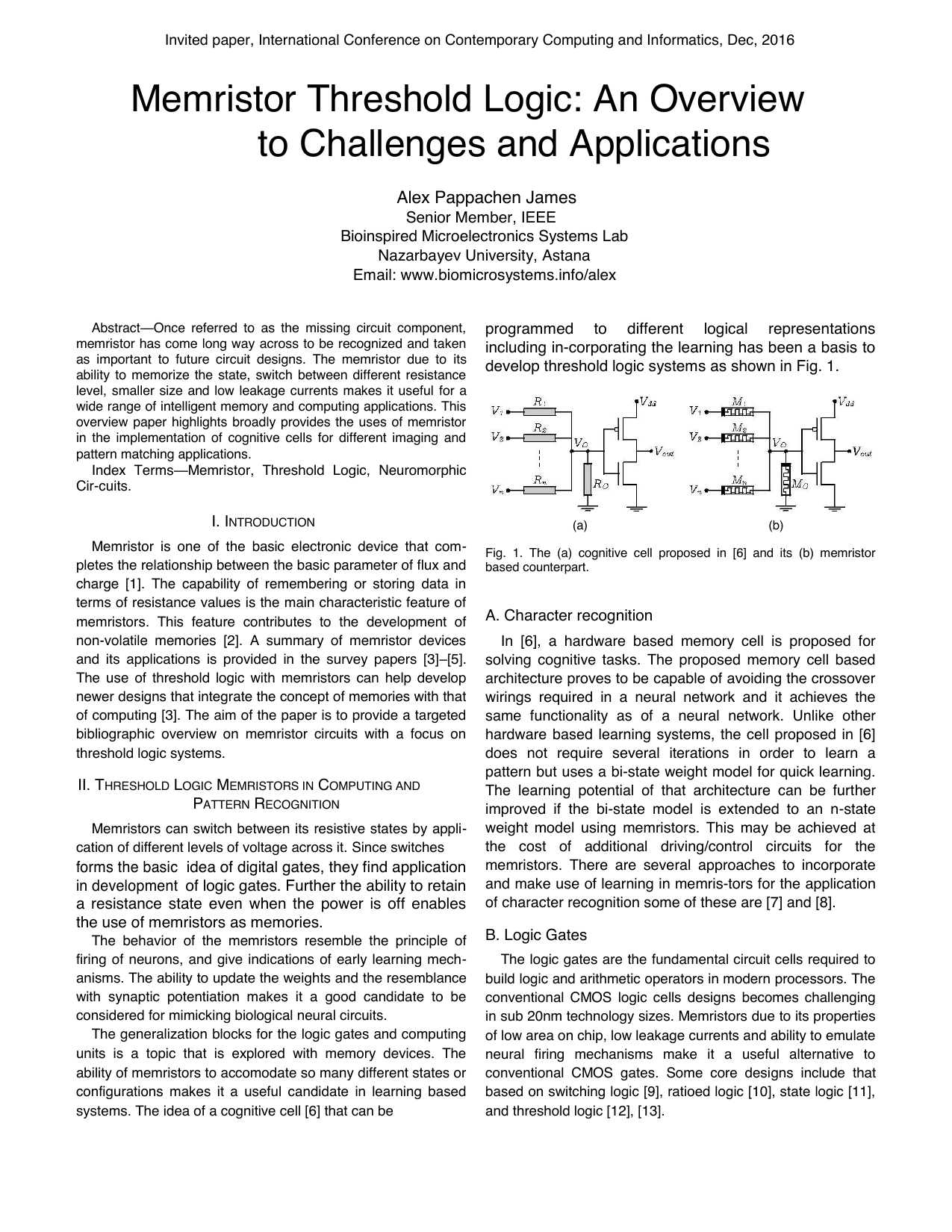
The generalization blocks for the logic gates and computing units is a topic that is explored with memory devices. The ability of memristors to accomodate so many different states or configurations makes it a useful candidate in learning based systems. The idea of a cognitive cell [6] that can be
In [6], a hardware based memory cell is proposed for solving cognitive tasks. The proposed memory cell based architecture proves to be capable of avoiding the crossover wirings required in a neural network and it achieves the same functionality as of a neural network. Unlike other hardware based learning systems, the cell proposed in [6] does not require several iterations in order to learn a pattern but uses a bi-state weight model for quick learning. The learning potential of that architecture can be further improved if the bi-state model is extended to an n-state weight model using memristors. This may be achieved at the cost of additional driving/control circuits for the memristors. There are several approaches to incorporate and make use of learning in memris-tors for the application of character recognition some of these are [7] and [8].
The logic gates are the fundamental circuit cells required to build logic and arithmetic operators in modern processors. The conventional CMOS logic cells designs becomes challenging in sub 20nm technology sizes. Memristors due to its properties of low area on chip, low leakage currents and ability to emulate neural firing mechanisms make it a useful alternative to conventional CMOS gates. Some core designs include that based on switching logic [9], ratioed logic [10], state logic [11], and threshold logic [12], [13].
In [14], the idea of cognitive cells were utilized for locating lesion probable regions in film mammography. Here, the cognitive cell parameters were adjusted according to the local and global input image statistic. In [15], [16], novel cognitive cell based architectures are used to find edges in digital/analog images. It was observed that the edge response obtained (Figure . 2(a)) by the use of cognitive cells was satisfactory. Exploiting the advantage of high processing speeds offered by cognitive cell based learning, the work in [17] proposed a method for real-time processing of medical data. The input considered were intraoperative MRI images (Figure.
Later in [18], the architecture proposed in [6] was studied for memristors. They studied memristor based architectures for implementing digital logic gates. Having the basic gates implemented using memristors, we can develop systems that perform higher level computing at great speeds. The work illustrated in [19] is an example proving that memristor based systems can be deployed for performing complex cognitive tasks like object detection and tracking shown in Figure .2(b).
The work in [20], proposes an implementation of Fast Fourier Transform and Vedic Multiplication using memristors. They highlighted the importance of memristors by reporting the lower chip area, THD and controllable leakage power.
The speech recognition represents one of the applications where the real-time processing of features becomes very important. The hardware processing of signals through memristor pattern recognisers can increase the overall performance of speed. Some of recent examples of attempts to build real-time speech recognition include that based on threshold logic [21] and neural circuits [22].
The recognition of the faces require the extraction of facial features from the images and would need to be robust to changes in natural variability. This problem represent a class of pattern recognition problem that is ofte
…(Full text truncated)…
This content is AI-processed based on ArXiv data.