Turbulent resistivity evaluation in MRI generated turbulence
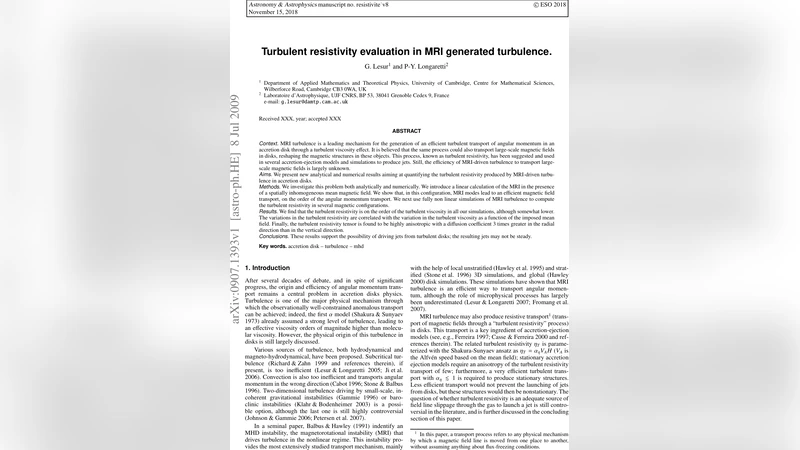
(abriged) MRI turbulence is a leading mechanism for the generation of an efficient turbulent transport of angular momentum in an accretion disk through a turbulent viscosity effect. It is believed that the same process could also transport large-scale magnetic fields in disks, reshaping the magnetic structures in these objects. This process, known as turbulent resistivity, has been suggested and used in several accretion-ejection models and simulations to produce jets. Still, the efficiency of MRI-driven turbulence to transport large-scale magnetic fields is largely unknown. We investigate this problem both analytically and numerically. We introduce a linear calculation of the MRI in the presence of a spatially inhomogeneous mean magnetic field. We show that, in this configuration, MRI modes lead to an efficient magnetic field transport, on the order of the angular momentum transport. We next use fully non linear simulations of MRI turbulence to compute the turbulent resistivity in several magnetic configurations. We find that the turbulent resistivity is on the order of the turbulent viscosity in all our simulations, although somewhat lower. The turbulent resistivity tensor is found to be highly anisotropic with a diffusion coefficient 3 times greater in the radial direction than in the vertical direction. These results support the possibility of driving jets from turbulent disks; the resulting jets may not be steady.
💡 Research Summary
This paper addresses a long‑standing question in accretion‑disk theory: whether the turbulence generated by the magnetorotational instability (MRI) can transport not only angular momentum (through an effective turbulent viscosity) but also large‑scale magnetic fields (through a turbulent resistivity). The authors combine an analytical linear calculation with fully non‑linear three‑dimensional shearing‑box simulations to quantify the turbulent resistivity tensor η_ij and compare it with the turbulent viscosity α.
In the analytical part, a mean‑field approach is adopted. The authors impose a spatially varying mean magnetic field and solve the linear MRI eigenvalue problem in this inhomogeneous background. They find that the electromotive force (EMF) generated by the unstable MRI modes is proportional to the gradient of the mean field, with a proportionality coefficient of the same order as the MRI growth rate. Consequently, the linear analysis predicts that MRI modes can transport magnetic flux with an efficiency comparable to the angular‑momentum transport produced by the same modes.
The numerical investigation uses a suite of high‑resolution shearing‑box simulations (≥64 cells per scale height) with various net magnetic‑field configurations (pure vertical, pure toroidal, and mixed) and plasma β values. By measuring the correlation between the fluctuating EMF and the imposed mean‑field gradients, the authors extract the components of the turbulent resistivity tensor. The key findings are:
-
Magnitude – The turbulent resistivity is of the same order as the turbulent viscosity (α ≈ 10⁻²–10⁻³), albeit slightly smaller (η ≈ 0.3–0.8 α). This demonstrates that MRI turbulence is capable of diffusing magnetic fields as efficiently as it transports angular momentum.
-
Anisotropy – The radial diffusion coefficient η_rr is roughly three times larger than the vertical coefficient η_zz, while the azimuthal component η_φφ is comparatively weak. This strong anisotropy implies that magnetic flux spreads more rapidly in the radial direction than in the vertical direction within the disk.
-
Dependence on field geometry – Pure vertical mean fields produce the strongest anisotropy, whereas a dominant toroidal mean field modestly enhances the vertical diffusion. The results therefore suggest that the geometry of the large‑scale field influences the shape of the η‑tensor.
-
Consistency with linear theory – The measured EMF‑gradient relationship matches the predictions of the linear calculation, confirming that the mean‑field closure employed is appropriate for MRI‑driven turbulence.
These results have direct implications for jet‑launching models that rely on a large‑scale poloidal magnetic field threading the disk. Since η is comparable to α, the magnetic flux can be advected inward by the accretion flow but also diffused outward by the turbulence at a similar rate. The pronounced radial diffusivity means that flux will tend to spread radially, potentially limiting the buildup of a strong vertical field near the disk surface. Consequently, jets launched from MRI‑turbulent disks may be intermittent or highly variable, rather than steady, as the magnetic configuration required for a magnetocentrifugal wind is constantly reshaped by the turbulence.
The authors acknowledge several limitations. The shearing‑box approximation neglects global curvature, radial stratification, and realistic boundary conditions, which could modify the effective η in a full disk. The parameter space explored (β, net flux strength) is limited, and the possible coupling between anisotropic viscosity (α_ij) and resistivity (η_ij) is not fully investigated. Future work should therefore extend these measurements to global MHD simulations and compare the resulting η‑tensor with observational constraints on jet variability and magnetic field structure.
In summary, the paper provides robust evidence that MRI‑driven turbulence yields a turbulent resistivity of the same order as the turbulent viscosity, with a markedly anisotropic diffusion tensor. This finding supports the feasibility of jet production from turbulent accretion disks while also highlighting the likely non‑steady nature of such outflows due to the continual turbulent reshaping of the large‑scale magnetic field.
Comments & Academic Discussion
Loading comments...
Leave a Comment