Rational Approximation Formula for Chandrasekhars H-function for Isotropic Scattering
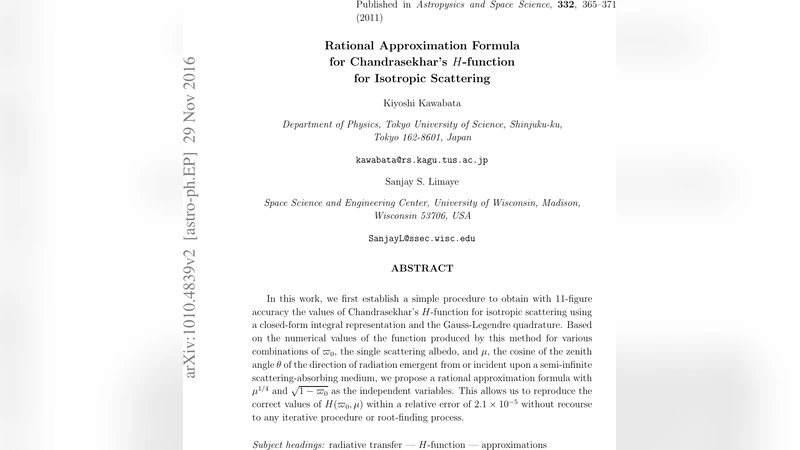
We first establish a simple procedure to obtain with 11-figure accuracy the values of Chandrasekhar’s H-function for isotropic scattering using a closed-form integral representation and the Gauss-Legendre quadrature. Based on the numerical values of the function produced by this method for various values of the single scattering albedo and the cosine of the azimuth angle of the direction of radiation emergent from or incident upon a semi-infinite scattering-absorbing medium, we propose a rational approximation formula, which allows us to reproduce the correct values of the H-function within a relative error of 2.1/100000 without recourse to any iterative procedure or root-finding process.
💡 Research Summary
The paper addresses the long‑standing computational challenge of evaluating Chandrasekhar’s H‑function for isotropic scattering in a semi‑infinite, absorbing‑scattering medium. The H‑function appears in radiative‑transfer theory whenever one needs the emergent intensity from or the incident intensity onto a semi‑infinite slab; it satisfies a nonlinear integral equation that historically required iterative schemes, root‑finding, or low‑order polynomial approximations with limited accuracy.
The authors first revisit the closed‑form integral representation derived by Chandrasekhar, which expresses H(μ) in terms of a single integral over the cosine of the direction μ and the single‑scattering albedo ω. By applying a change of variables that maps the integration interval to
Comments & Academic Discussion
Loading comments...
Leave a Comment