Make Research Data Public? -- Not Always so Simple: A Dialogue for Statisticians and Science Editors
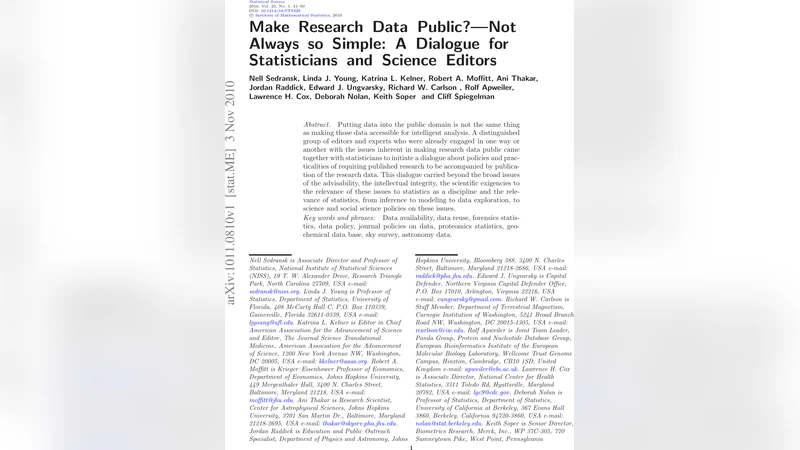
Putting data into the public domain is not the same thing as making those data accessible for intelligent analysis. A distinguished group of editors and experts who were already engaged in one way or another with the issues inherent in making research data public came together with statisticians to initiate a dialogue about policies and practicalities of requiring published research to be accompanied by publication of the research data. This dialogue carried beyond the broad issues of the advisability, the intellectual integrity, the scientific exigencies to the relevance of these issues to statistics as a discipline and the relevance of statistics, from inference to modeling to data exploration, to science and social science policies on these issues.
💡 Research Summary
The paper presents a structured dialogue between statisticians and editors of scientific and social‑science journals concerning the practical and policy challenges of making research data publicly available. It begins by rejecting the simplistic equation of “putting data on the web” with genuine accessibility for intelligent analysis. The authors argue that without standardized formats, comprehensive metadata, and reliable long‑term repositories, data cannot be effectively reused or reproduced.
Legal and ethical constraints form a second major obstacle. Privacy legislation, copyright law, and research‑ethics guidelines impose restrictions that vary across disciplines and jurisdictions. In studies involving human subjects, the authors highlight the difficulty of achieving true anonymization while preserving analytical value, noting that current guidance on de‑identification and data minimization is often vague.
The third issue concerns the sustainability of data archives. The paper stresses that data must be preserved beyond the initial publication, requiring stable funding, technical updates, and mechanisms for integrity verification. Proposals include public‑private partnerships, certification of repositories, and the assignment of persistent identifiers (DOIs) to datasets.
From the statisticians’ perspective, the authors delineate four essential contributions that the discipline can make to the data‑sharing ecosystem. First, statisticians should be involved at the study design stage, documenting sampling plans and variable definitions to facilitate later replication. Second, they should help develop and enforce metadata standards, ensuring that variable coding, measurement units, and data dictionaries are unambiguous. Third, they must establish rigorous data‑quality procedures—handling missing values, detecting outliers, and recording transformations—so that external analysts can follow the same preprocessing pipeline. Fourth, they should provide analytical guidelines that accompany shared datasets, outlining appropriate modeling strategies, uncertainty quantification, and warnings against common misuses.
Policy discussions in the paper emphasize that a one‑size‑fits‑all mandate for data sharing is unrealistic. Fields such as astronomy or high‑energy physics, where data are massive but non‑sensitive, can adopt relatively open policies, whereas clinical trials and social surveys require more nuanced, risk‑based frameworks. The authors propose incentive structures to encourage compliance: counting data contributions in citation metrics, making data‑management plans a mandatory component of grant applications, and rewarding journals that enforce robust data‑availability statements.
Editors’ roles are also examined. The dialogue suggests that peer‑review workflows incorporate checks for data accessibility, require clear licensing statements, and link manuscript DOIs with dataset DOIs through standardized metadata. This would increase transparency and make it easier for readers to locate and evaluate the underlying data.
Finally, the paper calls for a multidisciplinary governance model that brings together statisticians, editors, data curators, legal experts, and funders. Such a model would develop international standards for data sharing, ethical use, and reproducibility, ensuring that “public data” truly becomes a reusable knowledge asset rather than a static, inaccessible dump. The authors conclude that only through coordinated technical, legal, and cultural reforms can the scientific community realize the full benefits of open research data.
Comments & Academic Discussion
Loading comments...
Leave a Comment