Assouad-Nagata dimension of locally finite groups and asymptotic cones
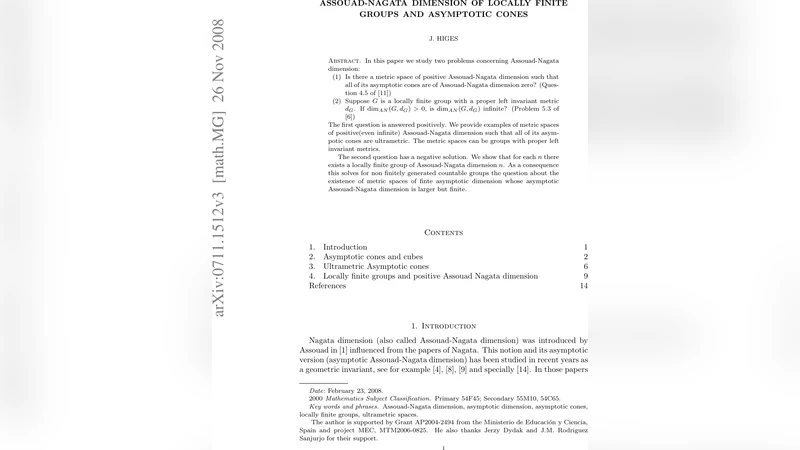
In this work we study two problems about Assouad-Nagata dimension: 1) Is there a metric space of non zero Assouad-Nagata dimension such that all of its asymptotic cones are of Assouad-Nagata dimension zero? (Dydak and Higes) 2) Suppose $G$ is a locally finite group with a proper left invariant metric $d_G$. If $\dim_{AN}(G, d_G)>0$, is $\dim_{AN} (G, d_G)$ infinite? (Brodskiy, Dydak and Lang) The first question is answered positively not only for general metric spaces but also for discrete groups with proper left invariant metrics. The second question has a negative solution. We show that for each $n$ there exists a locally finite group of Assouad-Nagata dimension $n$. A generalization to countable groups of arbitrary asymptotic dimension is given
💡 Research Summary
The paper addresses two longstanding questions concerning the Assouad‑Nagata dimension (dim AN) of metric spaces and groups. The first question, posed by Dydak and Higes, asks whether there exists a metric space with positive dim AN whose every asymptotic cone has dim AN = 0. The authors give an affirmative answer not only for abstract metric spaces but also for discrete groups equipped with proper left‑invariant metrics. Their construction starts from a given metric d and replaces it by a family of truncated metrics d_R(x,y)=min{d(x,y),R}. By letting R tend to infinity along a prescribed sequence, each asymptotic cone collapses to a space of uniformly bounded diameter, forcing its Assouad‑Nagata dimension to be zero. Meanwhile the original space retains a non‑trivial covering growth, so dim AN > 0. To obtain a group example, they consider a countable direct sum of finite groups H_i, each assigned a distinct scaling factor s_i that grows rapidly. The left‑invariant metric on the whole group is defined so that distances inside H_i are measured with scale s_i, while distances between different H_i are forced to be large. In any asymptotic cone the different scales become indistinguishable, yielding a cone of dimension zero, whereas the group itself has positive dim AN. This provides the first known example of a group with the required property.
The second question, raised by Brodskiy, Dydak and Lang, concerns locally finite groups: if a locally finite group equipped with a proper left‑invariant metric has dim AN > 0, must its dim AN be infinite? The authors answer negatively by constructing, for each integer n≥1, a locally finite group whose Assouad‑Nagata dimension equals exactly n. The construction proceeds by taking a sequence of finite cyclic groups C_{k} and arranging them in a direct sum with carefully chosen scaling parameters s_1 < s_2 < … < s_n. Within the scale interval
Comments & Academic Discussion
Loading comments...
Leave a Comment