Making the long code shorter, with applications to the Unique Games Conjecture
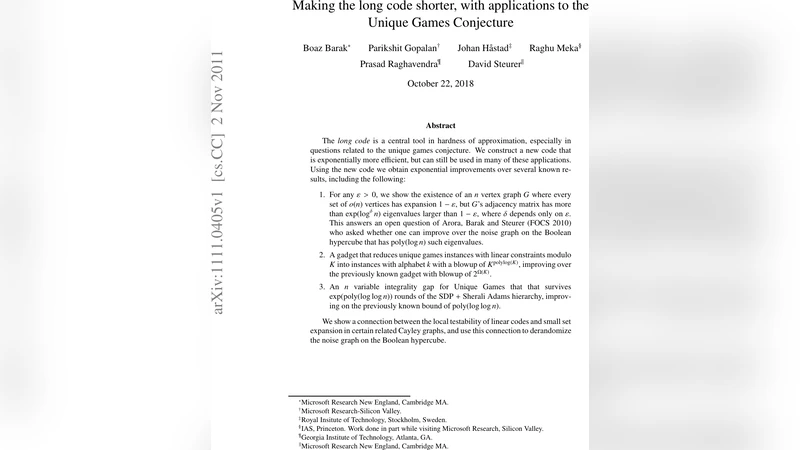
The long code is a central tool in hardness of approximation, especially in questions related to the unique games conjecture. We construct a new code that is exponentially more efficient, but can still be used in many of these applications. Using the new code we obtain exponential improvements over several known results, including the following: 1. For any eps > 0, we show the existence of an n vertex graph G where every set of o(n) vertices has expansion 1 - eps, but G’s adjacency matrix has more than exp(log^delta n) eigenvalues larger than 1 - eps, where delta depends only on eps. This answers an open question of Arora, Barak and Steurer (FOCS 2010) who asked whether one can improve over the noise graph on the Boolean hypercube that has poly(log n) such eigenvalues. 2. A gadget that reduces unique games instances with linear constraints modulo K into instances with alphabet k with a blowup of K^polylog(K), improving over the previously known gadget with blowup of 2^K. 3. An n variable integrality gap for Unique Games that that survives exp(poly(log log n)) rounds of the SDP + Sherali Adams hierarchy, improving on the previously known bound of poly(log log n). We show a connection between the local testability of linear codes and small set expansion in certain related Cayley graphs, and use this connection to derandomize the noise graph on the Boolean hypercube.
💡 Research Summary
The paper introduces a new coding scheme called the “short code” that dramatically reduces the size and dimension of the traditional long code while preserving the essential analytical properties needed for hardness of approximation results, especially those related to the Unique Games Conjecture (UGC).
The long code encodes an n‑bit string x by the truth table of every Boolean function on {0,1}ⁿ, yielding a vector of length 2^{2ⁿ}. This exponential blow‑up makes many reductions and integrality‑gap constructions inefficient. The authors define the d‑short code for a constant d as the evaluation vector of all degree‑≤ d multilinear polynomials over {0,1}ⁿ. For d = 1 the short code coincides with the Hadamard code; for d = n it becomes the long code. Since the number of degree‑≤ d polynomials is Θ(2ⁿ·n^{O(d)}), the short code’s length is only quasipolynomial in n, a huge improvement over the exponential length of the long code.
A central technical contribution is a “derandomized noisy cube”. The classical noisy hypercube H_{N,ε} has vertices {0,1}ᴺ and edges defined by flipping each bit independently with probability ε. Its top eigenvectors are exactly the long‑code words, and the Majority‑is‑Stablest theorem connects these eigenvectors to optimal cuts. By exploiting the local testability of Reed–Muller codes, the authors construct a small subgraph of the noisy cube whose vertex set corresponds to the short code. This subgraph retains the same spectral profile: it has many eigenvalues at least 1 − ε, yet its size is only n·polylog n rather than 2ⁿ.
Using this derandomized object the authors obtain three major applications.
-
Small‑Set Expanders with Many Large Eigenvalues (Theorem 1).
For any ε > 0 they build an n‑vertex graph G such that every set of o(n) vertices expands by at least 1 − ε, while the adjacency matrix of G possesses exp((log n)^δ) eigenvalues ≥ 1 − ε (δ depends only on ε). This resolves an open question of Arora, Barak, and Steurer, who previously only knew of poly(log n) such eigenvalues via the standard noisy cube. -
Efficient Alphabet‑Reduction Gadget (Theorem 4).
KKMO04 used the long code to reduce a Unique Games instance with alphabet size K to a binary alphabet, incurring a 2^K blow‑up. Replacing the long code with the short code yields a reduction from linear‑mod‑K constraints to an alphabet of size k ≈ log K with only K^{polylog K} blow‑up. The reduction works for instances whose constraints are affine permutations over the alphabet, a class sufficient for many applications. -
Strong Integrality Gaps for SDP Hierarchies (Theorems 2 and 3).
Prior integrality‑gap constructions survived only poly(log log n) rounds of the Sherali‑Adams (SA) hierarchy. The short‑code based construction yields an n‑variable Unique Games instance whose basic SDP value is 1 − 1/qpoly(log n) while the true optimum is o(1). Moreover, the instance resists qpoly(log n) rounds of the SA hierarchy and qqpoly(n) rounds of the stronger LH hierarchy, dramatically strengthening known lower bounds.
The underlying theoretical bridge is a connection between locally testable codes and small‑set expansion. Reed–Muller codes exhibit subspace hyper‑contractivity, which translates into the statement that any small subset of the associated Cayley graph has large edge boundary. This property directly yields the abundance of large eigenvalues in the derandomized noisy cube. The authors formalize this link for general locally testable codes and then instantiate it with Reed–Muller to obtain concrete graphs.
In summary, the short code provides a compact, efficiently testable replacement for the long code, enabling exponential improvements in several cornerstone results related to the Unique Games Conjecture: (i) construction of small‑set expanders with many large eigenvalues, (ii) a quasi‑polynomial‑blow‑up alphabet‑reduction gadget, and (iii) integrality‑gap instances that survive super‑polynomial rounds of SDP hierarchies. The work not only advances the state of hardness of approximation but also suggests a new “inner PCP” paradigm for attacking the UGC, where one first proves hardness for large alphabets and then applies the efficient reduction to obtain hardness for small alphabets. Future directions include extending the approach to non‑affine constraints and strengthening the results to the Lasserre hierarchy.
Comments & Academic Discussion
Loading comments...
Leave a Comment