On Tannaka Duality
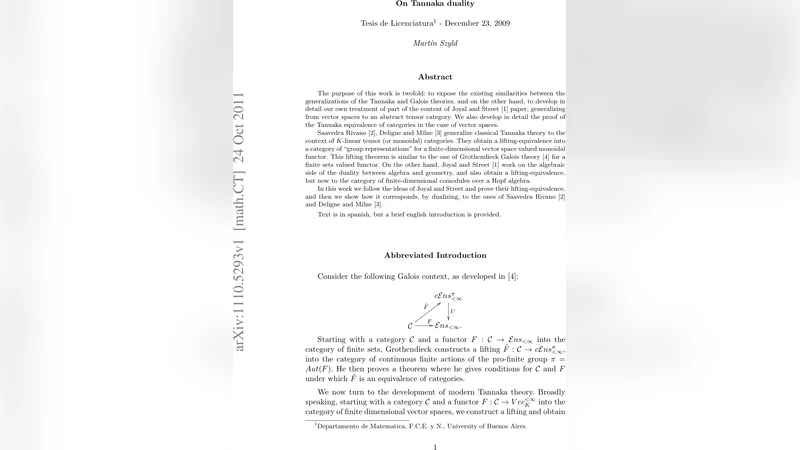
The purpose of this work is twofold: to expose the existing similarities between the generalizations of the Tannaka and Galois theories, and on the other hand, to develop in detail our own treatment of part of the content of Joyal and Street [1] paper, generalizing from vector spaces to an abstract tensor category. We also develop in detail the proof of the Tannaka equivalence of categories in the case of vector spaces. Saavedra Rivano [2], Deligne and Milne [3] generalize classical Tannaka theory to the context of K-linear tensor (or monoidal) categories. They obtain a lifting-equivalence into a category of \group representations" for a finite-dimensional vector space valued monoidal functor. This lifting theorem is similar to the one of Grothendieck Galois theory [4] for a finite sets valued functor. On the other hand, Joyal and Street [1] work on the algebraic side of the duality between algebra and geometry, and also obtain a lifting-equivalence, but now to the category of finite-dimensional comodules over a Hopf algebra. In this work we follow the ideas of Joyal and Street and prove their lifting-equivalence, and then we show how it corresponds, by dualizing, to the ones of Saavedra Rivano [2] and Deligne and Milne [3]. Text is in spanish, but a brief english introduction is provided.
💡 Research Summary
The paper “On Tannaka Duality” presents a comprehensive study of the deep connections between modern generalizations of Tannaka duality and Grothendieck’s Galois theory. It begins by recalling Grothendieck’s categorical formulation of Galois theory: given a functor F:C→Ens<∞> into the category of finite sets, one constructs the profinite group π=Aut(F) and a lifted functor ˜F:C→cEns_π<∞> into the category of continuous finite actions of π. Grothendieck’s theorem provides conditions (cofiltering diagrams, “representable concrete” functors) under which ˜F is an equivalence of categories.
The author then surveys the classical Tannaka theory as extended by Saavedra Rivano and by Deligne–Milne. In that setting one works with a K‑linear tensor (monoidal) category 𝓥 and a tensor functor F:C→Vect<∞>_K. Under hypotheses such as C being abelian, F exact, faithful, and tensorial, one obtains a lifting of C into the category of representations of an algebraic group G (the Tannaka group), and this lifting is an equivalence.
The core contribution of the thesis is a detailed exposition of the Joyal–Street approach, generalized from vector spaces to an arbitrary closed symmetric (or even braided) tensor category 𝓥 with a small full subcategory 𝓥₀ of dualizable objects. For a tensor functor F:C→𝓥₀ the author defines the end Nat^∨(F,F) (the “predual” of natural transformations) and shows that it carries a natural coalgebra structure. By exploiting the 𝓥‑cocategory structure on functors C→𝓥, the coalgebra becomes a bialgebra, and under additional symmetry and rigidity assumptions it acquires an antipode, thus becoming a Hopf algebra End^∨(F).
The thesis then constructs the lifted functor ˜F:C→Comod₀(End^∨(F)) into the category of finite‑dimensional comodules over this Hopf algebra. When 𝓥=Vect_K, the Hopf algebra is finite‑dimensional, and its spectrum Spec(End^∨(F)) is a group object G that plays the role of the automorphism group Aut(F) in Galois theory. Consequently the lifting coincides with the classical Tannaka lifting into Rep₀(G), establishing a precise duality between Hopf‑comodule representations and group representations.
A notable methodological feature is the use of Dubuc’s “elevator calculus” to manage coherence issues in symmetric tensor categories, and the systematic employment of ends and coends to define objects such as Nat^∨(F,G) in a fully categorical way, avoiding element‑wise arguments. The final chapter translates the Hopf algebraic structure into a group‑object language, showing how the Tannaka equivalence can be expressed in the “geometric Galois language.” The main theorem (9.10) states:
Let C be a tensor category with right duals, 𝓥 a symmetric cocomplete tensor category with internal Hom, 𝓥₀⊂𝓥 a full subcategory of dualizable objects, and F:C→𝓥₀ a tensor functor. Then there is a lifting Rep₀(G)≅C˜F where G=Spec(End^∨(F)) plays the role of the Galois group Aut(F). Moreover, when 𝓥=Vect_K, C is abelian and F is exact and faithful, the lifted functor is an equivalence of categories.
In summary, the work unifies two major strands of categorical duality: the Hopf‑algebraic formulation of Tannaka duality (Joyal–Street) and the group‑theoretic formulation of Grothendieck’s Galois theory. By providing explicit constructions, detailed proofs, and a clear translation between the two languages, the thesis offers a valuable reference for researchers interested in the interplay between algebraic geometry, representation theory, and higher‑category theory.
Comments & Academic Discussion
Loading comments...
Leave a Comment