Sufficient Conditions for Recognizing a 3-manifold Group
In this work we ask when a group is a 3-manifold group, or more specifically, when does a group presentation come naturally from a Heegaard diagram for a 3-manifold? We will give some conditions for partial answers to this form of the Isomorphism Problem by addressing how the presentation associated to a diagram for a splitting is related to the fundamental group of a 3-manifold. In the process, we determine an invariant of groups (by way of group presentations) for how far such presentations are from 3-manifolds.
💡 Research Summary
The paper tackles the longstanding problem of recognizing when a finitely presented group actually arises as the fundamental group of a closed, orientable 3‑manifold. The authors adopt the viewpoint of Heegaard diagrams: a diagram D = (S; X, Y) consists of a closed oriented surface S together with two collections of curves X and Y in general position. From such a diagram one can construct both a 3‑manifold M(D) (by attaching 2‑handles along X and Y and capping off resulting 2‑sphere boundaries) and a group presentation P(D) (generators correspond to components of X, relators are read off by traversing each component of Y and recording the sequence of generators with signs given by crossing orientation).
The first major result (Theorem 3.1) identifies a sufficient topological condition under which the presentation P(D) indeed presents the fundamental group of the associated manifold: if the complement S − X is connected and planar (i.e., it embeds in the plane as a graph), then |P(D)| ≅ π₁(M(D)). The proof rests on the observation that in this situation the “superfluous” curves—components of X or Y that bound planar regions—can be removed without altering the fundamental group, and the remaining diagram yields a standard Heegaard splitting whose algebraic data matches the presentation.
Having established a forward direction, the authors turn to the inverse problem: given a finite presentation P, can one decide whether there exists a diagram D with P(D) = P and, consequently, whether |P| is a 3‑manifold group? They show that a naïve algorithmic solution is impossible in general (Theorem 1.1). The undecidability follows from Rabin’s 1958 result on the non‑recursiveness of certain group properties and a theorem of Hempel–Jaco (1972) stating that a 3‑manifold group is a direct product of a surface group and ℤ only in trivial cases. By constructing a fixed 3‑manifold group Q (neither a surface group nor ℤ) and considering Q × P, they reduce the triviality problem for arbitrary P to the 3‑manifold‑group decision problem, contradicting Rabin’s theorem.
Despite this global negative result, the paper provides a constructive, recursively enumerable test for a large subclass of presentations. The key tools are:
-
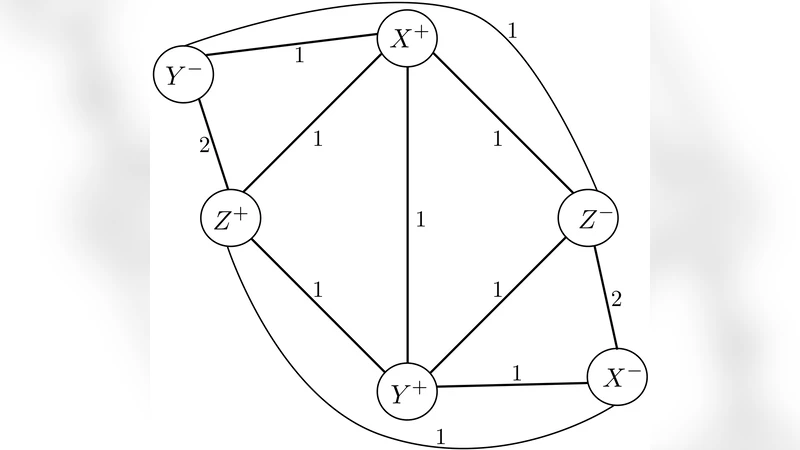
Whitehead Graph WΓ(P). Vertices correspond to each generator x_i with a “+” and “–” copy; edges are placed according to the cyclic order of letters in each relator. The graph encodes how generators appear consecutively in the relations.
-
Switch‑back detection. A switch‑back is a configuration in the graph that cannot arise from any Heegaard diagram; its presence certifies that P cannot be a 3‑manifold presentation.
-
Degree comparison. The algebraic degree deg_A(P) (sum of relator lengths) must equal the geometric degree deg_G(D) (number of X–Y intersections) for any diagram D yielding P.
If a presentation passes the switch‑back test, has matching degrees, and its Whitehead graph is planar (or, more generally, can be realized as the dual of a planar embedding of S − X), then it belongs to the recursively enumerable set described in Theorem 4.7. The authors outline an algorithm: enumerate all possible diagrams of bounded degree, compute the associated presentations, and compare them with the given P. Although the algorithm is brute‑force and its complexity is not analyzed, it guarantees that every “good” presentation will eventually be recognized.
A particularly satisfying specialization is the case of 2‑generator groups. Theorem 4.22 shows that for presentations with exactly two generators, the Whitehead graph reduces to a pair of vertices with multiple edges, and the planarity condition is automatically satisfied. Consequently, the problem is completely solved for this class: a 2‑generator presentation presents a 3‑manifold group if and only if it satisfies the elementary algebraic conditions (no switch‑back, matching degrees).
The paper also discusses the non‑uniqueness of the diagram‑to‑presentation map. For a fixed presentation P there is a finite family of diagrams of a given degree d (denoted
Comments & Academic Discussion
Loading comments...
Leave a Comment