Gendered Conversation in a Social Game-Streaming Platform
Online social media and games are increasingly replacing offline social activities. Social media is now an indispensable mode of communication; online gaming is not only a genuine social activity but also a popular spectator sport. With support for anonymity and larger audiences, online interaction shrinks social and geographical barriers. Despite such benefits, social disparities such as gender inequality persist in online social media. In particular, online gaming communities have been criticized for persistent gender disparities and objectification. As gaming evolves into a social platform, persistence of gender disparity is a pressing question. Yet, there are few large-scale, systematic studies of gender inequality and objectification in social gaming platforms. Here we analyze more than one billion chat messages from Twitch, a social game-streaming platform, to study how the gender of streamers is associated with the nature of conversation. Using a combination of computational text analysis methods, we show that gendered conversation and objectification is prevalent in chats. Female streamers receive significantly more objectifying comments while male streamers receive more game-related comments. This difference is more pronounced for popular streamers. There also exists a large number of users who post only on female or male streams. Employing a neural vector-space embedding (paragraph vector) method, we analyze gendered chat messages and create prediction models that (i) identify the gender of streamers based on messages posted in the channel and (ii) identify the gender a viewer prefers to watch based on their chat messages. Our findings suggest that disparities in social game-streaming platforms is a nuanced phenomenon that involves the gender of streamers as well as those who produce gendered and game-related conversation.
💡 Research Summary
This paper presents a large-scale, computational analysis of gender inequality and objectification on Twitch, a leading social game-streaming platform. The core research investigates how the gender of streamers correlates with the nature of viewer conversations and explores whether viewers themselves exhibit gendered preferences in their platform behavior.
The study leverages a massive dataset comprising over 1.2 billion public chat messages from 927,247 channels over 76 days in 2014. To ensure a controlled comparison, the authors constructed a matched sample of 200 female and 200 male streamers. Streamer gender was manually identified via archived webcam feeds, and male streamers were specifically sampled to match the chat activity levels (total message count) of their female counterparts, controlling for the confounding effect of channel popularity on language use.
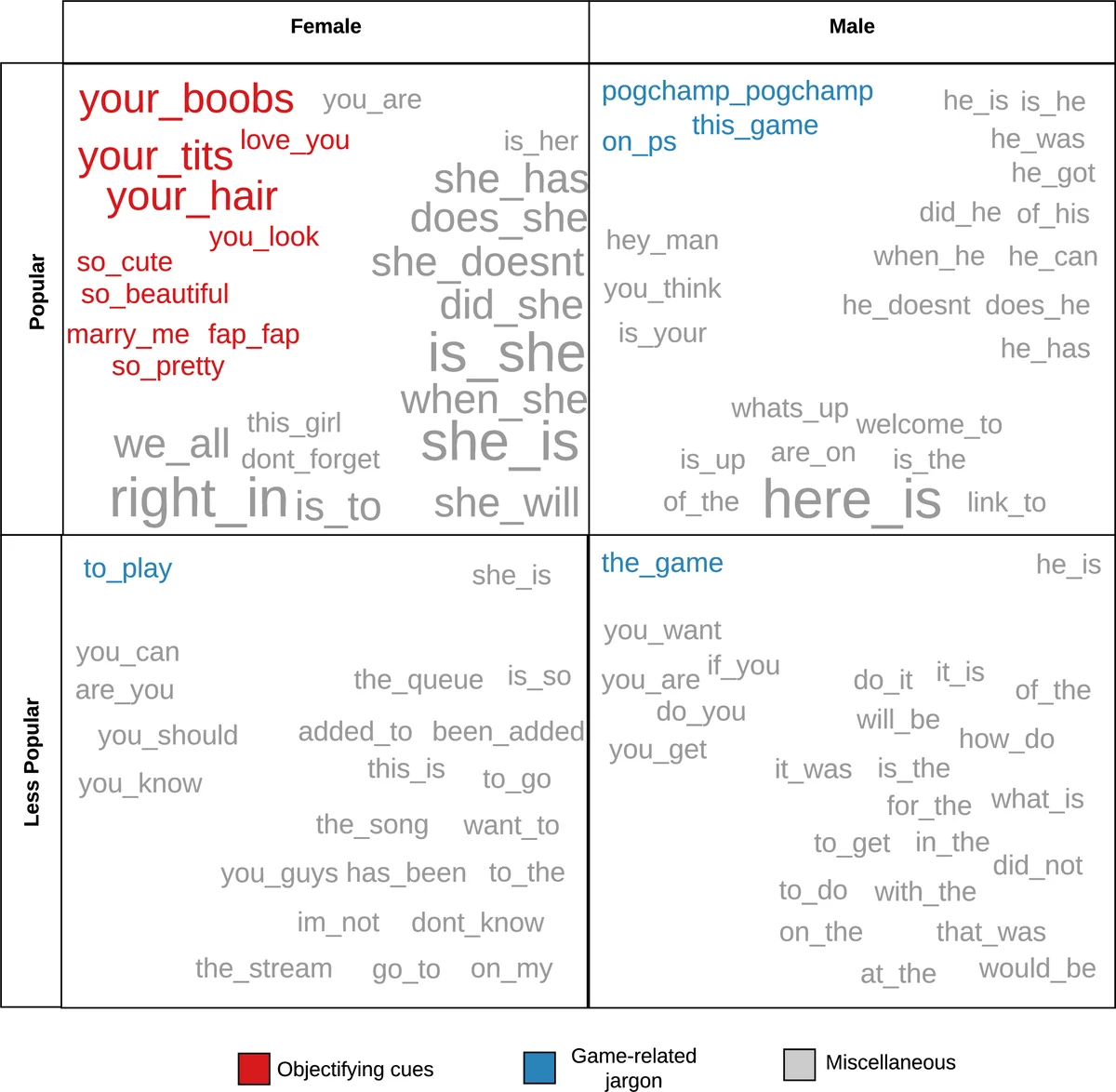
The analysis employs a two-pronged methodological approach. First, an exploratory language analysis using log-odds ratios with an informative Dirichlet prior identified words statistically overrepresented in chats directed at female versus male streamers. The results revealed a stark contrast, especially among popular channels. Chats in popular female streamers’ channels were characterized by objectifying language related to physical appearance (e.g., “cute,” “beautiful,” “boobs”), while chats in popular male streamers’ channels featured game-related jargon (e.g., “reset,” “shields,” “melee”). Interestingly, this pattern was less pronounced in less popular female channels, where social words like “hello” and “bye” were more prominent, suggesting community size and dynamics mediate the nature of gendered discourse.
Second, the researchers used a neural document embedding technique, the Paragraph Vector (Doc2Vec) model, to create semantic vector representations of entire channels (aggregating all chat messages) and individual users (aggregating all messages they posted). Visualizing these vectors using t-SNE showed clear clustering by streamer gender. A classifier using these Doc2Vec embeddings as features could predict a streamer’s gender based solely on their channel’s chat messages with 87% accuracy (AUC 0.93), significantly outperforming a traditional Bag-of-Words model. Furthermore, by training a similar model on user-level document vectors—where the label was the dominant gender of the channels a user participated in—the study successfully predicted a viewer’s gender-based channel preference from their own chat history. This finding crucially demonstrates that gendered discourse is not merely directed at streamers but is also produced by distinct communities of viewers who selectively engage with streams based on gender.
The study concludes that gender disparity on social game-streaming platforms is a nuanced, multi-actor phenomenon. It involves not only the gender of the streamer receiving objectifying or game-focused comments but also the active role of viewers who gravitate towards and help perpetuate gendered conversational norms within specific channels. The work highlights that as online gaming evolves into a dominant social and spectator platform, understanding and addressing these ingrained biases is critically important due to their potential to shape perceptions and reinforce inequalities beyond the digital realm.
Comments & Academic Discussion
Loading comments...
Leave a Comment