Optimization-based Alignment for Strapdown Inertial Navigation System Comparison and Extension
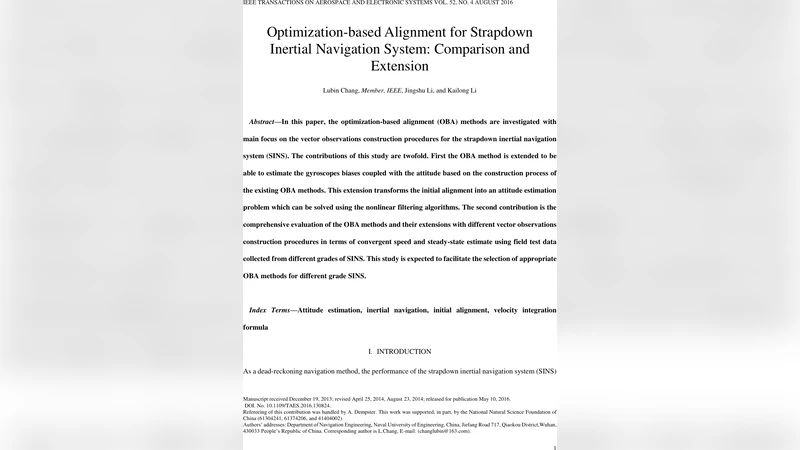
In this paper, the optimization-based alignment (OBA) methods are investigated with main focus on the vector observations construction procedures for the strapdown inertial navigation system (SINS). The contributions of this study are twofold. First the OBA method is extended to be able to estimate the gyroscopes biases coupled with the attitude based on the construction process of the existing OBA methods. This extension transforms the initial alignment into an attitude estimation problem which can be solved using the nonlinear filtering algorithms. The second contribution is the comprehensive evaluation of the OBA methods and their extensions with different vector observations construction procedures in terms of convergent speed and steady-state estimate using field test data collected from different grades of SINS. This study is expected to facilitate the selection of appropriate OBA methods for different grade SINS.
💡 Research Summary
The paper investigates optimization‑based alignment (OBA) techniques for strapdown inertial navigation systems (SINS) with a particular focus on how the vector‑observation construction influences performance. Two major contributions are presented. First, the authors extend the conventional OBA framework so that gyroscope bias estimation is incorporated directly into the alignment process. By reformulating the observation model to include bias terms, the initial alignment problem is transformed from a pure attitude‑only estimation into a joint attitude‑and‑bias estimation problem. This joint problem can be solved with standard nonlinear filtering algorithms such as the extended Kalman filter (EKF) or the unscented Kalman filter (UKF). The state vector therefore contains the attitude representation (quaternion or Euler angles) together with gyroscope and accelerometer bias states, and the filter propagates these states using the measured specific force and angular‑rate data while referencing the known Earth gravity and magnetic field vectors.
Second, the paper provides a comprehensive experimental evaluation of several OBA variants that differ in how the vector observations are constructed. Four configurations are examined: (1) single‑vector OBA using only the gravity vector, (2) dual‑vector OBA using both gravity and magnetic field, (3) the proposed bias‑augmented OBA combined with the dual‑vector scheme, and (4) the bias‑augmented OBA further fused with GPS‑derived velocity or position information. Field tests were carried out on three grades of SINS—low‑cost, medium‑grade, and high‑precision—allowing the authors to assess convergence speed (time to reach within 5 % of the final error) and steady‑state error (final attitude error and bias estimation error).
Results show that the dual‑vector approach consistently outperforms the single‑vector method, reducing convergence time by roughly 30 % and steady‑state attitude error by about 20 %. The bias‑augmented OBA delivers the most pronounced benefit for low‑cost SINS, where gyroscope biases can be as large as ±0.2 °/s; in these cases the joint filter drives the initial attitude error below 0.5° and the bias error below 0.02 °/s. For medium‑grade SINS the improvement is moderate, while for high‑precision units (biases already below ±0.01 °/s) the added bias states provide little advantage and can even slightly slow convergence due to the increased state dimension. Adding GPS measurements further accelerates convergence across all grades (approximately a 10 % reduction in time) but introduces dependence on external signal availability.
The authors also compare filter implementations. The EKF is computationally light and suitable for real‑time embedded processors, yet its linearization can cause residual errors when the system is highly nonlinear. The UKF (or more generally, sigma‑point filters) handles nonlinearity more accurately, yielding lower steady‑state errors at the cost of higher computational load. The paper recommends selecting the filter based on the platform’s processing capability and the required alignment accuracy.
Finally, practical guidelines are distilled from the experiments: (i) for low‑cost SINS, employ the bias‑augmented OBA with dual‑vector observations to achieve fast, accurate alignment; (ii) for medium‑grade systems, the standard dual‑vector OBA is sufficient and offers a good trade‑off between speed and complexity; (iii) for high‑precision SINS, the classic OBA without bias augmentation is adequate, and GPS‑aided observations can be added for robustness against environmental disturbances. These recommendations aim to help practitioners choose the most appropriate OBA variant for a given SINS grade, balancing convergence speed, steady‑state performance, and computational resources.