A photonic thermalization gap in disordered lattices
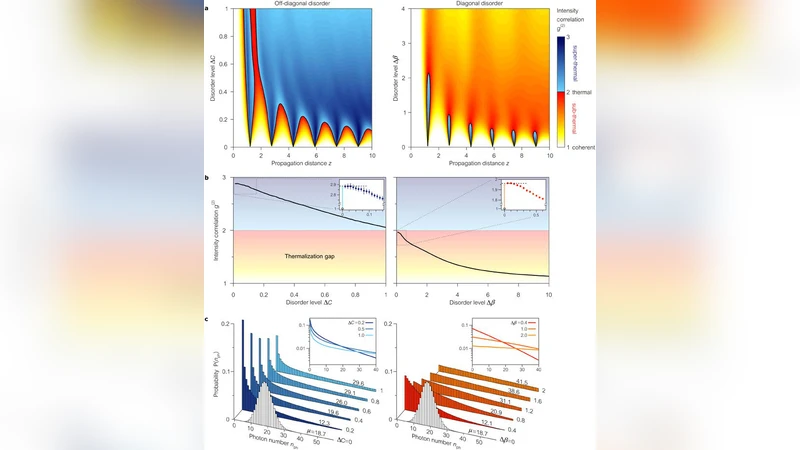
The formation of gaps – forbidden ranges in the values of a physical parameter – is a ubiquitous feature of a variety of physical systems: from energy bandgaps of electrons in periodic lattices and their analogs in photonic, phononic, and plasmonic systems to pseudo energy gaps in aperiodic quasicrystals. Here, we report on a thermalization' gap for light propagating in finite disordered structures characterized by disorder-immune chiral symmetry -- the appearance of the eigenvalues and eigenvectors in skew-symmetric pairs. In this class of systems, the span of sub- thermal photon statistics is inaccessible to input coherent light, which -- once the steady state is reached -- always emerges with super-thermal statistics no matter how small the disorder level. We formulate an independent constraint that must be satisfied by the input field for the chiral symmetry to be activated’ and the gap to be observed. This unique feature enables a new form of photon-statistics interferometry: the deterministic tuning of photon statistics – from sub-thermal to super-thermal – in a compact device, without changing the disorder level, via controlled excitation-symmetry-breaking realized by sculpting the amplitude or phase of the input coherent field.
💡 Research Summary
The paper reports the discovery of a “thermalization gap” for light propagating through finite disordered photonic lattices that possess disorder‑immune chiral symmetry. In such systems the Hamiltonian satisfies a chiral (or sub‑lattice) symmetry, meaning that for every eigenvalue λ there exists a partner –λ and the corresponding eigenvectors appear in skew‑symmetric pairs. This symmetry is robust against any amount of on‑site disorder, so the spectral properties of the lattice remain chiral even when the refractive index is randomly perturbed.
The authors first formulate the precise condition under which the chiral symmetry is “activated” by the input field. The input electric‑field vector must respect the same skew‑symmetric pairing as the lattice modes: the field amplitude on any site i must be equal (up to a global phase factor) to the amplitude on its chiral partner j. When this symmetry‑matched excitation is satisfied, the evolution operator U(z)=exp(iHz) mixes the ±λ mode pairs completely, and after a propagation distance long compared with the transport mean free path the photon‑number statistics converge to a Bose‑Einstein distribution. Consequently the second‑order intensity correlation g^(2) is always larger than 2, i.e., the light is super‑thermal, regardless of how weak the disorder is. The key point is that the gap is not an energy gap but a forbidden range of photon‑statistics: sub‑thermal values (g^(2)<2) cannot be reached from a coherent input under symmetry‑matched conditions.
If the input field deliberately breaks the chiral pairing—by sculpting the amplitude or phase so that the site‑pair symmetry is violated—the chiral symmetry is effectively de‑activated. In this case the mode mixing is incomplete, and the steady‑state photon statistics can be tuned continuously from sub‑thermal (g^(2)<2) through the coherent limit (g^(2)=1) up to the super‑thermal regime. The authors demonstrate this deterministic control experimentally using a 1‑D disordered waveguide array fabricated in glass fiber, with the disorder introduced by random variations of the refractive index. A spatial‑light modulator shapes the input coherent beam, allowing precise control of the relative phase and amplitude on each waveguide. By varying the phase offset between symmetry‑related sites, they observe g^(2) values ranging from ~1.2 (sub‑thermal) to ~3.5 (strongly super‑thermal). Numerical simulations confirm that the thermalization gap persists for different disorder statistics (Gaussian, uniform, Lévy) and for lattice lengths exceeding roughly 20–30 coupling lengths, indicating that the effect is robust and not an artifact of a particular disorder model.
The paper positions this phenomenon as a new paradigm for photon‑statistics interferometry. Traditional methods to modify photon statistics rely on nonlinear media, gain/loss engineering, or quantum state preparation. Here, the statistics are governed solely by the symmetry of the underlying linear system and the symmetry properties of the input field. This enables ultra‑compact devices that can switch between sub‑thermal and super‑thermal light without altering the physical disorder, simply by re‑programming the input wavefront. Potential applications include low‑noise optical communication (where sub‑thermal statistics reduce intensity fluctuations), on‑chip quantum‑optics platforms that require deterministic photon‑bunching control, and novel information‑encoding schemes that exploit the statistical degree of freedom as an additional channel. The authors also suggest that extending the concept to higher‑dimensional lattices, topological photonic structures, or hybrid light‑matter systems could further enrich the toolbox for controlling light beyond amplitude and phase, opening avenues for statistical‑engineered photonics.
Comments & Academic Discussion
Loading comments...
Leave a Comment