Completely reducible sets
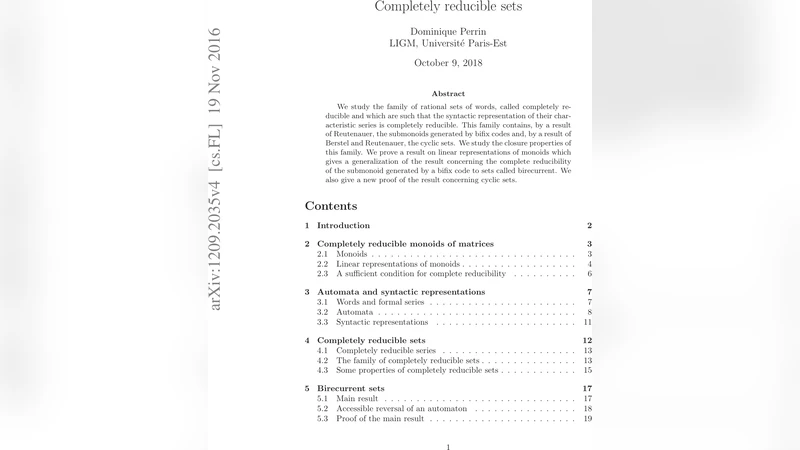
We study the family of rational sets of words, called completely reducible and which are such that the syntactic representation of their characteristic series is completely reducible. This family contains, by a result of Reutenauer, the submonoids generated by bifix codes and, by a result of Berstel and Reutenauer, the cyclic sets. We study the closure properties of this family. We prove a result on linear representations of monoids which gives a generalization of the result concerning the complete reducibility of the submonoid generated by a bifix code to sets called birecurrent. We also give a new proof of the result concerning cyclic sets.
💡 Research Summary
The paper investigates a class of rational languages—called completely reducible sets—characterized by the property that the syntactic representation of their characteristic series decomposes into a direct sum of irreducible components. Formally, for a language (X\subseteq A^{*}) over a finite alphabet (A), the characteristic series (\underline{X}) is an element of the formal power series ring (\mathbb{K}\langle!\langle A\rangle!\rangle) (with (\mathbb{K}) a field). The syntactic algebra (\mathcal{S}(X)) is the quotient of the free algebra (\mathbb{K}\langle A\rangle) by the two‑sided ideal that annihilates (\underline{X}). The language is said to be completely reducible if the natural representation (\rho_{X}:\mathcal{S}(X)\rightarrow \operatorname{End}(V)) (where (V) is the minimal linear representation of (\underline{X})) is completely reducible, i.e. every invariant subspace admits a complementary invariant subspace.
The authors first recall two known families that belong to this class. Reutenauer proved that the submonoid generated by a bifix code (a set of words that is simultaneously a prefix and a suffix code) yields a completely reducible syntactic representation. Berstel and Reutenauer later showed that cyclic sets—languages closed under cyclic rotations of words—also enjoy this property. Both results were proved by ad‑hoc arguments that relied heavily on the specific combinatorial structure of the respective languages.
The central contribution of the paper is a unifying algebraic framework that extends these isolated results to a broader family, called birecurrent sets. A set (X) is birecurrent if both the left and right actions of the free monoid (A^{*}) on the minimal automaton of (X) are recurrent, i.e. each state can be reached from any other state by a word on the left and also on the right. This condition translates into a property of the transition monoid (M_{X}): it is a finite monoid whose regular (\mathcal{J})‑classes are groups and whose idempotents generate a submonoid acting transitively on the state set.
The paper proves a general theorem about linear representations of finite monoids:
Theorem (Monoid Representation Decomposition).
Let (M) be a finite monoid and (\rho:M\rightarrow\operatorname{End}(V)) a finite‑dimensional representation over a field (\mathbb{K}). If the regular (\mathcal{J})‑classes of (M) are groups and the idempotent generated submonoid acts transitively on the minimal invariant subspaces, then (\rho) is completely reducible; equivalently, (V) decomposes as a direct sum of irreducible (M)‑submodules.
Applying this theorem to the transition monoid of a birecurrent set yields that the syntactic representation of any birecurrent language is completely reducible. Consequently, the class of completely reducible sets contains all submonoids generated by bifix codes (since such submonoids are birecurrent) and, more importantly, all birecurrent languages, which is a strict superset of the previously known families.
The authors then revisit cyclic sets with this new machinery. They show that the transition monoid of a cyclic set is isomorphic to a cyclic group algebra, which satisfies the hypotheses of the monoid decomposition theorem. Hence the syntactic representation of a cyclic set is completely reducible, providing a concise proof that bypasses the intricate combinatorial arguments of earlier works.
Beyond the core structural results, the paper studies closure properties of the completely reducible class. It is proved that the class is closed under finite unions, intersections, complement, inverse homomorphisms, and under the standard regular operations of prefix, suffix, and factor extraction. These closure results are derived by showing that the corresponding operations on syntactic algebras preserve the complete reducibility of the associated representations.
The final section outlines several directions for future research. One line of inquiry is the classification of completely reducible languages via the structure of their syntactic algebras, possibly leading to a “Jordan–Hölder” type theorem for rational languages. Another promising avenue is the extension of the notion to non‑rational (context‑free or even context‑sensitive) languages, investigating whether analogous representation‑theoretic criteria can be formulated. The authors also suggest algorithmic applications: because completely reducible representations can be efficiently decomposed, decision problems such as membership, equivalence, or minimization may admit more efficient solutions for this subclass.
In summary, the paper provides a unifying algebraic perspective on a family of rational languages whose syntactic representations are completely reducible. By introducing birecurrent sets and proving a general monoid representation theorem, it subsumes earlier results on bifix‑code generated submonoids and cyclic sets, establishes robust closure properties, and opens a pathway toward deeper structural and algorithmic investigations in formal language theory.
Comments & Academic Discussion
Loading comments...
Leave a Comment