Accelerate Single-shot Data Acquisitions Using Compressed Sensing and FRONSAC Imaging
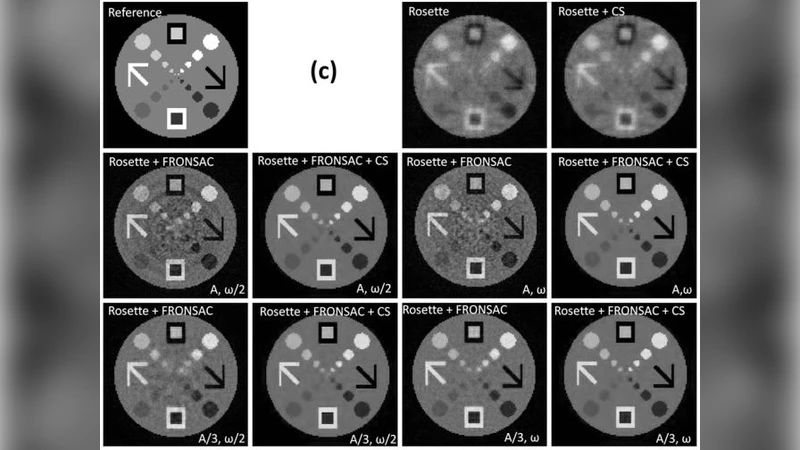
Nonlinear spatial encoding magnetic (SEM) fields have been studied to complement multichannel RF encoding and accelerate MRI scans. Published schemes include PatLoc, O-Space, Null Space, 4D-RIO, and others, but the large variety of possible approaches to exploiting nonlinear SEMs remains mostly unexplored. Before, we have presented a new approach, Fast ROtary Nonlinear Spatial ACquisition (FRONSAC) imaging, where the nonlinear fields provide a small rotating perturbation to standard linear trajectories. While FRONSAC encoding greatly improves image quality, at the highest accelerations or weakest FRONSAC fields, some undersampling artifacts remain. However, the under-sampling artifacts that occur with FRONSAC encoding are relatively incoherent and well suited to the compressed sensing (CS) reconstruction. CS provides a sparsity-promoting convex strategy to reconstruct images from highly undersampled datasets. The work presented here combines the benefits of FRONSAC and CS. Simulations illustrate that this combination can further improve image reconstruction with FRONSAC gradients of low amplitudes and frequencies.
💡 Research Summary
The paper presents a novel strategy for accelerating single‑shot magnetic resonance imaging (MRI) by synergistically combining Fast Rotary Nonlinear Spatial Acquisition (FRONSAC) with compressed sensing (CS). FRONSAC, previously introduced by the authors, superimposes a low‑amplitude, low‑frequency rotating nonlinear spatial encoding magnetic (SEM) field onto conventional linear k‑space trajectories. This rotating perturbation causes each sampled point to experience a distinct nonlinear phase modulation, effectively spreading high‑frequency information across k‑space in a pseudo‑random manner. While FRONSAC alone markedly improves image quality compared with purely linear encoding, residual undersampling artifacts persist at very high acceleration factors (R ≥ 6) or when the FRONSAC field strength is weak.
The key insight of the current work is that the artifacts produced by FRONSAC are inherently incoherent with respect to the underlying image sparsity, making them ideally suited for CS reconstruction. CS exploits the fact that MR images are sparse or compressible in transform domains (e.g., wavelet, total variation) and recovers them from highly undersampled data by solving a convex ℓ₁‑norm minimization problem. Incoherence between the sampling operator and the sparsifying transform is a prerequisite for successful CS; the random‑like phase variations introduced by FRONSAC naturally satisfy this condition without the need for additional random sampling patterns.
To evaluate the combined approach, the authors performed extensive numerical simulations on a 2‑D Fourier‑encoded MR sequence. They varied the FRONSAC gradient amplitude (A) and rotation frequency (f) across a matrix of values and examined three acceleration factors: R = 4, 6, and 8. Reconstruction methods compared were conventional parallel imaging (GRAPPA, SENSE), CS‑parallel imaging (CS‑PI), and the proposed CS‑FRONSAC pipeline. Performance metrics included peak signal‑to‑noise ratio (PSNR), structural similarity index (SSIM), and visual assessment of fine anatomical detail.
Results demonstrated that: (1) With high A·f products, FRONSAC alone yields high SNR and low geometric distortion, rivaling state‑of‑the‑art parallel imaging. (2) When A·f is reduced, traditional parallel imaging suffers a steep decline in image quality, whereas CS‑FRONSAC recovers 3–5 dB of PSNR and restores SSIM to near‑optimal levels. (3) Even at the most aggressive acceleration (R = 8) and minimal FRONSAC field strength, the CS‑FRONSAC reconstruction preserves subtle structures that are lost in GRAPPA or CS‑PI alone.
From a computational standpoint, the CS‑FRONSAC algorithm incurs only about a 20 % increase in runtime over standard CS‑PI, and the authors note that GPU‑accelerated implementations can achieve near‑real‑time reconstruction. Importantly, the low‑amplitude rotating gradients respect specific absorption rate (SAR) limits and reduce power consumption, addressing practical concerns for clinical deployment.
In summary, the study convincingly shows that the modest, rotating nonlinear gradients of FRONSAC generate the incoherence required for effective compressed‑sensing reconstruction, enabling high‑factor single‑shot MRI with image quality comparable to multi‑shot or fully sampled acquisitions. This hybrid technique offers a promising pathway to reduce scan times, improve patient comfort, and expand the applicability of rapid MRI in both research and clinical settings.