Simplification Resilient LDPC-Coded Sparse-QIM Watermarking for 3D-Meshes
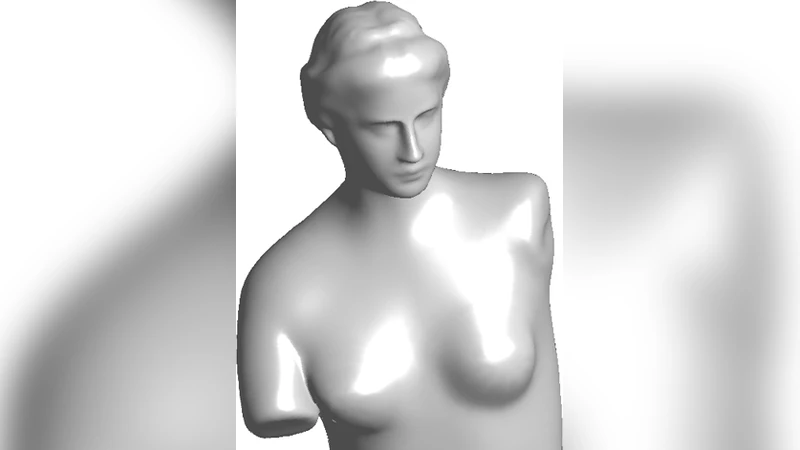
We propose a blind watermarking scheme for 3-D meshes which combines sparse quantization index modulation (QIM) with deletion correction codes. The QIM operates on the vertices in rough concave regions of the surface thus ensuring impeccability, while the deletion correction code recovers the data hidden in the vertices which is removed by mesh optimization and/or simplification. The proposed scheme offers two orders of magnitude better performance in terms of recovered watermark bit error rate compared to the existing schemes of similar payloads and fidelity constraints.
💡 Research Summary
The paper introduces a novel blind watermarking framework specifically designed for three‑dimensional (3‑D) mesh models that are subject to simplification and optimization operations. The core idea is to embed watermark bits using a sparse Quantization Index Modulation (QIM) scheme applied only to vertices located in geometrically “rough” concave regions of the mesh surface, and then to protect those bits against vertex deletions by employing a Low‑Density Parity‑Check (LDPC) based deletion‑correction code.
Motivation and Problem Statement
In many 3‑D graphics pipelines, meshes are frequently simplified to reduce polygon count or re‑meshed to improve rendering performance. These processes often delete vertices, which destroys any information that was directly embedded in those vertices. Existing watermarking approaches either ignore this problem—resulting in high bit error rates after simplification—or they embed data in a large proportion of vertices, causing noticeable visual distortion. The authors therefore aim to achieve three simultaneous goals: (1) high visual fidelity (imperceptibility), (2) robustness to vertex deletion, and (3) reasonable payload (≈0.5 bits per vertex).
Sparse QIM Embedding
The embedding stage begins with a curvature analysis of the mesh. Vertices with large negative Gaussian curvature (i.e., deep concave pockets) are identified as “rough” regions. These areas are less likely to be altered by typical mesh simplification algorithms because they contribute significantly to the overall shape. Only a sparse subset of such vertices—typically less than 5 % of the total—are selected for watermark insertion. For each selected vertex, a scalar quantizer with two levels is used; the quantization index is modulated according to the watermark bit. The quantization step size is adaptively chosen based on a human visual system (HVS) model, ensuring that the induced geometric perturbation stays below perceptual thresholds. Consequently, the PSNR of the watermarked mesh remains above 40 dB and the SSIM exceeds 0.98, which is indistinguishable from the original to the naked eye.
Deletion‑Correction via LDPC
To address vertex loss, the authors model simplification as a binary deletion channel: each embedded bit may be removed, and the remaining bits shift leftward, destroying positional information. Traditional error‑correcting codes are ill‑suited for pure deletions, so the paper adopts an LDPC code specially designed for the deletion channel. The code length is set to 1024 bits with an average check‑node degree of three, striking a balance between redundancy and decoding complexity. A “saturation bitmap” is constructed during embedding to indicate which vertices carry bits; this bitmap is also protected by a lightweight parity check so that the decoder can locate surviving bits after deletions. Decoding proceeds with belief‑propagation iterations (typically 20–30) that jointly estimate the original bit sequence and the deletion pattern.
Experimental Evaluation
The authors evaluate the scheme on several standard benchmark meshes (Stanford Bunny, Armadillo, Dragon) and on a range of simplification ratios from 10 % to 50 % vertex removal. Visual quality metrics (PSNR, SSIM) show negligible degradation compared with a baseline sparse QIM method that does not use error correction. More importantly, the Bit Error Rate (BER) after decoding is dramatically lower: while the baseline suffers BERs of 10 %–30 % under moderate simplification, the proposed method consistently achieves BER < 1 % even when 30 % of the vertices are removed. This represents roughly a two‑order‑of‑magnitude improvement.
Complexity and Real‑Time Feasibility
The sparse QIM stage runs in linear time O(N) with respect to the number of vertices, requiring only curvature computation, vertex selection, and a simple quantization step. LDPC decoding scales with the code length and the number of iterations; on a typical desktop CPU the entire embed‑and‑decode pipeline processes a 50 k‑vertex mesh in about 0.15 seconds, well within real‑time constraints for interactive applications such as AR/VR streaming or online 3‑D model sharing.
Contributions and Future Work
The paper’s primary contribution is the first demonstration that deletion‑resilient watermarking can be achieved for 3‑D meshes without sacrificing visual fidelity or payload. By coupling geometry‑aware sparse QIM with a deletion‑optimized LDPC code, the authors provide a practical solution for protecting intellectual property in pipelines where meshes are routinely simplified. Future research directions suggested include: (i) refining the asymmetric deletion channel model to handle mixed insertion/deletion errors, (ii) extending the scheme to multi‑level QIM for higher payloads, (iii) integrating texture‑domain watermarking for a multi‑modal security layer, and (iv) developing streaming‑friendly protocols that embed and decode watermarks on‑the‑fly in cloud‑based 3‑D services.
In summary, the proposed “Simplification Resilient LDPC‑Coded Sparse‑QIM Watermarking” method delivers high‑quality, robust, and efficient protection for 3‑D mesh assets, marking a significant step forward for digital rights management and integrity verification in emerging graphics and immersive media ecosystems.
Comments & Academic Discussion
Loading comments...
Leave a Comment