Jointly Optimal Channel and Power Assignment for Dual-Hop Multi-channel Multi-user Relaying
We consider the problem of jointly optimizing channel pairing, channel-user assignment, and power allocation, to maximize the weighted sum-rate, in a single-relay cooperative system with multiple channels and multiple users. Common relaying strategie…
Authors: Mahdi Hajiaghayi, Min Dong, Ben Liang
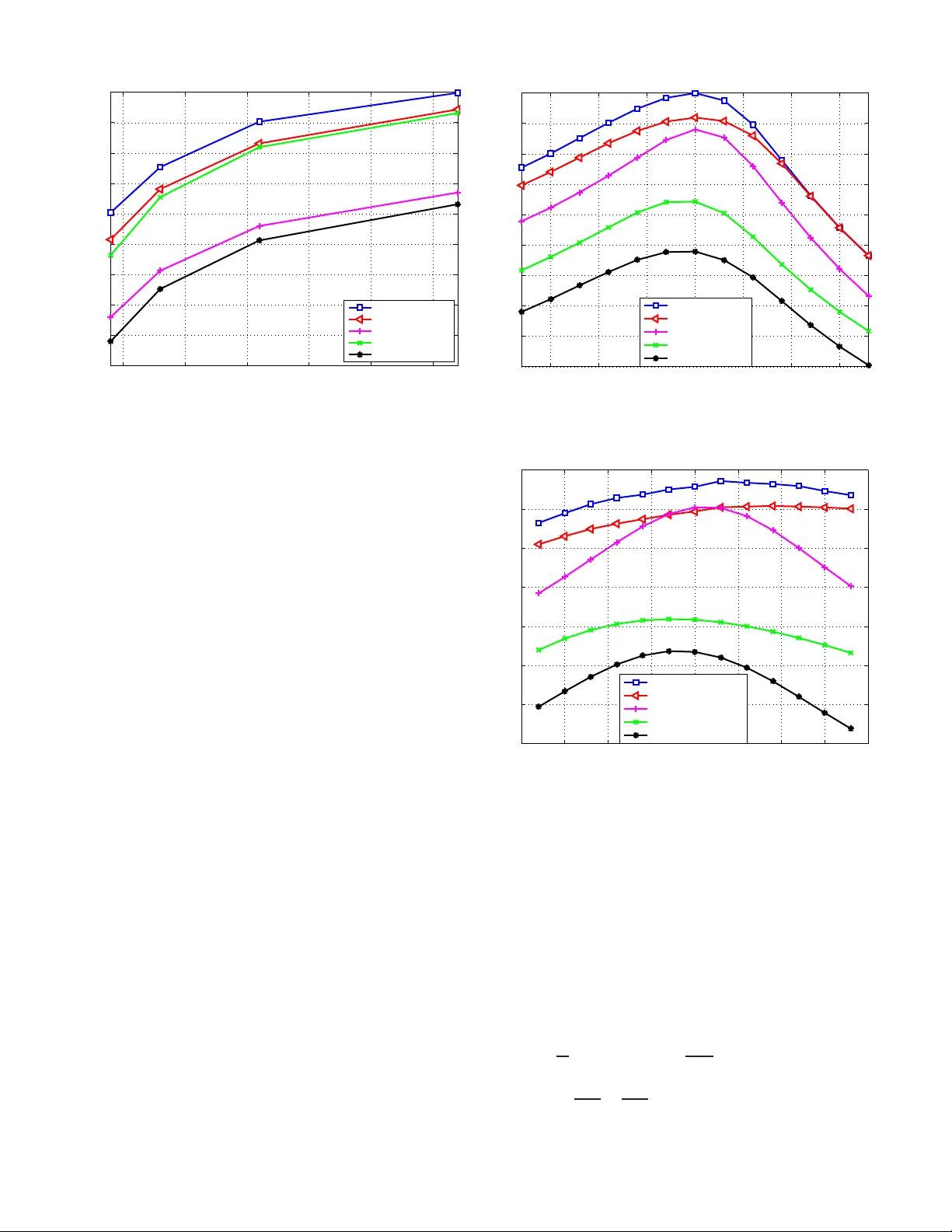
LONG VERSION OF IEEE J. SELECT . AREAS COMMUN., VOL. 30, NO. 9, OCTOBER 2012 1 Jointly Optimal Channel and Po wer Assign ment for Dual-Hop Multi-channel Multi-user Relaying Mahdi Hajiaghayi, Student Member , IEEE , Min Dong, Senior Me mber , IEEE , and Be n Lia ng, Senior Member , IEEE Abstract —W e consi der the problem of jointly op timizing chan- nel pairing, channel-user assignment, and power allocation, to maximize the weighted sum-rate, in a sin gle-relay cooperati ve system with multiple channels and multiple users. Common r elay- ing strategies are considered, and transmission power constraints are imposed on both individual transmitters and the aggregate ov er all transmitters. T he joint optimization problem naturally leads to a mixed-integer progra m. Despite the general expectation that such problems are intractable, we construct an efficient algorithm to find an optimal solution, which incurs computational complexity th at is polynomial in the number of channels and the number of u sers. W e further d emonstrate through numerical experiments that the jointly optimal solution can signifi cantly impro ve system perfo rmance o ver its subop timal alternativ es. I . I N T R O D U C T I O N W e c onsider the p roblem of resou rce assignment for m ulti- channel multi-user com munication th rough relaying. The prob- lem typically ar ises in cellular commun ication or wireless lo cal area networks, thro ugh either dedicated r elay stations or users temporar ily serv ing as relay nodes. In tradition al narrow-band cooper ati ve relaying systems, the relay r etransmits a pro cessed version of the received sign al over the same frequen cy channel. In contrast, when multiple frequ ency chan nels are a vailable, the relay can exploit the ad ditional frequen cy dimen sion, to process incoming signals adaptively b ased on the div ersity in channel strength. In narrow-band cooperativ e relaying systems, the relay retransmits a p rocessed version of th e received sign al over th e same freq uency chann el. I n contr ast, wh en multiple freq uency channels are available, the relay can exploit th e addition al frequen cy dimension, to process incom ing signals adaptively based on the di versity in chann el strength. Channel p air - ing , which devises a match ing o f incoming and outgoing subcarriers in OFDM-based relaying , was proposed indepen- dently in [ 2] an d [3] fo r single- user relayin g 1 . In a m ulti- user commun ication environment, both i ncomin g a nd outgoin g channels at th e relay are shared among all user s. A cru- cial problem is to determine th e assignment of a subset of M. Hajia ghayi and B. Liang are with the Dep artment of Electrical and Com- puter Engine ering, Univ ersity of T oronto, Cana da. M. Dong i s with the Depart- ment of Electrica l Computer and Softwa re E nginee ring, Uni versity of Ontario Institut e of T echnology , Canada. E mails: { mahdih,liang } @comm.utoro nto.ca, min.dong@uoit .ca. This work was supported in part by the Natural Science s and Engineeri ng Research Council of Canada and the Ontario Ministry of Researc h and Inno vation . A preli minary version of this work has appeared in [1]. This is the full version of a paper to appea r in the IEEE Journal on Selec ted A re as in Communicati ons, Special Issue on Cooperative Networki ng - Challenge s and Applications (P art II) , October 2012. 1 Since a vast majorit y of multi-channe l relaying systems in the literature are based on OFDM, we use it as an illustrati ve example in this work, so that the terms “channel” and “subcarrie r” are synonymous. incoming -outgo ing chan nel pairs to each user , which we term channel-user assignment . Since the channel conditio n can vary drastically fo r different users, an d over the sam e incom ing and outgo ing chan nels, ju dicious c hannel-u ser assignment and channel pairing can po tentially lead to significan t i mprovement in spectral efficiency . T o gether with power alloc ation over multiple chann els at the transmitter s, essential for perform ance optimization , th ese are three main resource assignment prob - lems in mu lti-channel multi-user relay ing. There is stro ng correlatio n amon g ch annel pa iring, ch annel- user assignment, and p ower a llocation. Joint consideration of these three pro blems is required to ach iev e o ptimal system perfor mance. However , th e combin atorial nature of chann el pairing and assignment generally leads to a mixed-integer progr amming problem , wh ose solu tion o ften bears prohibitive computatio nal complexity and renders the pr oblem intractable . As a result, previous attemp ts to optimize the p erforman ce of multi-chan nel m ulti-user r elaying systems thro ugh resource allocation o ften c onsider on ly a subset of the se three prob lems [4] - [1 6], o r adopt sub optimal ap proach es [17] - [23]. In this work , we consider all three resou rce assignment problem s in a dual-ho p multi-chann el relaying ne twork for multi-user communication th rough a single relay , u nder se veral common relaying strategies. W e sh ow that ther e is an effi- cient metho d to jointly o ptimize channel pairing , ch annel-user assignment, an d power allocation in such general dual-ho p relaying n etworks. The pr oposed solutio n fra mew o rk is built upon contin uous relaxation an d Lagr ange dual minimiz ation. Although this approach is o ften app lied to integer program - ming problems [24], it generally provides only heuristic or approx imate solutions. Howe ver, by exploring the rich struc- ture in our p roblem, we show tha t ju dicious reformu lation and ch oices of th e optimizatio n trajectory can preserve b oth the binar y constra ints and th e strong duality pro perty of the continuo us version, th us enabling a jointly optimal so lution. Throu gh reformulation, we transfo rm the core of the o rig- inal p roblem into a spec ial incid ence of the class of th ree- dimensiona l assignment p roblems, which is NP har d in gen- eral but has polyno mial-time solutions – in terms o f the number of ch annels and users – fo r our specific setting of channel pairing and cha nnel-user assignment. F or the often studied con ventional decode-a nd-for ward (DF) relayin g with a maxim um weighted sum-rate objective, we further propose a di vide-and -conqu er algor ithm for d ual minimization, which guaran tees that con vergence to an optimal solution requires only a polyno mial n umber of iterations in the n umber of channels. This e nsures the scalability o f the pr oposed solution to lar ge multi-channel systems. LONG VERSION OF IEE E J. SELECT . AREA S COMMUN., VOL. 30, NO. 9, OCTOBER 2012 2 Our propo sed solution is applicab le to a wide rang e of sys- tem con figuration s, accommodating both total a nd individual power constrain ts, and allowing d irect sou rce-destination link s in r elaying. W e show that it can be modified to work with var- ious r elaying strategies in addition to DF , includ ing variants of compress-an d-forward (CF) an d amplify- and-fo rward (AF). It also ac commod ates general concave utility function s. Through simulation and numerical comparison, we further illustrate that there is often a large perform ance gap between th e jointly optimal solution an d th e suboptimal alter nativ es. The rest of the p aper is organized as follows. W e first provide a literature review of the related work in Section II. In Section III, we discuss the system m odel and formulate the jo int o ptimization pro blem. For weig hted sum- rate max- imization with DF relaying, we de scribe our fram ew o rk of finding the optimal solution with polynom ial complexity in Section IV. Extension to oth er relaying stra tegies ar e explained in Section V. Num erical studies are presented in Section VI, and conclusions ar e g iv en in Section VII. I I . R E L A T E D W O R K Most existing works on o ptimizing reso urce allo cation for multi-chan nel relaying systems consider a subset of the th ree aforemen tioned problems. After ch annel p airing was pro posed in [2] and [ 3], its op timization has been considered in se veral studies. In the ab sence of the d irect source-destinatio n lin k, [4] showed th at the sorted -SNR chann el pairing scheme, which matches the incom ing and ou tgoing sub carriers ac cording to the sorted order of their SNRs fo r some giv en power allocation, is sum-rate optimal for a single-user AF r elaying OFDM system. When the direct source-destinatio n link is av ailable, a low com plexity optima l chan nel p airing sche me was established in [5] f or AF r elaying. In addition , it was shown that cha nnel pairing is op timal a mong all unitary linear processing at the relay under a fixed ga in power assumptions. Howe ver, no ne of these works con sidered op timizing power allocation. Channel- user assignm ent in multi-user relaying networks, under given po wer allocation, was considered in [6], where the au thors soug ht an optimal chann el-user and channel- relay a ssignment to maxim ize the uplin k d ata ra te for AF and DF relaying with mu ltiple rela ys. For a m ulti-chann el network with multiple sou rces, single AF relay , and single destination, [7] studied the problem of channel pairing and channel- user assignment. I t m aximizes th e sum r eceiv ed SNR, assuming that the power allocation is given. A suboptimal solution is pro posed fo r distributed implemen tation using game theory . Finally , the pr oblem o f optimal power allo cation for OFDM relayin g in specific r elay network setups was studied in nume rous works fo r different relay strategies and power constraints, see for example [8], [9], [10]. Jointly optimizing ch annel pair ing and power allocatio n for single-user re laying w as considered in sev eral studies. W ithout the direct source-d estination link, [11 ] and [1 2] considered this problem f or dua l-hop DF relaying in an OFDM system for total power and ind i vidual power co nstraints, respectively . It was shown that joint subcarrier pairing and power allocation are separab le for sum -rate optimization . This separatio n was also estab lished in the general multi-ho p case in [1 3], for both AF an d DF re laying, and u nder either to tal power or individual power co nstraints. W ith consider ation fo r the d irect source-d estination link, the authors o f [14] a nd [15] studied joint sub carrier pairin g and power allocation in a single- user OFDM system, f or AF and DF relaying respectively . The joint optimization pr oblems were formula ted as mixed- integer progr ams and solved in the Lag range dual domain. Altho ugh strict optimality was n ot established, the p roposed solutions were sho wn to be asy mptotically optim al as the nu mber of subcarriers approaches infinity , based o n th e frequency-d omain virtual time-sharing argument [25]. For r elay-assisted multi- user scenarios, join t optimization of chann el-user assignment and power allocation was considered in [ 16] for communica- tion between a base st ation and users who ha ve the ab ility to relay infor mation fo r eac h other . Based on the same virtual time-sharing argument [25], asymptotically optimal solu tion was p rovided for network u tility maximization. The pr oblem is especially ch allenging when chan nel p air- ing, chann el-user assignm ent, a nd power allocation n eed to be optimized jo intly in relay -assisted mu lti-user scenar ios. Existing w o rk to tackle it has been scarce. In [17], such joint optimization was con sidered f or cooper ation amo ng u sers in uplink commu nication, accou nting fo r th e splitting of band- width at a u ser that needs to simultan eously tr ansmit its o wn data and relay for others. T he p roposed pr oblem was NP hard and a sub optimal heur istic alg orithm was constru cted. T he authors of [18] stud ied this p roblem for a single r elay using DF withou t the direct source- destination link. Under a total power con straint, they sho wed that, for sum -rate maximization , it is optima l to sep arately design ch annel-user assignment, channel p airing, and p ower allocation. Howe ver, this ap proach is subo ptimal for the genera l ca se when the direct link is av ailable, when the user weig hts are non-unif orm, or when individual power constraints are considered. In comparison , we consider more general relayin g strate gies that use the direct source-d estination link, so that the simple pairing scheme based on sorted chann el gain is no lon ger op timal. Further- more, our p roposed appro ach a ccommod ates individual power constraints in a ddition to total power constraints, r elaying strategies other than DF , and oth er optimizatio n objectives. In Section VI, we fu rther illustrate with nu merical data that there is a large p erform ance g ap betwee n suc h a separ ate optimization approach an d the jointly optimal solution. There are also other studies o n r esource allocation in multi- channel relaying systems, with d ifferent system models from the on e presen ted in this paper (for examp le, [1 9], [ 20], [2 1], [22], [23]). Due to th e sign ificant complexity in th ese system models, no general optimal solution has been fo und. Rather, suboptimal algo rithms are proposed with an aim to sup port satisfactory system performan ce. In co ntrast, in this work we tack le the pro blem of join t re source o ptimization in a simpler, single- relay system with m ultiple users, p roposing a provably optimal so lution with a forma l pro of for po lynomial- time complexity . Som e preliminary results of this study ha ve appeared in [1]. This version conta ins substantial extensions, adding detailed solu tions o n how to accommo date alternate power c onstraints an d per forman ce objectives, and presenting LONG VERSION OF IEE E J. SELECT . AREA S COMMUN., VOL. 30, NO. 9, OCTOBER 2012 3 N User K User 2 User 1 Relay Source Hop 1 Hop 2 2 1 Fig. 1. Illustra tion of dual-hop multi-channel relaying. new derivations, proofs, and n umerical results. I I I . S Y S T E M M O D E L A N D P R O B L E M F O R M U L AT I O N W e consider the scena rio where a source communicate s with K user s via a single re lay as illustrated in Fig. 1. The av ailab le radio spectrum is divided into N equa l bandwid th chan nels, accessible by all nodes. W e fo cus on th e downlink in our analysis in this paper , but the proposed solution framework can be adopted for the uplink by swapping the roles of the source and the users. W e denote by h sr i , h r k i , and h sk i the state of chann el i , for 1 ≤ i ≤ N , over the first ho p between the source and the relay , over the second ho p between the relay and u ser k , an d over the direct link b etween the source an d u ser k , respectively . The additive no ise on a chan nel at the relay and u ser k are modeled as i.i.d. zero-mean Gaussian random variables with v ariances σ 2 r and σ 2 k , respectively . The ch annel state is assumed to be av ailable at bo th th e sou rce and the relay , which enables th em to dynamically assign channels and allocate p ower accor ding to channel c onditions. A. Channel Assignment The relay transmits a pro cessed version of the incoming data to its intended user using a spe cific relay strategy . The relay also conducts channel pairing and channel-user assignment. Channel pairing refers to a one- to-one mapp ing between the incoming channels an d o utgoing c hannels at the relay . Th rough channel- user assignme nt, on the oth er hand, a subset of incoming -outgo ing ch annels is ass igned to each user . Clearly , channel- pairing c hoices are closely con nected with how the channels are assigned to the users. W e term th e joint decision on cha nnel p airing and c hannel-u ser assignment the channel assignment pr oblem. As the different chann els exhibit various quality , judicio us ch annel assignment can potentially lead to significant improvement in spectral effi ciency . W e say a path P ( m, n, k ) is selected, if first-hop chann el m is p aired with seco nd-ho p ch annel n , a nd the p air of channels ( m, n ) is assigned to user k . W e define indicator functions φ mnk for channel assign ment as fo llows : φ mnk = ( 1 , if P ( m, n, k ) is selected , 0 , otherwise . (1) There is a o ne-to-on e map ping between fir st-hop chann els and second- hop chan nels. Furthermo re, we require th at each channel pair be assign ed to o nly one user, but a user m ay be assigned multiple channe l pairs. Hence φ mnk is constrained by N X n =1 K X k =1 φ mnk = 1 , ∀ m, N X m =1 K X k =1 φ mnk = 1 , ∀ n. (2) B. P ower Allocation Along any path P ( m, n, k ) , the sour ce a nd relay transmis- sion powers are denoted by P s mnk and P r mnk , respectively . W e consider both in dividual power constraints , N X n =1 N X m =1 K X k =1 P s mnk ≤ P s , N X n =1 N X m =1 K X k =1 P r mnk ≤ P r , (3) and the tota l power constraint , N X n =1 N X m =1 K X k =1 ( P s mnk + P r mnk ) ≤ P t , (4) where P s , P r , and P t are the maximum allowed tra nsmission power by the source, the relay , and the co mbined sour ce and relay , respec ti vely . This is a general rep resentation of the power limitations im posed o n the system inclu ding, e.g., hardware constraint, legal or regulato ry requirement, or energy conservation. Note that this genera l representation can be easily tailored to also specify systems with only individual power con straints, or only total power co nstraint, by setting one or m ore of P s , P r , and P t to suf ficiently large v alues. Each constrain t ab ove is either in activ e ( i.e., a t optimality it is satisfied with strict inequality) or active (i.e. , at optimality it is satisfied with equality) . W e consider the ca se where all activ e constraints ar e strictly active, i. e., if th e prob lem is modified b y chan ging the power limits b y small amou nts, at optimality the con straints rema in active. This is withou t loss of generality , since any con straint that is active but not strictly activ e can be made in activ e, by incr easing the power limit by a small a mount, without altering the problem solu tion. Define p mnk = ( P s mnk , P r mnk , P s mnk + P r mnk ) a nd π = ( P s , P r , P t ) . C. R elaying Strate gy W e initially fo cus on DF relaying but will later show ho w the propo sed method can be applied to other relaying schemes, such as AF and C F . W e consider a general case where, ap art from the r elay path, th e direct link s are av ailable b etween the source and users. In th is case, the signals rec ei ved from the relay pa th an d the direc t link can b e co mbined to imp rove the decodin g p erform ance. I n DF , each tr ansmission time fram e is divided into two equal slots. In the first slot, the so urce transmits an information bloc k o n each channel, which is received by bo th the relay and the intend ed user . In the seco nd slot, the relay attempts to decode the received m essage from each incoming chan nel (first hop), and forwards a version of the decoded message on an ou tgoing cha nnel (second hop) to the intend ed user . The inten ded u ser c ollects the rece i ved signals in both time slo ts, ap plies m aximum ratio combin ing, and decodes the message. LONG VERSION OF IEE E J. SELECT . AREA S COMMUN., VOL. 30, NO. 9, OCTOBER 2012 4 Consider th e conventional r epetition-co ding ba sed DF re- laying [26], [27], wh ere the relay is r equired to fully deco de the incoming message, re-encod e it with repetition co ding, and for ward it to the inten ded user . The max imum ach iev able source-d estination rate on p ath P ( m, n, k ) is g iv en by [2 7] R ( m, n, k ) = 1 2 min { log(1 + a m P s mnk ) , log(1 + c mk P s mnk + b nk P r mnk ) } , (5) where a m = | h sr m | 2 σ 2 r , b nk = | h rk n | 2 σ 2 k , and c mk = | h sk m | 2 σ 2 k are normalized channel power ga ins ag ainst the noise variance at the relay and user k , and the base of logarithm is 2. D. Optimization Objective V ariou s rate-u tility fu nctions can be used a s o bjectives . For conv enience of illustration, in this pape r we focus on th e weighted sum-r ate. Den oting by w k the relative weigh t for user k , s uch that P K k =1 w k = 1 , we formulate the pr oblem of weighted sum-rate m aximization as max Φ , P s , P r K X k =1 w k N X n =1 N X m =1 φ mnk R ( m, n, k ) (6) s.t. (2) , (3) , (4) , φ mnk ∈ { 0 , 1 } , ∀ m, n, k (7) P s mnk ≥ 0 , P r mnk ≥ 0 , ∀ m, n, k , (8) where Φ ∆ = [ φ mnk ] N × N × K , P s ∆ = [ P s mnk ] N × N × K , an d P r ∆ = [ P r mnk ] N × N × K . Given the relative weights and the channel gains on each p ath P ( m, n, k ) , the optimization pro blem (6) finds the jointly optim al solution o f cha nnel pairing , ch annel- user assignm ent, and power allocation by o ptimizing Φ , P s , and P r . I V . W E I G H T E D S U M - R A T E M A X I M I Z A T I O N F O R M U LT I - C H A N N E L D F The optimizatio n in (6) is a mixed- integer program ming problem , which in gen eral has intractab le comp lexity due to its combinatorial natu re. Howev er , in this section, we present a m ethod to find an op timal solution with co mputationa l complexity growing only p olynomia lly with the number of channels and users. A. Con vex Reformula tion via Continuou s Relaxatio n The proposed app roach is built on the r eformula tion o f (6) into a con vex optim ization problem with a real-valued ˜ Φ a nd strong Lagran ge du ality . W e later show that the reformulated problem is o ptimized b y a bin ary Φ = ˜ Φ . W e first substitute P s mnk = P s mnk φ mnk and P r mnk = P r mnk φ mnk (9) into the objective of (6). This doe s n ot change the original opti- mization p roblem, since if φ mnk = 1 , then (9) is trivially tru e; and if φ mnk = 0 , then by l’H ˆ opital’ s rule, φ mnk R ( m, n, k ) remains zer o befo re an d after the sub stitution. Indee d, it obvi- ously preserves the optimality of po wer allocation to enforce P s mnk = P r mnk = 0 for all ( m, n, k ) such that φ mnk = 0 . W e then r elax the binary constraint on Φ by d efining a continuo us version of φ mnk , d enoted b y ˜ φ mnk , wh ich m ay take any value in the interval [0 , 1] . Then, the reform ulated version of the optimization problem (6) can be wr itten as max ˜ Φ , P s , P r X m,n,k w k 2 ˜ φ mnk min { log(1 + a m P s mnk ˜ φ mnk ) , log(1 + c mk P s mnk ˜ φ mnk + b nk P r mnk ˜ φ mnk ) } (10) s.t. X n,k ˜ φ mnk = 1 , ∀ m, X m,k ˜ φ mnk = 1 , ∀ n, (11) 0 ≤ ˜ φ mnk ≤ 1 , ∀ m, n, k , (12) (3) , ( 4) , (8) . The o bjectiv e functio n (10) is co ncave in ( ˜ Φ , P s , P r ) , since ˜ φ mnk log(1 + a m P s mnk ˜ φ mnk ) and ˜ φ mnk log(1 + c mk P s mnk ˜ φ mnk + b nk P r mnk ˜ φ mnk ) are the perspectives of the concave function s log(1 + a m P s mnk ) and log (1 + c mk P s mnk + b nk P r mnk ) , resp ec- ti vely 2 . It is also note d that the minimu m of two con cav e function s is a conc a ve fun ction. Fur thermore, since all the constraints are affine, and there are obvious feasible po ints, Slater’ s con dition is satisfied [2 8]. Hence, the convex opti- mization pr oblem (10) has z ero duality g ap, suggestin g tha t a globally o ptimal solutio n can be f ound in the Lagran ge dual domain. Using continuous relaxation on integer programming prob- lems is not a new tech nique [24]. Howev er , doing so ty pically leads only to heur istics or approximation s. Clearly , solving a maximization prob lem with relaxed constraints generally gi ves only an upper bou nd to the original prob lem. In particular, all global optima fo r (10) d o n ot necessarily g iv e a binar y ˜ Φ , which is requir ed for (6). Howev er , we n ext show that, in the prob lem u nder consideratio n, inde ed th ere always exists a globally op timal solu tion to (10) consisting of a bin ary ˜ Φ , an d the pr oposed app roach ensures that such an o ptimal solution is found in poly nomial time. B. P ower Allocatio n via Maximization o f Lagrange Functio n over P s and P r Consider the Lag range function for (10), L ( ˜ Φ , P s , P r , λ ) = X m,n,k w k 2 ˜ φ mnk min { log (1 + a m P s mnk ˜ φ mnk ) , log(1 + c mk P s mnk ˜ φ mnk + b nk P r mnk ˜ φ mnk ) } − ( λ s + λ t ) X m,n,k P s mnk − ( λ r + λ t ) X m,n,k P r mnk + λπ T , (13) where λ = ( λ s , λ r , λ t ) is the vecto r of Lag range multipliers associated with the power co nstraints (3) an d (4). T he dua l function is the refore g ( λ ) = max ˜ Φ , P s , P r L ( ˜ Φ , P s , P r , λ ) (14) 2 The perspe cti ve of function f : R n → R is defined as g ( x, t ) = tf ( x/t ) , with domain { ( x, t ) | x/t ∈ dom f , t > 0 } . The perspect i ve operation preserv es concavi ty [28]. Here we include ˜ φ mnk = 0 in the domain of the perspecti ves. It is easy to see that they remain concav e. LONG VERSION OF IEE E J. SELECT . AREA S COMMUN., VOL. 30, NO. 9, OCTOBER 2012 5 s.t. (11) , (1 2) , (8) . The above maximiza tion of the Lagran ge function can be carried o ut by fir st o ptimizing th e power allocation g iv en fixed ˜ Φ . The KKT co nditions su ggest that th e maximiza tion of (14) over P s and P r can be decomposed into N × N × K indepen dent subprob lems to find the op timal P s ∗ mnk and P r ∗ mnk : max P s mnk ≥ 0 ,P r mnk ≥ 0 L mnk ( ˜ φ mnk , P s mnk , P r mnk , λ ) (15) where L mnk ( ˜ φ mnk , P s mnk , P r mnk , λ ) is the part of L ( ˜ Φ , P s , P r , λ ) that concerns on ly the path P ( m, n, k ) . It can b e sho wn that the solution to ( 15) has the following form. The d eriv ation details are g i ven in Appen dix A. Note that, since P s ∗ mnk and P r ∗ mnk depend s on ˜ φ mnk in an obvious way , we simply p resent th em as fun ctions of λ for th e rest of this section. P s ∗ mnk ( λ ) , P r ∗ mnk ( λ ) = h w k α ( λ s + λ t ) − 1 a m i + ˜ φ mnk , 0 , if a m ≤ c mk p 1 , if a m > c mk and c mk λ s + λ t < b nk λ r + λ t arg max ( P s ,P r ) ∈{ p 1 , p 2 } L mnk ( ˜ φ mnk , P s , P r , λ ) , o.w . (16) where α = 2 ln 2 , [ x ] + = max { x, 0 } , p 1 = 1 , a m − c mk b nk × h w k b nk α ( b nk ( λ s + λ t )+( a m − c mk )( λ r + λ t )) − 1 a m i + ˜ φ mnk , and p 2 = h w k α ( λ s + λ t ) − 1 c mk i + ˜ φ mnk , 0 . C. Chann el Assignment via Maximization of Lagrange Func- tion over ˜ Φ T o maximize the L agrange f unction ov er ˜ Φ , we define A mnk ( λ ) = 1 ˜ φ mnk L mnk ( ˜ φ mnk , P s ∗ mnk ( λ ) , P r ∗ mnk ( λ ) , λ ) . (17) Note that A mnk ( λ ) is independen t of ˜ φ mnk because of th e multiplication f orm of (16) b y ˜ φ mnk . Then , (14) can be determined by the following o ptimization problem over ˜ Φ : max ˜ Φ X m,n,k ˜ φ mnk A mnk ( λ ) (18) s.t. (11) , (12) . T o pr oceed, we present the fo llowing lemma on the d ecom- position of ˜ Φ . Lemma 1: Any matrix ˜ Φ = [ ˜ φ mnk ] N × N × K with 0 ≤ ˜ φ mnk ≤ 1 and satisfying (11) can be d ecomposed in to one matrix X = [ x mn ] N × N and M N vectors y mn = [ y mn k ] 1 × K , such that ˜ φ mnk = x mn y mn k , ∀ m, n, k , with 0 ≤ x mn ≤ 1 and 0 ≤ y mn k ≤ 1 , satisfying P n x mn = 1 , ∀ m , P m x mn = 1 , ∀ n , an d P k y mn k = 1 , ∀ m, n . Furtherm ore, any su ch m atrix X and vector s y mn uniquely d etermines a matrix ˜ Φ tha t is giv en b y ˜ φ mnk = x mn y mn k and satisfies ( 11). Pr oof: The proof is provid ed in Appendix B . Note th at, even though th e above deco mposition can also be applied to a binary Φ as a trivial spec ial c ase o f L emma 1, we require the g eneral fo rm of this lemm a to d eal with co ntinuous values in ˜ Φ , X , and y mn . In particu lar , the mapping f rom ˜ Φ to ( X , { y mn } ) is one-to- many , which is qu ite different from the binary case. Lemma 1 im plies that any optimizatio n over ( X , y mn ) also o ptimizes ˜ Φ for the same o bjectiv e. This allows us to replace, in problem (18), ˜ φ mnk with x mn y mn k . Fur thermor e, the constant terms can be d ropped from (18). Hence, we can equiv alently seek solutions to the following p roblem max X , { y mn } X m,n x mn X k y mn k A mnk ( λ ) (19) s.t. X n x mn = 1 , ∀ m, X m x mn = 1 , ∀ n, 0 ≤ x mn ≤ 1 , ∀ m, n, (20) X k y mn k = 1 , ∀ m, n, 0 ≤ y mn k ≤ 1 , ∀ m, n, k . (21) The fo llowing two-stage solution is sufficient. First, the inner- sum term is maximize d over y mn k for each ( m, n ) pair , i.e., A ′ mn ( λ ) = max y mn X k y mn k A mnk ( λ ) (22) s.t. (21) . An optimal solu tion to (22) is readily obtained as y mn k ∗ = ( 1 , if k = arg max 1 ≤ l ≤ K A mnl ( λ ) 0 , otherwise . (23) In the above maximization, arbitrary tie-brea king ca n be perfor med if nec essary . Next, inserting A ′ mn ( λ ) into (1 9), we have the linear op timization problem max X X m,n x mn A ′ mn ( λ ) (24) s.t. (20) . It is well k nown that ther e always exists an optimal solu tion to (24) that is b inary [24, Chapter 3]. An intuitive expla nation is the following. Since (24) is a linear progra m with a bounded objective, an optimal solution can be found at the vertices of the feasible regio n. Fu rthermor e, since X is a doubly stochastic matrix , it is a co n vex combina tion of permutation matrices. On e of these vertex perm utation matrices is an optimal solution to (24), so at least one optimal X is binary . Then, to find a binar y optim al X , (2 4) is a two-dimen sional assignment p r oblem . Efficient a lgorithms, such as the Hung ar- ian Algo rithm [29], e xist to produc e an optimal solution with computatio nal complexity b eing polynomial in N . Finally , the optim al ˜ φ mnk giv en λ is ˜ φ ∗ mnk ( λ ) = x ∗ mn ( λ ) y mn k ∗ ( λ ) . (25) Since binary x ∗ mn ( λ ) and y mn ∗ k ( λ ) are co mputed following the above pr ocedure, ˜ φ ∗ mnk ( λ ) is also b inary . This shows that there exists at least o ne binary optimal solu tion to the maximization in (1 8). Intuitively , the g lobally op timal solution d escribed above suggests a pairing b etween the input and output chan nels at the relay , and if channels m and n are paired, they ar e assigned to a s ingle user k , whose associated A mnk ( λ ) is the greatest LONG VERSION OF IEE E J. SELECT . AREA S COMMUN., VOL. 30, NO. 9, OCTOBER 2012 6 among all u sers. Note that such an interp retation might lead u s to conclud e tha t we could ha ve forgone continuo us relaxation from th e very b eginning and focu sed only o n a binary Φ . Howe ver, we would still have required the continuo us ˜ Φ to construct a convex optimization prob lem, whose strong duality proper ty provid es the optimality of the proposed app roach. Th e optimality o f ( X , { y mn } ) tak ing bina ry values is implied o nly throug h the above deriv ation. Interestingly , the origina l op timization pr oblem (18) with a binar y matrix Φ is a special case of the axillary thr ee - dimensiona l assignment pr oblems [30]. It is well k nown that the gen eral form o f this family of pro blems is NP hard and cannot be solved by continu ous relax ation on Φ , unlike the two-dimensional assignment pro blem in (24). In o ur case, th e special structure of ˜ Φ expressed in (11), namely the absence of a constra int on p er-user resour ce alloca tion, makes p ossible the a vailability of an ef ficien t solu tion to (18). It is also worth noting that, given any λ , there may exist non-in teger optimal solutions to (18). For example, when the maximal value of A mnk in (2 2) is achiev ed by multiple users having the same channel gains, there is an in finite numbe r of optimal y mn , leading to no n-integer op timal solution s for ˜ φ mnk . Howe ver, the procedur e above find s only one of the optimal solu tions in b inary fo rm, which is sufficient fo r computin g the dual function. D. Dual Minimization: Baseline Sub gradient Appr oach The previous subsection provides a way to find the Lagran ge dual g ( λ ) for any Lagrang e multiplier vector λ . Next, the standard approach calls for minimizing the du al f unction: min λ g ( λ ) (26) s.t. λ 0 . This can be solved using the subgr adient method [31]. It is easy to verify that a sub gradient at the point λ is given by θ ( λ ) = π − X m,n,k p ∗ mnk ( λ ) , ( 27) where P s ∗ mnk ( λ ) and P r ∗ mnk ( λ ) are com puted based on (16) and ˜ φ ∗ mnk ( λ ) found u sing (25). For completen ess, we first summarize the standard sub- gradient updating algorithm for solving the dual problem in the fo llowing. W e will present a mo dified dual minim ization algorithm in Sectio n I V - F, which is guaranteed to con verge in polyno mial time. 1) Initialize λ (0) . 2) Given λ ( l ) , ob tain the optimal values of P s ∗ mnk ( λ ( l ) ) , P r ∗ mnk ( λ ( l ) ) , and ˜ φ ∗ mnk ( λ ( l ) ) . 3) Update λ th rough λ ( l +1) = [ λ ( l ) − θ ( λ ( l ) ) ν ( l ) ] + where ν ( l ) is the step size at the l th iteration. 4) Let l = l + 1 ; repeat fro m Step 2) until the convergence of min l g ( λ ( l ) ) . Sev eral step-size rules ha ve been proven to guarantee con- vergence under some general co nditions [31][32]. For exam- ple, using a con stant step size ν , i.e., ν ( l ) = ν , or using a constant step length ν , i.e., ν ( l ) = ν / k θ ( λ ( l ) ) k 2 , le ads to an objective within a given neighbo rhood of a glob al optimu m; while u sing the non -summable, square- summable rule leads to asymptotic conv ergence to a g lobal optimum. Furtherm ore, one may satisfy any c onstraints on λ ( l ) within a conve x region by projecting λ ( l ) onto the re gion. This i s the general pr o jected subgrad ient method, which does not redu ce the speed of conv ergence [3 2]. For example, Step 3 above ensures that λ ( l ) 0 , an d we will further consider pro jection onto conve x regions R 1 and R 2 in Section IV -F. E. Primal Optimality W ith standard subgrad ient upd ating, the du al optimal λ ∗ is obtained, f rom which we compu te the chann el assignment a nd power allocation m atrices ( Φ ∗ , P s ∗ , P r ∗ ) , where Φ ∗ = ˜ Φ ∗ . Since the optim ization pro blem (10) is a convex p rogram that satisfies Slater’ s co ndition, it has zero dua lity gap. Denote by f ∗ ( π ) the m aximal value of the objectiv e in (10). Then f ∗ ( π ) = g ( λ ∗ ) , and fur thermor e it is con cav e in π . W e consider systems that have the following strictly dimin ishing rate-power relation: Assumption 1: f ∗ ( π ) is strictly con cav e in any strictly activ e po wer constraint P x ∈ { P s , P r , P t } . In other words, as the data rate increases, each u nit o f increment require s m ore and mo re marginal power . W ith a strictly concave R ( m, n, k ) in term s o f p mnk , this assumption holds wh en either th ere is no tie- breaking in ( 23) o r (24) or there is tie-break ing th at is due to users or paths h aving the same weights o r channel gains 3 . Pr opo sition 1: Un der Assumptio n 1, ( Φ ∗ , P s ∗ , P r ∗ ) is a globally optimal so lution to the origin al prob lem (6). Pr oof: Since P s ∗ and P s ∗ are un iquely determined by λ ∗ and Φ ∗ , we need only to focus on Φ ∗ . For any inactiv e constraint P x , we ha ve λ ∗ x = 0 and the subgrad ients of g ( λ ) in the direc tion o f λ x are all positive. Hence any Φ ∗ is feasible with respect to P x . For any strictly activ e constraint P x , we have λ ∗ x > 0 . Furthermo re, f ∗ ( π ) = L ( Φ ∗ , P s ∗ , P r ∗ , λ ∗ ) ≤ f ∗ ( X m,n,k p ∗ mnk ) − λ ∗ ( X m,n,k p ∗ mnk − π ) T . (28) Giv en Assump tion 1, the ab ove is p ossible o nly wh en a ll strictly active constraints are satisfied with eq uality . Therefo re, any Φ ∗ is fea sible with respec t to P x and the co mplementar y slackness cond ition is satisfied. Hence, ( Φ ∗ , P s ∗ , P r ∗ ) is a globally optimal so lution to (10). Furthermo re, since (10) is a constrain t-relaxed version of (6), Φ ∗ giv es an upp er bo und to the o bjectiv e of (6). Finally , since Φ ∗ satisfies the binary constraints in (6) at each iteration of th e sub gradient alg orithm, it satisfies all con straints in (6). Therefo re, it is a globa lly o ptimal solu tion to ( 6). W e point ou t that using co n ventional co n vex optimization software package s d irectly on the r elaxed proble m (1 0) is no t 3 Ho wev er , we cannot rule out the possibility of a case where other forms of tie-bre aking in (23 ) or (24) might create linear segment s in f ∗ ( π ) , although in all simulation tests with arbitra ry parameters, we hav e not produced a case where this assumption fails. LONG VERSION OF IEE E J. SELECT . AREA S COMMUN., VOL. 30, NO. 9, OCTOBER 2012 7 sufficient to solve (6 ). This is because there is no guaran tee that they will retu rn a binary ˜ Φ ∗ , and fu rthermo re due to complicated three- dimensional depen dencies amon g φ mnk , there is no readily a vailable method to tran sform a fractional ˜ Φ ∗ to the d esired binary solution . F . Du al Minimization: Divide-and-Con quer Alg orithm with P olyno mial Complexity The standard subgr adient meth od p roduces a g lobal op - timum, but its c omputation al comp lexity is not generally known. Previous studies ha ve provided asymptotic b ounds or conjecture s on its ef ficiency throug h comp utational experien ce. In general, the n umber of iterations in sub gradien t updating depend s o n the step-size rule, the distance be tween the in itial solution and the optimal solution, and the 2-no rm of th e subgrad ients [31], [32]. Next, we pr opose a new dual m inimization algorithm that guaran tees conver gence with polyno mial complexity in N and K , to a global op timum for our o ptimization pro blem. It uses a divide-and-con quer appr oach, by gr ouping the po ssible locations of λ ∗ into two regions and applyin g p rojected subgrad ient upd ating c onstrained within eithe r . It ensures tha t in each region, ou r choice of th e initial λ (0) and su bsequent subgrad ient upd ating lead to con vergence in poly nomial time. W e first d efine th e fo llowing two overlapping conve x r e- gions in terms of λ : R 1 ∆ = λ : λ s + λ t ≥ min { k : w k > 0 } w k min { min { m : a m > 0 } a m , min { m,k : c mk > 0 } c mk } 4 α (max m a m min { P s , P t } + 1 ) , λ 0 , R 2 ∆ = λ : λ s + λ t + min { m : a m > 0 } a m max n,k b nk ( λ r + λ t ) ≥ min { k : w k > 0 } w k α min { P s , P t } + 1 min { m : a m > 0 } a m , λ 0 . These are two p ossible region s where λ ∗ resides, which depend s on whether ther e exists at least one chosen path with non-ze ro direct-link ch annel gain c mk . This is formalized in the following lem ma. Its pr oof is g i ven in [33]. Lemma 2: If there exists some ( m, n, k ) su ch th at φ ∗ mnk = 1 and c mk > 0 , then λ ∗ ∈ R 1 . Otherwise, λ ∗ ∈ R 2 . The propo sed divide-and-con quer dual minim ization (DCDM) algor ithm c onsiders bo th possible regions for λ ∗ . It first creates the two condition s in Lemma 2 by artificially setting direc t-link channe l gains to zero. It the n applies the projected sub gradient algo rithm on R 1 and R 2 separately , an d chooses th e better solution between these two. The algorithm is form ally d etailed in Algo rithm 1, and its op timality and complexity are given in Propo sitions 2 and 3, respectively . Note that one can not use Lemma 2 to determine, before the optimal ch annel assignment matrix ˜ Φ is chosen, which region λ ∗ is in. This nec essitates the comparison step in the DCDM algorithm . Algorithm 1 Divide-and-Conqu er Dual Minimization (DCDM) if there exists some m and k su ch that c mk > 0 then λ ∗ 1 = output of subgradien t updatin g alg orithm with projection onto λ ( l ) ∈ R 1 Set c mk = 0 for all 1 ≤ m ≤ N and 1 ≤ k ≤ N λ ∗ 2 = output of subgradien t updatin g alg orithm with projection onto λ ( l ) ∈ R 2 return arg min λ ∈{ λ ∗ 1 , λ ∗ 2 } g ( λ ) else λ ∗ = output of subgradien t updatin g alg orithm with projection onto λ ( l ) ∈ R 2 return λ ∗ end if Pr opo sition 2: With DCDM, the com puted ch annel assign - ment and power allocation matrices ( Φ ∗ , P s ∗ , P r ∗ ) , where Φ ∗ = ˜ Φ ∗ , is a globally optim al solution to the original problem (6). Pr oof: Suppose there exists some ( m, n, k ) such that φ ∗ mnk = 1 and c mk > 0 . Th en Lemm a 2 shows th at λ ∗ ∈ R 1 . Ther efore, by Pr oposition 1, λ ∗ 1 obtained by subgrad ient updating projected onto R 1 is an o ptimal solution . Furthermo re, setting c mk = 0 f or all 1 ≤ m ≤ N and 1 ≤ k ≤ N only redu ces R ( m, n, k ) for all paths, so that subsequen tly min imizing the Lag range dual yield s an inferior solution. Th erefore, arg min λ ∈{ λ ∗ 1 , λ ∗ 2 } g ( λ ) = λ ∗ 1 is retu rned by DCDM. Suppose c mk = 0 for all ( m, n , k ) such th at φ ∗ mnk = 1 , i.e., all chosen p aths have zer o direct-lin k c hannel gain. Then, setting c mk = 0 for all 1 ≤ m ≤ N and 1 ≤ k ≤ N only reduces R ( m, n, k ) for the no n-chosen paths. Subsequen tly minimizing th e Lagran ge dual y ields the same so lution as before changing c mk . Furthermo re, Le mma 2 sh ows th at this optimal solution is in R 2 . Hence, λ ∗ 2 obtained by su bgradien t updating projected onto R 2 is an optima l solution. In this case, arg min λ ∈{ λ ∗ 1 , λ ∗ 2 } g ( λ ) = λ ∗ 2 is returned b y DC DM. The polyno mial comp utational co mplexity of DCDM is stated in Proposition 3. Its p roof requir es the following lem- mas, which gi ve upper bo unds on k λ ∗ k 2 and k θ ( λ ( l ) ) k 2 , where k · k 2 denotes the 2 -norm. Lemma 3: At global op timum, k λ ∗ k 2 is uppe r boun ded b y λ max = O ( N 2 ) . Pr oof: The proof is provided in App endix D. Lemma 4: At e very step of subgradient upda ting in the DCDM algorithm, k θ ( λ ( l ) ) k 2 is u pper b ounde d b y θ max = O ( N 2 ) . Pr oof: The proof is provided in App endix E. Pr opo sition 3: T o ach iev e a weigh ted sum-r ate within an arbitrary ǫ > 0 neig hborh ood of the op timum g ( λ ∗ ) , using e i- ther a constan t step size or a constant step length in su bgradien t updating , the DCDM algor ithm h as polyno mial comp utational complexity in N and K . Pr oof: At each iteration of the standard subgrad ient updating a lgorithm, the proced ures described in Sections IV -B and IV -C are e mployed. This has co mputationa l com plexity LONG VERSION OF IEE E J. SELECT . AREA S COMMUN., VOL. 30, NO. 9, OCTOBER 2012 8 polyno mial in N an d K . The refore, it rem ains to show that the total number o f iterations is not more than polynomial in N or K . For either case of pr ojecting o nto R 1 or R 2 , one may choo se an initial λ (0) such that the distanc e between λ (0) and λ ∗ is upper boun ded by λ max . Then, it can be shown th at, at the l th iteration, th e distan ce betwee n the curren t best o bjective to the optimum objective g ( λ ∗ ) is upper boun ded, by λ 2 max + ν 2 θ 2 max l 2 ν l if a co nstant step size is used (i.e. , ν ( l ) = ν ), or by λ 2 max θ max + ν 2 θ max l 2 ν l if a co nstant step length is u sed (i.e., ν ( l ) = ν / k θ ( λ ( l ) ) k 2 ) [31][32]. For the former and latter bounds, if we set ν = ǫ/ θ 2 max and ν = ǫ /θ max respectively , both ar e upper bound ed by ǫ wh en l ≥ λ 2 max θ 2 max /ǫ 2 = O ( N 4 ) . Hence, the number of required iterations until conver gence, fo r either of the two pr ojected sub gradient upd ating pr ocedure s in DCDM, is polynomial in N and independen t o f K . Note that using the non-sum mable, squa re-summab le step- size r ule in the ea rly iterations of su bgradien t updating , often leads to faster movement toward a glob al optimum than u sing a co nstant step size or a con stant step length. Th is is d ue to its larger step sizes when l is small. Howe ver, su ch a s tep-size rule does n ot guarantee polyn omial c on vergence time 4 . Therefore, one may start with the non-sum mable, square- summable rule, and then switch to one of the co nstant-step ru les when the step size or step length is suf ficien tly n ear the pr escribed value in Proposition 3. This would reduce the c on vergence time in practice while pr eserving th e gu arantee o f polyno mial complexity . V . E X T E N S I O N S T O G E N E R A L R E L A Y I N G S T R AT E G I E S For any relayin g strategy in wh ich da ta sent through different co mmunicatio n paths P ( m, n, k ) are indep endent and the ach iev able rates R ( m, n, k ) is a co ncave fu nction in tran smission po wers ( P s mnk , P r mnk ) , the pro posed solution approa ch gives jointly o ptimal channel assignment an d power allocation for weighted sum-rate maximization . T o see this, we first note that any concave r ate function would lea d to co n vex progr amming for the relaxed and ref ormulated problem, which satisfies Slater’ s c ondition and h ence has zero duality gap. Furthermo re, to ward maxim izing the Lag range fun ction, we can generalize (1 5) into the following form : max P s mnk ≥ 0 ,P r mnk ≥ 0 w k ˜ φ mnk R ( P s mnk ˜ φ mnk , P r mnk ˜ φ mnk ) − λp T mnk . Since th e partial d eriv atives of the above maximiza tion ob- jectiv e contains P s mnk and P r mnk only in the f orm of P s mnk ˜ φ mnk and P r mnk ˜ φ mnk , we always have P s ∗ mnk and P s ∗ mnk as the produ ct o f ˜ φ mnk and a n on-negative factor . This leads to a maximization problem of th e form in (18), which has be en s hown to adm it a binary o ptimal solution in Section IV -C. Besides DF , the time-sharin g variants of a ny relaying strate- gies with long-term or short-ter m average power con straints, as well as all capacity achieving strategies, h a ve concave ach iev- able rates [34]. Our algorithm is applicable to these current 4 Consider the follo wing idealized example for illustrat ion. If ν ( l ) = 1 l for all l , the number of iteration s woul d need to be L = Θ( e λ max ) to satisfy the con ver gence requirement P L l =1 ν ( l ) = Θ( λ max ) . and futur e relaying strategies to find the optimal solu tion. Howe ver, the closed-fo rm solutions fo r ( P s ∗ mnk , P r ∗ mnk ) m ay be d ifficult to find in some cases, requirin g more inv o lved numerical computation. For relaying strate gies that do not ha ve conca ve achiev ab le rates, such as AF , near-optimal solutions can be o btained by using the pr oposed approach in the follo wing senses: • A concave bo und of the achiev ab le rate may be used to approx imate R ( m, n, k ) . For example, with AF , we have R ( m, n, k ) = 1 2 log(1 + a m b nk P r mnk P s mnk 1+ a m P s mnk + b nk P r mnk + P s mnk c mk ) . A c oncave upp erboun d is obtained by removing “1 ” fr om the d enominato r . By substituting such a con cav e bound for R ( m, n, k ) in the original op timization prob lem, we obtain a solution tha t op timizes in term s of the bound. In the case of AF , such solu tion is ne ar-optimal for weighted sum-rate, since th e “1” is n egligible for paths with h igh effecti ve SNR, while paths with low effectiv e SNR do no t contribute substan tially to the perform ance objective. • It has b een shown in [ 25] th at, regard less of the c on vex- ity of the objectiv e fu nction in a multi-chan nel resou rce assignment problem , if the ob jectiv e at optimum is a concave function of th e maximu m allowed p owers, the duality gap o f th e L agrange d ual ind uced by power con- straints is zero . This is due to time-sha ring ov er resource assignment strategies. Furth ermore, there is a fr equency- domain ap proxim ation of time-sharing, so that the du ality gap is asym ptotically zero when the n umber of chann els goes to infinity . H ence, for systems with a large n umber of channels, ne ar-optimal results c an b e ach ie ved by the propo sed app roach. Finally , if we consider R ( m, n, k ) as a g eneral concave utility function o f the rate on path P ( m, n, k ) , then for con cav e and increasing rates, the utility function is also co ncave in th e op timization variables, so that a similar op timization approa ch is applicab le. An example is the weighted α -fair utility fu nction [3 5], which represents gen eral fairness targets such as proportional fairness and ma x-min fairness. Note th at this pr ovides o nly fairness among the paths, instead o f am ong users who cou ld be assigned multiple paths. V I . N U M E R I C A L R E S U LT S In this section, we compare the pe rforman ce o f jointly optimal channel pairing, channel-u ser assignmen t, and power allocation with that of sub optimal schemes. W e fu rther study the different factors that affect the perfo rmance g ap under these schemes, in order to shed light on the tradeo ff between perfor mance o ptimality an d imp lementation complexity . The suboptimal schemes con sidered are • No P a iring : Channel-u ser assignmen t and power allo- cation are jointly op timized, b ut no chan nel pairing is perfor med, i.e. the same inco ming and o utgoing cha nnels are assumed. The solutio n is found by always assigning an identity ma trix to X instead of solv ing (24). • No P A : Allocate p ower unifor mly across all ch an- nels, subject to power constraints. Chann el pairing and channel- user assign ment are jointly optimized by solving LONG VERSION OF IEE E J. SELECT . AREA S COMMUN., VOL. 30, NO. 9, OCTOBER 2012 9 user 2 user 1 R user 3 user 4 S Fig. 2. Simulati on configurat ion with K = 4 users (6) with given p ower , which is a three-dime nsional as- signment pr oblem over binary Φ . The solution is found by following the procedure in Section IV -C. • Sepa rate Optimization : The three-stage solution propo sed in [18], with chann el-user assignment based on maximum channel gain over th e second- hop cha nnels, c hannel pair- ing based o n sorted channel gains, an d water-filling po wer allocation. • Max Chann el Gain : Channel-user a ssignment by maxi- mum chann el gain over the seco nd hop, with u niform power allocation and no ch annel p airing. W e use OFDMA a s a n example f or a multi-ch annel system. The relaying network setup is shown in Fig. 2, wher e the distance between the sour ce and the relay is denoted by d sr , and K = 4 users are located on a half-c ircle arc aro und the relay with rad ius d r d . A 4 -ta p fr equency-selective propagation channel is assumed fo r each ho p, a nd the numbe r of chan nels is set to N = 16 . W e define a nomin al SNR, denoted by SNR nom , as the a verage recei ved SNR over each subcarr ier under un iform p ower allo cation. Specifically , with to tal power constraint P t , we have SNR nom ∆ = P t ( ¯ d sd ) − κ 2 σ 2 N , wh ere κ = 3 denotes the path loss exponent, σ 2 denotes the noise power per chann el, and ¯ d sd denotes th e average distance between the source and users. A total p ower con straint and equal individual power constraints on both the s ource and the relay are assumed with P s = P r = 2 3 P t , unless it is stated otherwise. A. P erformance versus Nomin al SNR W e com pare the perfor mance of various channel assignment and p ower allocation schemes at different SNR nom lev els for K = 4 . W e fix the ratio d sr /d r d to be 1 / 3 . Fig. 3 depicts the norma lized weighted sum-rate ( normalized over N ) vs. SNR nom for DF relaying with eq ual weight, i.e ., w ∆ = [ w k ] 1 × K = [ . 25 , . 25 , . 25 , . 25] . Th e jointly op timal sch eme outperf orms the other suboptimal schemes, and provides as much a s 2 0 % gain over th e Se parate Optimization schem e. The gain is in creased when an uneq ual weight vector w is required to satisfy different user QoS dem ands or fairness. Fig. 4 shows the no rmalized we ighted sum-rate vs. SNR nom for w = [ . 1 5 , . 15 , . 3 5 , . 35] , where a substantial gain is observed by employing the jointly optimal s olution. B. P erformance versus Numb er of Users In this experiment, we show ho w the number of users af fec ts the pe rforman ce of v ario us resource assgin ment sche mes. W e increase the nu mber o f users in Fig 2, and uniform ly place 0 1 2 3 4 5 6 7 8 9 0.2 0.25 0.3 0.35 0.4 0.45 0.5 0.55 0.6 0.65 Nominal SNR, dB Normalized Weighted Sum−Rate Joint Opt. No Pairing No PA Separate Opt. Max Channel Gain Fig. 3. Normalize d weighted sum-rate vs. nominal SNR with w = [ . 25 , . 25 , . 25 , . 25] , N = 16 , K = 4 , and DF relayi ng. 0 1 2 3 4 5 6 7 8 9 0.1 0.2 0.3 0.4 0.5 0.6 0.7 0.8 Nominal SNR, dB Normalized Weighted Sum−Rate Joint Opt. No Pairing No PA Separate Opt. Max Channel Gain Fig. 4. Normalize d weighted sum-rate vs. nominal SNR with w = [ . 15 , . 15 , . 35 , . 35] , N = 16 , K = 4 , and DF relayi ng. them ar ound th e h alf-circle arc. In o rder to properly co mpare weighted sum-r ate u nder different numb er o f users, we do not normalize P K k =1 w k = 1 . Instead, we fix w k = 1 f or all k . Th e nominal SNR is SNR nom = 4 dB, and th e ra tio d sr /d r d = 1 / 3 . Fig 5 shows the n ormalized weig hted-sum r ate vs. the numb er of users for DF r elaying under total power constra int P t . As we see, th e sum-r ate is improved due to the m ulti-user d i versity gain with an in creased nu mber of user s. In addition , consistent perfor mance gain under joint optimization can b e seen over different user population si zes. C. I mpact of Relay P o sition Throu gh this experim ent, we study how th e relay position affects the pe rforman ce under various reso urce assignm ent schemes. Th e K = 4 users are located close to each other as a clu ster , an d th ey h a ve ap proxima tely the same distance to the relay and the source. W e chan ge the relay position along LONG VERSION OF IEE E J. SELECT . AREA S COMMUN., VOL. 30, NO. 9, OCTOBER 2012 10 5 10 15 20 25 30 1.6 1.7 1.8 1.9 2 2.1 2.2 2.3 2.4 2.5 No. of Users Normalized Weighted Sum−Rate Joint Opt. No Pairing No PA Separate Opt. Max Channel Gain Fig. 5. Normalized weighted sum-rate vs. number of users with equal weight w i = 1 , for 1 ≤ i ≤ K , N = 16 , and DF relaying . the path between the so urce an d the user clu ster . Fig s 6 and 7 demonstrate the normalized weigh ted-sum rate vs. the ratio d sr /d sd . W e set w = [ . 15 , . 1 5 , . 35 , . 3 5] , an d SNR nom = 3 dB. Fig. 6 shows the DF r elaying case under b oth total an d individual po wer constraints, and Fig. 7 shows the AF relaying case under a total power constrain t. W e see fr om Fig. 6 that better p erforma nce is observed when the relay is closer to the source than to the u sers in DF relayin g, as corr ectly decodin g data at relay is impor tant in successful DF relaying . In addition, compar ing the joint optimal scheme with No P airing schem e, we see that the gain of channel pairing is evident when the relay is closer to the source , but diminishes wh en the relay m oves closer to the u sers. In th e latter case, as the first-hop becomes the bottleneck , ch annel pa iring at the second-hop pr ovides n o benefit. This is not the c ase for AF relaying. As sh own in Fig. 7, channel pairing g ain is ob served throug hout different relay po sitions. Furthe rmore, the performan ce of the join tly optimal solution only has mild variation throug hout dif f erent relay position s, unlike the No P A schem e. This suggests tha t the benefit of optimal power allocation for AF relaying is mor e significant when the relay is closer to eith er the source or th e users. V I I . C O N C L U S I O N W e hav e studied the pro blem of jo intly o ptimizing chan - nel pairing, chann el-user assignmen t, an d power allocation in a g eneral single-relay multi-ch annel multi-u ser system. Although such joint o ptimization natura lly leads to a m ixed- integer pro gramming for mulation, we show that there is a n efficient algorith m to find an optimal solu tion to o ur p roblem. The prop osed app roach transform s the or iginal problem into a specially structured three-dimen sional assignment problem , which n ot on ly p reserves the b inary co nstraints and strong La- grange duality , but in some cases can also lead to p olynom ial- time computatio n comp lexity throug h careful choices of the optimization trajectory . Th e prop osed f ramework is ap plicable 0.1 0.2 0.3 0.4 0.5 0.6 0.7 0.25 0.3 0.35 0.4 0.45 0.5 0.55 0.6 0.65 0.7 d sr /d sd Normalized Weighted Sum−Rate Joint Opt. No Pairing No PA Separate Opt. Max Channel Gain Fig. 6. Normalized weighted sum-rate vs. rela y location; K = 4 , w = [ . 15 , . 15 , . 35 , . 35] , N = 16 , and DF relaying. 0 0.1 0.2 0.3 0.4 0.5 0.6 0.7 0.8 0.3 0.35 0.4 0.45 0.5 0.55 0.6 d sr /d sd Normalized Weighted Sum−Rate Joint Opt. No Pairing No PA Separate Opt. No Pairing, Sept. Opt. Fig. 7. Normalized weighted sum-rate vs. rela y location; K = 4 , w = [ . 15 , . 15 , . 35 , . 35] , N = 16 , and AF relaying. to a wide v a riety of scenarios. The pote ntially significant im- provement of system performanc e over suboptimal alternativ es demonstra tes the benefit o f judicial d esign in such systems. A P P E N D I X A D E R I V AT I O N O F E Q UAT I O N (1 6) For notational simplicity , we drop all subscripts m , n , an d k from (15). W e have th e following max imization pr oblem, which can b e solved in the two cases belo w . max P s ,P r w 2 ˜ φ min n log 1 + aP s ˜ φ , log 1 + cP s ˜ φ + bP r ˜ φ o − ( λ s + λ t ) P s − ( λ r + λ t ) P r (29) s.t. P s , P r ≥ 0 . LONG VERSION OF IEE E J. SELECT . AREA S COMMUN., VOL. 30, NO. 9, OCTOBER 2012 11 A. Case One : a ≤ c In this case, th e first term insid e the min fun ction in (29) is always smaller than the second ter m. Hence, (2 9) is redu ced to max P s ,P r w 2 ˜ φ log 1 + aP s ˜ φ − ( λ s + λ t ) P s − ( λ r + λ t ) P r s.t. P s , P r ≥ 0 . (30) Then, the optimal solutions fro m water -filling are obtained as P s ∗ = w 2( λ s + λ t ) ln 2 − 1 a + ˜ φ, P r ∗ = 0 (31) B. Case T wo : a > c For this mo re com plicated case, we prop ose the following solution. W e inspect the two p ossible ou tcomes in comparing the first and second terms in the min functio n in ( 29) a t optimality . T wo separate maximization of (29) are performed under the constraint o f either outcome. Th en, the optimal ( P s , P r ) is gi ven by the better of th ese tw o solutions. 1) Assumption 1: aP s ∗ ≤ bP r ∗ + cP s ∗ : Under this assumption, we have b > 0 and the fo llowing op timization problem : max P s ,P r w 2 ˜ φ log 1 + aP s ˜ φ − ( λ s + λ t ) P s − ( λ r + λ t ) P r s.t. ( i ) P s , P r ≥ 0 ( ii ) aP s ≤ bP r + cP s . (32) It has two possible solution s fro m the KKT co nditions. One is obtained when the Lagrang e multiplier c orrespon ding to constraint ( ii) is zero and the constraint is strictly satisfied. This implies tha t P s ∗ = w 2( λ s + λ t ) ln 2 − 1 a + ˜ φ, P r ∗ = 0 . (33) Howe ver, this solution contradicts with the assumption that (ii) is strictly satisfied. The other, correct solution occurs at the bo rder P r = a − c b P s . By inserting th is into the o bjective function , we ha ve P s ∗ = wb 2 b ( λ s + λ t ) ln 2 + 2( a − c )( λ r + λ t ) ln 2 − 1 a + ˜ φ , (34) P r ∗ = a − c b P s ∗ . 2) Assumption 2: aP s ∗ ≥ bP r ∗ + cP s ∗ : Under this assumption, we h av e the following o ptimization problem: max P s ,P r w 2 ˜ φ log 1 + cP s ˜ φ + bP r ˜ φ − ( λ s + λ t ) P s − ( λ r + λ t ) P r s.t. ( i ) P s , P r ≥ 0 ( ii ) aP s ≥ bP r + cP s (35) From the KKT co nditions, at optimality , either bP r ∗ = ( a − c ) P s ∗ , or the Lag range m ultiplier correspon ding to con straint (ii) is ze ro and the constraint is strictly satisfied. In the form er case, b > 0 since a 6 = c . Furtherm ore, since the first and s econd terms in the min function in (29) are the same, we ob tain the same solution as in (34). In the latter case, we d efine two new variables V s = ( λ s + λ t ) P s and V r = ( λ r + λ t ) P r . Substituting them into th e objective o f (35), we have max V s ,V r w 2 ˜ φ log 1 + cV s ˜ φ ( λ s + λ t ) + bV r ˜ φ ( λ r + λ t ) − V s − V r . (36) The solution depend s o n the relation between c λ s + λ t and b λ r + λ t : • If c λ s + λ t > b λ r + λ t , then we have V r ∗ = 0 , since otherwise a better solution to (36) would be ( V s = V s ∗ + V r ∗ , V r = 0) . Su bstituting V r ∗ = 0 in to (36), we ha ve V s ∗ = w 2 ln 2 − λ s + λ t c + ˜ φ . • If c λ s + λ t = b λ r + λ t , (36) is a f unction of ( V s + V r ) only , and V r ∗ = 0 is a ma ximizer . Hence, ag ain we have V s ∗ = w 2 ln 2 − λ s + λ t c + ˜ φ . • If c λ s + λ t < b λ r + λ t , similarly we have V s ∗ = 0 . Howe ver, this tog ether with our assumptio n that co nstraint (ii) of (35) is strictly satisfied, i.e., bP r ∗ < ( a − c ) P s ∗ , implies that V r ∗ < 0 , which is n ot a feasible solution. Theref ore, in this case at optimality the co ndition bP r ∗ = ( a − c ) P s ∗ prev ails. A P P E N D I X B P R O O F O F L E M M A 1 Giv en any ˜ Φ = [ ˜ φ mnk ] N × N × K with 0 ≤ ˜ φ mnk ≤ 1 and satisfying (11), let x mn = P K k =1 ˜ φ mnk . Fro m P N m =1 P K k =1 ˜ φ mnk = 1 , we have P N m =1 x mn = 1 . Similarly , we h a ve P N n =1 x mn = 1 . Hence 0 ≤ x mn ≤ 1 . Then , y mn k can be con structed as y mn k = ( ˜ φ mnk /x mn , x mn > 0 1 /K , x mn = 0 . (37 ) Hence, P K k =1 y mn k = 1 and 0 ≤ y mn k ≤ 1 . Note that 1 /K above is arbitrar ily cho sen, and th e mappin g from ˜ Φ to ( X , y mn ) is o ne-to-many . Giv en X and y mn with 0 ≤ x mn ≤ 1 a nd 0 ≤ y mn k ≤ 1 , satisfying P N n =1 x mn = 1 , ∀ m , P N m =1 x mn = 1 , ∀ n , and P K k =1 y mn k = 1 , ∀ m, n , clear ly 0 ≤ ˜ φ mnk = x mn y mn k ≤ 1 , and it is easy to verify that (11) is satisfied. This establishes the equi valence of ˜ Φ and th e p roposed decomposition . A P P E N D I X C P R O O F O F L E M M A 2 W e note that ther e exists at least on e ind ex vector ( m ′ , n ′ , k ′ ) such that φ ∗ m ′ n ′ k ′ ( λ ∗ ) = 1 . Furthermo re, this ch o- sen path must have no n-degenera te user weight and channel gains so that the weighted rate function w k ′ R ( m ′ , n ′ , k ′ ) is not unifor mly zer o, i.e., w k ′ > 0 , a m ′ > 0 , and b n ′ k ′ + c m ′ k ′ > 0 . Suppose there exists φ ∗ m ′ n ′ k ′ ( λ ∗ ) = 1 such th at P s ∗ m ′ n ′ k ′ ( λ ∗ ) is either w k ′ α ( λ ∗ s + λ ∗ t ) − 1 a m ′ + or w k ′ α ( λ ∗ s + λ ∗ t ) − 1 c m ′ k ′ + . In the fo rmer case, a m ′ ≤ c m ′ k ′ , and th e latter , a m ′ > c m ′ k ′ and c m ′ k ′ λ ∗ s + λ ∗ t ≥ b n ′ k ′ λ ∗ r + λ ∗ t . Fur thermor e, since b n ′ k ′ LONG VERSION OF IEE E J. SELECT . AREA S COMMUN., VOL. 30, NO. 9, OCTOBER 2012 12 and c m ′ k ′ cannot both be z ero in the latter ca se, c m ′ k ′ > 0 . Then we ha ve min { P s , P t } ≥ X m,n,k P s ∗ mnk ( λ ∗ ) ≥ P s ∗ m ′ n ′ k ′ ( λ ∗ ) ≥ min n w k ′ α ( λ ∗ s + λ ∗ t ) − 1 a m ′ + , w k ′ α ( λ ∗ s + λ ∗ t ) − 1 c m ′ k ′ + o ≥ w k ′ α ( λ ∗ s + λ ∗ t ) − 1 min { a m ′ , c m ′ k ′ } . (38) Hence, λ ∗ s + λ ∗ t ≥ w k ′ min { a m ′ ,c m ′ k ′ } α (min { a m ′ ,c m ′ k ′ } min { P s ,P t } +1) , so λ ∗ ∈ R 1 . Otherwise, for all φ ∗ mnk ( λ ∗ ) = 1 , we hav e a m > c mk and P s ∗ mnk ( λ ∗ ) = w k b nk α ( b nk ( λ ∗ s + λ ∗ t )+( a m − c mk )( λ ∗ r + λ ∗ t )) − 1 a m + . W e proceed with the following ca ses: • If there exists φ ∗ m ′ n ′ k ′ ( λ ∗ ) = 1 such that c m ′ k ′ > 0 and c m ′ k ′ λ ∗ s + λ ∗ t < b n ′ k ′ λ ∗ r + λ ∗ t , then w e h av e min { P s , P t } ≥ X m,n,k P s ∗ mnk ( λ ∗ ) ≥ P s ∗ m ′ n ′ k ′ ( λ ∗ ) ≥ w k ′ b n ′ k ′ α ( b n ′ k ′ ( λ ∗ s + λ ∗ t ) + ( a m ′ − c m ′ k ′ )( λ ∗ r + λ ∗ t )) − 1 a m ′ , ≥ w k ′ b n ′ k ′ α ( b n ′ k ′ ( λ ∗ s + λ ∗ t ) + b n ′ k ′ ( a m ′ − c m ′ k ′ ) c m ′ k ′ ( λ ∗ s + λ ∗ t )) − 1 a m ′ , (39) which imp lies that λ ∗ s + λ ∗ t ≥ w k ′ c m ′ k ′ α ( a m ′ min { P s ,P t } +1) , and hence λ ∗ ∈ R 1 . • Else, if there exists φ ∗ m ′ n ′ k ′ ( λ ∗ ) = 1 such th at c m ′ k ′ λ ∗ s + λ ∗ t ≥ b n ′ k ′ λ ∗ r + λ ∗ t , th en c m ′ k ′ > 0 since b n ′ k ′ and c m ′ k ′ cannot both be zer o. I n this case, the th ird ex- pression in (16) applies to the path ( m ′ , n ′ , k ′ ) . Since w k ′ b n ′ k ′ α ( b n ′ k ′ ( λ ∗ s + λ ∗ t )+( a m ′ − c m ′ k ′ )( λ ∗ r + λ ∗ t )) − 1 a m ′ + is the op- timal power allocation for this path, we ha ve L m ′ n ′ k ′ (1 , P s 1 m ′ n ′ k ′ , P r 1 m ′ n ′ k ′ , λ ∗ ) ≥ L m ′ n ′ k ′ (1 , P s 2 m ′ n ′ k ′ , P r 2 m ′ n ′ k ′ , λ ∗ ) , (40) where P s 1 m ′ n ′ k ′ ∆ = h w k ′ b n ′ k ′ α ( b n ′ k ′ ( λ ∗ s + λ ∗ t ) + ( a m ′ − c m ′ k ′ )( λ ∗ r + λ ∗ t )) − 1 a m ′ i + P s 2 m ′ n ′ k ′ ∆ = h w k ′ α ( λ ∗ s + λ ∗ t ) − 1 c m ′ k ′ i + (41) correspo nd to the cases a m ′ P s 1 m ′ n ′ k ′ = b n ′ k ′ P r 1 m ′ n ′ k ′ + c m ′ k ′ P s 1 m ′ n ′ k ′ and a m ′ P s 2 m ′ n ′ k ′ > b n ′ k ′ P r 2 m ′ n ′ k ′ + c m ′ k ′ P s 2 m ′ n ′ k ′ , respecti vely . This implies th at (42). Hence, λ ∗ s + λ ∗ t ≥ w k ′ c m ′ k ′ 4 α ( a m ′ min { P s , P t } + 1 ) , so λ ∗ ∈ R 1 . • Else, the only scena rio left is when c mk = 0 for { m, k : φ ∗ mnk ( λ ∗ ) = 1 } . In this case, th ere exists b nk > 0 , since otherwise the a chiev ed sum-r ate is uniformly zero . Then for an y ( m ′ , n ′ , k ′ ) such that φ ∗ m ′ n ′ k ′ ( λ ∗ ) = 1 , min { P s , P t } ≥ X m,n,k P s ∗ mnk ( λ ∗ ) ≥ P s ∗ m ′ n ′ k ′ ( λ ∗ ) ≥ w k ′ b n ′ k ′ α ( b n ′ k ′ ( λ ∗ s + λ ∗ t ) + a m ′ ( λ ∗ r + λ ∗ t )) − 1 a m ′ , (43) which implies th at ( λ ∗ s + λ ∗ t ) + a m ′ b n ′ k ′ ( λ ∗ r + λ ∗ t ) ≥ w k ′ α (min { P s ,P t } + 1 a m ′ ) . Con sidering th e extreme case for th e slope and intercept of th is linear inequality , we hav e λ ∗ ∈ R 2 . A P P E N D I X D P R O O F O F L E M M A 3 T o find an upper bou nd for k λ ∗ k 2 , we con sider th e follow- ing cases for the acti vation pattern of the individual po wer constraints (3) and the total power con straint (4) at global optimum . • Neither constraint in (3) is active: In this case, (4) must be active, since otherwise there would b e more po wer to increase the sum- rate. Th us, we have λ ∗ s = λ ∗ r = 0 and P t = X m,n,k P s ∗ mnk ( λ ∗ ) + P r ∗ mnk ( λ ∗ ) . (44) Since φ ∗ mnk ( λ ∗ ) ≤ 1 , substituting φ ∗ mnk ( λ ∗ ) = 1 an d λ ∗ s = λ ∗ r = 0 into ( 16), and considerin g all possible scenarios of (1 6), we have P t ≤ X m,n,k max { w k αλ ∗ t − 1 a m + , w k αλ ∗ t − 1 c mk + , w k αλ ∗ t } = X m,n,k w k αλ ∗ t = N 2 αλ ∗ t . (45) Hence, we have λ ∗ t ≤ N 2 αP t , so that k λ ∗ k 2 ≤ N 2 αP t . (46) • Both constraints in (3) ar e active: W e h av e P s = X m,n,k P s ∗ mnk ( λ ∗ ) , P r = X m,n,k P r ∗ mnk ( λ ∗ ) . (47) Again, substituting φ ∗ mnk ( λ ∗ ) = 1 in to (16), and c onsid- ering all po ssible scenarios, we conclude that P s ≤ X m,n,k max n w k α ( λ ∗ s + λ ∗ t ) − 1 a m + , w k α ( λ ∗ s + λ ∗ t ) − 1 c mk + , 1( a m > c mk ) w k b nk α ( b nk ( λ ∗ s + λ ∗ t ) + ( a m − c mk )( λ ∗ r + λ ∗ t )) o ≤ X m,n,k w k α ( λ ∗ s + λ ∗ t ) = N 2 α ( λ ∗ s + λ ∗ t ) , (48) LONG VERSION OF IEE E J. SELECT . AREA S COMMUN., VOL. 30, NO. 9, OCTOBER 2012 13 w k ′ 2 log(1 + a m ′ P s 1 m ′ n ′ k ′ ) − ( λ ∗ s + λ ∗ t )(1 + a m ′ − c m ′ k ′ b n ′ k ′ ) P s 1 m ′ n ′ k ′ ≥ w k ′ 2 log(1 + c m ′ k ′ P s 2 m ′ n ′ k ′ ) − ( λ ∗ s + λ ∗ t ) P s 2 m ′ n ′ k ′ w k ′ 2 log(1 + a m ′ P s 1 m ′ n ′ k ′ ) + ( λ ∗ s + λ ∗ t ) P s 2 m ′ n ′ k ′ ≥ w k ′ 2 log(1 + c m ′ k ′ P s 2 m ′ n ′ k ′ ) w k ′ 2 log(1 + a m ′ min { P s , P t } ) + w k ′ α ≥ w k ′ 2 log(1 + c m ′ k ′ P s 2 m ′ n ′ k ′ ) 4 + 4 a m ′ min { P s , P t } ≥ 1 + c m ′ k ′ P s 2 m ′ n ′ k ′ 4 + 4 a m ′ min { P s , P t } ≥ w k ′ c m ′ k ′ α ( λ ∗ s + λ ∗ t ) . (42) P r ≤ X m,n,k 1( a m > c mk ) w k ( a m − c mk ) α ( b nk ( λ ∗ s + λ ∗ t ) + ( a m − c mk )( λ ∗ r + λ ∗ t )) ≤ X m,n,k w k α ( λ ∗ s + λ ∗ t ) = N 2 α ( λ ∗ r + λ ∗ t ) , (49) Hence, we h a ve λ ∗ s + λ ∗ t ≤ N 2 αP s , and λ ∗ r + λ ∗ t ≤ N 2 αP r , so that k λ ∗ k 2 ≤ √ 2 N 2 α min { P s , P r } . (50) • Only one co nstraint in (3) is a ctive: W e have either λ ∗ r = 0 and (4 8), o r λ ∗ s = 0 and (49). F or both cases, an upperb ound for k λ ∗ k 2 is gi ven by (5 0). Summarizin g the three cases above, we have k λ ∗ k 2 ≤ √ 2 N 2 α min { P s , P r , P t } . (51) A P P E N D I X E P R O O F O F L E M M A 4 W e first note that th ere must exist one path ( m, n, k ) with non-d egenerate user weight an d chann el gains so that the weighted rate function w k R ( m, n, k ) is not un iformly zer o, i.e., w k > 0 , a m > 0 , and b nk + c mk > 0 . In Algorithm 1, subgrad ient up dating is perfor med over two ca ses, either there exists som e c mk > 0 and λ ( l ) ∈ R 1 , or c mk = 0 for all m and k and λ ( l ) ∈ R 2 . In the form er case, let ǫ 1 = min { k : w k > 0 } w k min { min { m : a m > 0 } a m , min { m,k : c mk > 0 } c mk } 4 α (max m a m min { P s , P t } + 1 ) . The projected subgrad ient updating is per formed over λ ( l ) s + λ ( l ) r ≥ ǫ 1 . Since th ere exists so me m and k such that w k > 0 , a m > 0 , and c mk > 0 , we h av e ǫ 1 > 0 . From (16), we see that in all scenarios P s ∗ mnk ( λ ( l ) ) ≤ w k α ( λ ( l ) s + λ ( l ) r ) ≤ w k αǫ 1 < ∞ , (52) P r ∗ mnk ( λ ( l ) ) ≤ a m − c mk b nk P s ∗ mnk ( λ ( l ) ) ≤ w k ( a m − c mk ) αǫ 1 b nk < ∞ . (53) The secon d in equality ab ove hold since P r ∗ mnk ( λ ( l ) ) = 0 when b nk = 0 . In the latter case, let ǫ 2 = min { k : w k > 0 } w k α min { P s , P t } + 1 min { m : a m > 0 } a m . The projected subgradient updating is p erform ed over ( λ s + λ t ) + min { m : a m > 0 } a m max n,k b nk ( λ r + λ t ) ≥ ǫ 2 . S ince t here e xists some m and k s uch that w k > 0 , a m > 0 , we have ǫ 2 > 0 . Furthe rmore, b nk > 0 since From (16), we see that in all scenar ios P s ∗ mnk ( λ ( l ) ) ≤ w k α ( λ ( l ) s + a m b nk λ ( l ) r ) ≤ w k αǫ 2 < ∞ , (54) P r ∗ mnk ( λ ( l ) ) ≤ a m − c mk b nk P s ∗ mnk ( λ ( l ) ) ≤ w k ( a m − c mk ) αγ b nk < ∞ . (55) The secon d in equality ab ove hold since P r ∗ mnk ( λ ( l ) ) = 0 when b nk = 0 . W e no te that the bounds in ( 52)-(55) are n ot fun ctions of m and n . Substituting the boun ds of either of th ese two cases into ( 27), and noting that only N 2 paths are chosen, we hav e k θ ( λ ) k 2 = O ( N 2 ) . R E F E R E N C E S [1] M. Hajiagha yi, M. Dong, and B. Liang, “Optimal channel assignment and po wer allocat ion for dual-hop multi-cha nnel multi-user relayin g, ” in P r oc. IEEE Conf . on Computer Communicatio ns (INFOCOM), Mini- Confer ence , Apr . 2011. [2] A. Hotti nen and T . Heikkin en, “Subchannel assignment in OFDM rela y nodes, ” in Proc . of Annual Conf. on Information Sciences and Systems (CISS) , Princeton, NJ, Mar . 2006. [3] M. Herdin, “ A chunk base d OFDM amplify-and-forw ard relaying scheme for 4G mobile radio systems, ” in Proc. IEEE Int. Conf. Com- municati ons (ICC) , Jun. 2006. [4] A. Hottinen and T . Heikkin en, “Optimal subchanne l assignment in a two-ho p OFDM relay , ” i n Pr oc. IEEE W orkshop on Signal Pr ocessing advance s in W ireless Commun.(SP A WC) , Jun. 2007. [5] M. Dong, M. Hajiagh ayi, and B. Liang, “Optimal fixe d gain linear processing for amplify-and-f orward multi-chann el relayi ng, ” in press, to appear in IEEE T rans. Signal Pr ocessing , 2012. [6] G. Li and H. L iu, “Resource allocatio n for OFDMA relay networks with fair ness constraints, ” IEEE J . Select. Ar eas Commun. , vol. 24, no. 11 , pp. 2061–2069, Nov . 2006. [7] T . Heikkinen and A. Hottinen, “Distribute d subchannel assignment in a two-ho p network, ” Computer Networks , vol. 55, pp. 33 – 44, Jan. 2011. [8] I. Hammerstrom and A. W ittnebe n, “Po wer allo cation schemes for amplify-a nd-forwa rd MIMO-OFDM relay links, ” IEE E T rans. W ire less Commun. , vol. 6, no. 8, pp. 2798–2802, Aug. 2007. [9] L. V andendorpe, R. Duran, J. Louveaux, and A. Zaidi, “Po wer allocation for OFDM transmissio n with DF relaying, ” in Proc . IEEE Int. Conf . Communicat ions (ICC) , May 2008. [10] X. Zhang, W . Jiao, and M. T ao, “End-to-end resource allocat ion in OFDM based linear multi-hop network s, ” in Pro c. IEEE Conf . on Computer Communications (INFOCOM) , Apr . 2008. [11] W . W ang, S. Y an, and S. Y ang, “Optimal ly joint subcar rier matching and power all ocati on in OFDM multihop syste m, ” EURASIP J . Appl. Signal P r ocess. (USA) , Mar . 2008. LONG VERSION OF IEE E J. SELECT . AREA S COMMUN., VOL. 30, NO. 9, OCTOBER 2012 14 [12] W . W ang and R. W u, “Capacit y maximization for OFDM two-hop relay system with separate power constraints, ” IE EE T rans. V eh. T ec hnol. , vol. 58, no. 9, pp. 4943–4954, Nov . 2009. [13] M. Hajiaghayi, M. Dong, and B. Liang, “Jointly optimal channel pairing and power alloc ation for multi-chann el m ulti-h op relaying , ” IEEE T rans. Signal P r ocessing , vol. 59, no. 10, pp. 4998–5012, Oct. 2011. [14] W . Dang, M. T ao, H. Mu, and J. Huang, “Subcarrier -pair based resource alloc ation for cooperati ve multi -relay OFDM systems, ” IEEE Tr ans. W ire less Commun. , vol. 9, no. 5, pp. 1640 –1649, May 2010. [15] C.-N. Hsu, H.-J. Su, and P .-H. L in, “Joint subcarrier pairing and power alloc ation for OFDM transmission wit h decode-and -forward rel aying, ” IEEE T rans. Signal Pr ocessing , vol. 59, no. 99, pp. 399–414, Jan. 2011. [16] T . C. -Y . Ng and W . Y u, “Joint opti mization of relay strat egie s and resource allocations in cooperati ve cellu lar netwo rks, ” IEEE J. Select. Area s Commun. , vol. 25, no. 2, pp. 328–339, Feb . 2007. [17] Z. Han, T . Himsoon, W . Siriwongpa irat, and K. Liu, “Resourc e alloca- tion for multiuser cooperati ve OFDM networks: Who helps whom and ho w to cooperat e, ” IEEE T rans. V eh. T echnol. , vol. 58, no. 5, pp. 2378 –2391, J un. 2009. [18] N. Z hou, X. Zhu, Y . Huang, and H. L in, “ Adapti ve resource alloca tion for multi-de stinatio n rela y systems based on OFDM modulation, ” in Pr oc. IEE E Int. Conf. Communications (ICC) , Jun. 2009. [19] M. A wad and X . Shen, “OFDMA based two-ho p cooperati ve relay netw ork resources allocat ion, ” in Proc . IEEE Int. Conf. Communicatio ns (ICC) , May 2008. [20] Y . Cui, V . Lau, and R. W ang, “Distribu ti ve sub band alloca tion, po wer and rate control for relay-assiste d OFDMA cellula r system with imper- fect system sta te kn owl edge, ” IEEE T rans. W ir eless C ommun. , v ol. 8, no. 10, pp. 5096–5102, Oct. 2009. [21] H. Xu and B. L i, “Ef ficient resource allocat ion with flexi ble channel coopera tion in OFDMA cogniti ve radio netw orks, ” in Pr oc. IEE E Conf. on Computer Communications (INFOCOM) , Mar . 2010. [22] Y . Hua, Q. Zhang, and Z. Niu, “Resource allocation in m ulti-c ell OFDMA-based relay netw orks, ” in Pro c. IE EE Conf. on Computer Communicat ions (INFOCOM) , Mar . 2010. [23] Y . L iu, M. T ao, B. Li, and H. Shen, “Opti mization framew ork and graph- based approach for relay-assiste d bidirection al ofdma cellula r networks, ” IEEE T rans. W ireless Commun. , v ol. 9, no. 11, pp. 3490–3500, Nov . 2010. [24] R. S. Garfinkel and G. L. Nemhauser , Inte ger Pro gramming . Ne w Y ork: W iley , 1972. [25] W . Y u and R. Lui, “Dual methods for noncon vex spectrum optimizatio n of m ultic arrier s ystems, ” IE EE Tr ans. Commun. , vol. 54, no. 7, pp. 1310 –1322, J uly 2006. [26] T . Cove r and A. El Gamal, “Capacity theorems for the relay channel, ” IEEE T rans. Inform. Theory , vol . IT -25, no. 5, pp. 572–584, Sep. 1979. [27] J. Laneman, D. Tse, and G. W ornell, “Cooperati ve di versity in wireless netw orks: Effici ent protocols and outag e behav ior , ” IEE E T rans. Inform. Theory , vol. 50, no. 12, pp. 3062 – 3080, Dec. 2004. [28] S. Boyd and L. V andenb erghe , Conv ex Optimizat ion . Cambridge Uni versi ty Press, March 2004. [29] H. W . Kuhn, “The Hungarian m ethod for the assignment proble m, ” Naval R esear ch Logistic s , pp. 7–21, 2005. [30] K. Gilbert and R. Hofstra, “Multidi mensional assignment problems, ” Decision Science s , vol. 19, pp. 306–321, 1988. [31] N. Z. Shor , Minimi zation Met hods for Non-Diffe ren tiable Functions . Springer -V erlag, 1985, translated by K. C. Kiwiel and A. Ruszczynski. [32] S. Boyd, L. Xiao, and A. Mutap cic, Subgradien t Methods (lec- tur e notes) , Stanford Uni versit y , Oct. 2003, [online av ailable at http:/ /www .stanford.edu/cl ass/ee392o/subgrad-method.pdf]. [33] M. Hajiagh ayi, M. Dong, and B. Liang, “Jointl y optimal channel and powe r assignment for dual-hop multi-c hannel multi-user relaying, ” arXi v:1102.5314 [cs.IT]. [34] A. El Gamal, M. Mohseni, and S. Zahedi, “Bounds on capacity and min- imum energy-p er-bit for A WGN relay channels, ” IE EE T rans. Inform. Theory , vol. 52, no. 4, pp. 1545–1561, Apr 2006. [35] J. Mo and J. W alrand , “Fai r end-to-end windo w-based congestion control , ” IEEE/ACM T rans. Networkin g , vol. 8, no. 5, pp. 556 – 567, Oct. 2000. PLA CE PHO TO HERE Mahdi Hajiaghayi (S’10) recei ved the B.Sc. de- grees in electric al engineer ing and petroleum en- gineeri ng simul taneously from Sharif Univ ersity of T echnolo gy , T ehran, Iran, in 2005, and the M.Sc. de- gree in electri cal and computer engineering from the Uni versi ty of Alberta, Edmonton, Alberta, Canada, in 2007. He is currently pursuing the Ph.D. degree in elect rical and computer engineering at the Uni versi ty of T oronto, T oronto, Ont ario, C anada. He won the Ontario Graduate Scholarship in 2010-2011. PLA CE PHO TO HERE Min Dong (S’00-M’05-SM’09 ) recei ved the B.Eng. degre e from Tsinghua Uni versi ty , Beijing, China, in 1998, and the Ph.D. degree in Electrica l an d Com- puter E nginee ring with minor in Applied Mathemat- ics from Cornell Univ ersity , Ithac a, NY , in 2004. During 2004-20 08, she was with Corporate Researc h and Deve lopment, Qualcomm Inc., San Diego, CA. Since July 200 8, she has been with th e Faculty of Engineeri ng and Applied Scienc e at the Uni versity of Ontario Institute of T echnology , Ontario, Canad a, where she is currently an Assista nt Professor . She also holds a status-only Assistant Professor appoint ment in the De partment of Electrica l and Computer Engineering at the Uni versi ty of T oronto. She recei ved the Ontario ME DI Early Researche r A ward in 2012, and the 20 04 IEEE Signal Processing Society Best Pap er A ward. She currently serves as an Associate Editor for the IE EE Transacti ons on Sig nal Processing a nd IEEE Signal Processing Letter . PLA CE PHO TO HERE Ben Liang (S’94-M’01-SM’06) recei ved honors si- multaneo us B.Sc. (va ledic torian) and M.Sc. degrees in el ectric al engineeri ng from Polytechn ic Unive rsity in Brooklyn, New Y ork, in 1997 and the Ph.D. de- gree in elect rical engineering with computer science minor from Cornell Uni versity in Ithaca, New Y ork, in 2001. In the 2001 - 2002 academic year , he was a visitin g lecturer and post-doct oral research associate at Cornell Univ ersity . He joined the D epart ment of Electric al and Computer E nginee ring at the Univ er- sity of T oronto in 2002, where he is no w a Professor . He receiv ed an Intel Foundati on Graduate Fello wship in 2000 and an Ontario MRI Early Researcher A ward in 2007. He was a co-author of the Best Paper A ward in the IFIP Network ing conference in 2005 and a Best Paper Finalist in IEEE INFOCOM in 2010. He i s an editor for the IEEE Transact ions on W ireless Communication s and an associate editor for the Wil ey Security and Communicat ion Networks journal.
Original Paper
Loading high-quality paper...
Comments & Academic Discussion
Loading comments...
Leave a Comment