Growth Rate of the Weight Distribution of Doubly-Generalized LDPC Codes: General Case and Efficient Evaluation
The growth rate of the weight distribution of irregular doubly-generalized LDPC (D-GLDPC) codes is developed and in the process, a new efficient numerical technique for its evaluation is presented. The solution involves simultaneous solution of a 4 x…
Authors: Mark F. Flanagan, Enrico Paolini, Marco Chiani
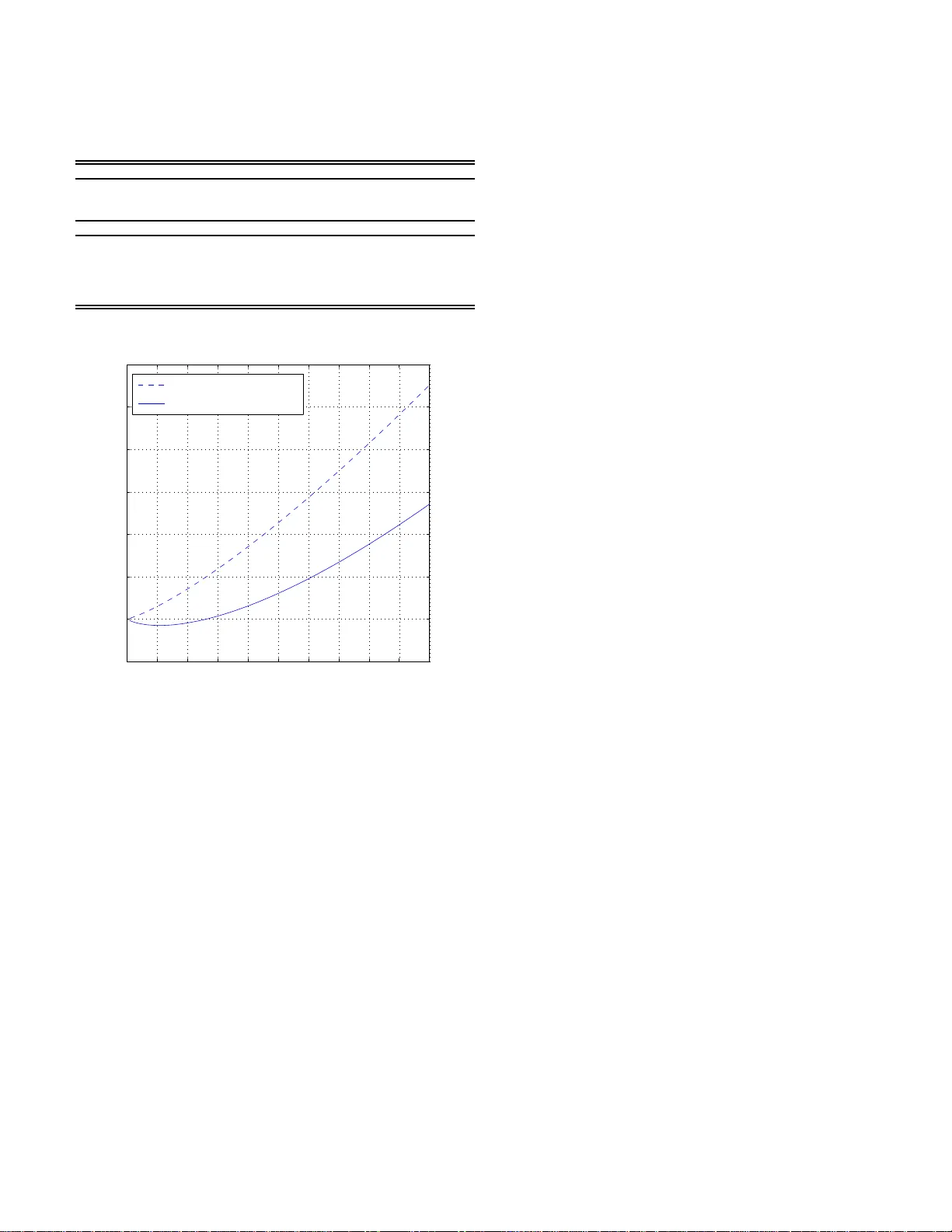
Gro wth Rate of the W eight Distrib ution o f Doubly-Generalized LDPC Codes: General Case and Ef ficient Ev aluation Mark F . Flanagan , Enrico Paolini, Marco Chiani, and Marc P . C. Foss orier Abstract —The gro wt h rate of th e weight distribution o f irreg- ular doubly-generalized LDPC (D-GLDPC) codes is deve loped and in the pro cess, a new efficient numerical technique f or its ev aluation is presented. The solution inv olves simultaneous solution of a 4 × 4 system of polynomial equations. This repr esents the first efficient numerical technique fo r exact ev aluation of the gro wt h rate, ev en fo r LDPC codes. The techniq ue is applied to two example D-GLDPC code ensembles. I . I N T RO D U C T I O N Recently , the design an d ana lysis of coding schemes repre- senting g eneralization s of Gallager’ s low-density par ity-check (LDPC) codes [1] has gained increasing attention. This interest is motiv a ted above all by th e potential capability of these coding schemes to of fer a better compro mise between waterfall and erro r floor perf ormance than is curre ntly offered by state- of-the- art L DPC codes. In the T anner graph of an LDPC cod e, any degree- q variable node (VN) m ay be interp reted as a leng th- q repetition co de, i.e., as a ( q , 1) linear bloc k code. Similarly , any degree- s check node (CN) m ay b e interpreted as a leng th- s single par ity- check (SPC) code, i.e., as a ( s, s − 1 ) linear block code. Th e first pro posal of a class of linear block co des gener alizing LDPC cod es may b e fou nd in [2], wher e it was su ggested to replace each CN o f a r egular LDPC code with a generic linear block code, to enhan ce the overall minimum distance. The correspo nding coding scheme is known as a regular generalized L DPC (GLDPC) code, o r T anner cod e, and a CN that is n ot a SPC code as a generalized CN. More recently , irregular GLDPC co des were considered (see for instance [3]). For such c odes, the VNs e xhibit d ifferent degrees a nd the CN set is composed of a mixture of dif ferent linear block codes. A further generalization step is rep resented b y doubly - generalized LDPC (D-GLDPC) codes [4]. In a D-GLDPC code, not only the CNs b u t also the VNs may be represented by generic linear b lock codes. T he VNs wh ich are n ot repetition codes are c alled generalized VNs. The main motiv ation for introdu cing gener alized VNs is to overcome some pro blems connected with the use o f gen eralized CNs, such as an overall M. F . Flanaga n is with the School of Electrica l, Electronic and Mechan- ical E nginee ring, Uni versi ty Colle ge Dublin, Belfield, Dublin 4, Ireland (e- mail:mark.flan agan@i eee.or g). E. Paoli ni and M. Chiani are with DEIS, Univ ersity of Bologna, V ia V enezi a 52, 47023 Cesena (FC), Cesena, Italy (e-mail:e.paol ini@uni bo.it, marco.chia ni@unibo .it). M. P . C. Fossorie r is with ETIS ENSEA, UCP , CNRS UMR-8051, 6 avenue du Ponceau, 95014 Cergy Pontoise, France (e-mail: mfossorier@ie ee.org ). code rate loss which makes GLDPC codes interesting m ainly for low co de r ate application s, and a loss in terms of deco ding threshold (for a d iscussion on dr awbacks of generalized CNs and on beneficial effects of gene ralized VNs we refer to [ 5] and [6], respecti vely). A useful tool fo r a nalysis and design of LDPC cod es and their generalization s is represented b y the g rowth rate of the weight distribution, or equiv alen tly , the asymptotic weight enumera ting fu nction (WEF). Th e growth r ate of the weight distribution was introd uced in [1] to show that the minimum distance of a ran domly ge nerated regular LDPC code with a VN degree of at least three is a linear functio n of the codew o rd length with hig h pro bability . Th e sam e appr oach was taken in [7] and [ 8] to obtain r elated results on the minimum distance of subclasses of T an ner codes. The growth rate of the weight distribution has been subse- quently investigated for unstru ctured ensembles of irregular LDPC cod es. W o rks in this area are [9], [10], [1 1], [12]. In p articular, in [12] a technique f or appr oximate ev alu ation of the growth rate of any (eventually expurgated ) irregular LDPC ensem ble has been developed, based o n Haym an’ s formu la. Asym ptotic weight e numerato rs of ensembles of irregular L DPC codes b ased on protog raphs and on multiple edge ty pes have bee n der i ved in [13] and [14], respectiv ely . The approach pr oposed in [13] has then been extend ed to protog raph GLDPC codes and to pro tograp h D-GLDPC codes in [15] and [16], r espectively . In [17], the authors p resented a compact form ula for the growth rate of gen eral unstructured irregular D- GLDPC co de ensembles for the specific case of small weight codewords. In this paper, an an alytical expression for the growth rate of the weigh t distribution of a gen eral unstructured irregular ensemble of D-GLDPC cod es is d ev eloped. As op posed to th e formu la developed in [17], the propo sed e xpression holds f or any codeword weight. The present work also extends to the fully-irr egular case an expr ession fo r the growth rate obta ined in [1 8] assuming a CN set co mposed of linear block c odes all of the same ty pe. In the process of this d ev elopmen t, we obtain an efficient e valuation tool for computing the growth rate exactly . This tool always req uires th e solution of a (4 × 4) polyno mial system of equations, re gar dless of the numb er of VN types and CN types in the D-GLDPC en semble. As shown throug h n umerical examples, the p roposed tool allows to ob tain a prec ise plot o f the growth rate with a low computatio nal effort. For the c ase of irregular LDPC cod es, a techniq ue for numerical evaluation o f th e growth r ate of the weight distribution was g iv en in [1 2]; in contrast to the technique developed in this paper, the method of [1 2] provided an appr oximate n umerical solution for the growth rate; it is also more computationally com plex th an that pr oposed in th e present work. I I . P R E L I M I N A RI E S A N D N OT A T I O N W e define a D-GLDPC co de ensemble M n as follows, where n den otes th e number of VNs. Th ere are n c different CN type s t ∈ I c = { 1 , 2 , · · · , n c } , and n v different VN types t ∈ I v = { 1 , 2 , · · · , n v } . For each CN ty pe t ∈ I c , we d enote by h t , s t and r t the CN dimension , len gth and minimum distan ce, respectively . For e ach VN ty pe t ∈ I v , we deno te b y k t , q t and p t the VN dimensio n, leng th and minimum distance, respec ti vely . For t ∈ I c , ρ t denotes the fraction o f e dges co nnected to CNs of typ e t . Similarly , f or t ∈ I v , λ t denotes the fraction of edges connected to VNs of type t . Note that all of these v ariables are independent of n . The polynomia ls ρ ( x ) an d λ ( x ) are defined by ρ ( x ) , P t ∈ I c ρ t x s t − 1 and λ ( x ) , P t ∈ I v λ t x q t − 1 . If E denotes the number of edges in th e T anne r graph, the number of CNs of type t ∈ I c is then gi ven by E ρ t /s t , and the number of VNs of type t ∈ I v is then given b y E λ t /q t . Deno ting as usual R 1 0 ρ ( x ) d x an d R 1 0 λ ( x ) d x by R ρ and R λ respectively , we see that the number of e dges in the T a nner graph is gi ven by E = n/ R λ and the n umber of CNs is given by m = E R ρ . Therefo re, the fraction of CNs of type t ∈ I c and th e f raction of VNs of type t ∈ I v are given by γ t = ρ t s t R ρ and δ t = λ t q t R λ (1) respectively . Also the length of any D-GLDPC codew ord in the ensemble is giv en by N = X t ∈ I v E λ t q t k t = n R λ X t ∈ I v λ t k t q t . (2) Note that this is a linear f unction o f n . Sim ilarly , the total number of p arity-check equation s for any D-GLDPC code in the ensemble is g iv en by M = m R ρ P t ∈ I c ρ t ( s t − h t ) s t . A mem- ber o f the en semble M n then correspon ds to a pe rmutation on the E ed ges connecting CNs to VNs. The WEF for CN type t ∈ I c is given by A ( t ) ( z ) = 1 + P s t u = r t A ( t ) u z u . Here A ( t ) u ≥ 0 denotes the n umber of weight- u codewords for CNs of ty pe t . The input-outpu t weight enumera ting function (IO-WEF) fo r VN ty pe t ∈ I v is given by B ( t ) ( x, y ) = 1 + P k t u =1 P q t v = p t B ( t ) u,v x u y v . Here B ( t ) u,v ≥ 0 denotes the n umber of weight- v codewords generated b y in put words of weight u , for VNs of ty pe t . Also, B ( t ) 2 is the total number of weight- 2 codew ords for VNs of ty pe t . If there exist CNs an d VNs with minimum distance equal to 2 , and define the (positi ve) par ameters C = 2 X t : r t =2 ρ t A ( t ) 2 s t ; V = 2 X t : p t =2 λ t B ( t ) 2 q t . (3) The design rate of any D-GL DPC ensemble is gi ven by R = 1 − P t ∈ I c ρ t (1 − R t ) P t ∈ I v λ t R t (4) where for t ∈ I c (resp. t ∈ I v ) R t is the lo cal code r ate of a type- t CN (resp. VN). Throu ghout this p aper, the n otation e = ex p(1) denotes Napier’ s number, all the logarithms are assumed to ha ve base e and for 0 < x < 1 the notation h ( x ) = − x log( x ) − (1 − x ) log(1 − x ) denotes the binary entropy f unction. I I I . G ROW T H R AT E O F T H E W E I G H T D I S T R I B U T I O N O F G E N E R A L I R R E G U L A R D - G L D P C C O D E E N S E M B L E S The growth rate of the weight distribution of th e ir regular D-GLDPC ensemble sequence {M n } is defined by G ( α ) , lim n →∞ 1 n log E M n [ N αn ] (5) where E M n denotes the e xpectation opera tor over th e ensem- ble M n , and N w denotes the numb er of codewords of weight w of a r andom ly chosen D-GLDPC cod e in the ensemb le M n . The limit in (5) assumes the inclusion of only tho se positive integers n for wh ich αn ∈ Z an d E M n [ N αn ] is po siti ve. Note that the argu ment of the growth rate functio n G ( α ) is equa l to the ratio of D-GLDPC codeword leng th to the number of VNs; by (2), this captu res the be haviour o f cod ew ords linear in the block length, as in [12] for the LDPC case. A D-GLDPC ensemble is said to be asymp totically good if and o nly if α ∗ , inf { α > 0 | G ( α ) ≥ 0 } > 0 . The par ameter α ∗ is called the ensemb le relative minimum distance . In [19], it w as sho wn that a D-GLD PC e nsemble is always asympto tically g ood if there exist no CNs o r VNs with minimum distance 2 wh ile, if the exist both CNs and VNs with minimum distance 2 , the ensemble is asymp totically g ood if and only if C · V < 1 , where C and V are given b y (3). Note that using (2), we may also d efine the growth rate with respect to the number of D-GLDPC code bits N as fo llows: H ( γ ) , lim N →∞ 1 N log E M n [ N γ N ] . (6) It is straightforward to sho w that H ( γ ) = G ( γ y ) y (7) where y = 1 R λ X t ∈ I v λ t k t q t . In this section, we formulate an expression o f the growth rate for an irregular D-GLDPC ensemble M n over a wider range of α than w as considered in [17], [19] (w here the case α → 0 was analyzed). The following theo rem constitutes our main result. Theor em 1: The growth rate of the weight distribution of the irr egular D-GLDPC ensem ble seq uence {M n } is given by G ( α ) = X t ∈ I v δ t log B ( t ) ( x 0 , y 0 ) − α log x 0 + R ρ R λ X s ∈ I c γ s log A ( s ) ( z 0 ) + log 1 − β R λ R λ (8) where x 0 , y 0 , z 0 and β are the uniqu e p ositiv e real solutions to the 4 × 4 system of polyn omial eq uations 1 z 0 R ρ R λ X t ∈ I c γ t d A ( t ) d z ( z 0 ) A ( t ) ( z 0 ) = β , (9) x 0 X t ∈ I v δ t ∂ B ( t ) ∂ x ( x 0 , y 0 ) B ( t ) ( x 0 , y 0 ) = α , (10) y 0 X t ∈ I v δ t ∂ B ( t ) ∂ y ( x 0 , y 0 ) B ( t ) ( x 0 , y 0 ) = β , (11) and β Z λ (1 + y 0 z 0 ) = y 0 z 0 . (12) The theorem is proved in Section IV. I V . P RO O F O F T H E M A I N R E S U LT In this sectio n we prove Th eorem 1. The proo f uses the concepts of assignment and split assignmen t , d efined next. Definition 1: An assignment is a subset of the edg es o f the T anner g raph. An assignment is said to have weight k if it has k elements. An assignmen t is said to be check-valid if the following c ondition ho lds: suppo sing that each ed ge of the assignment carries a 1 a nd each of the oth er edges c arries a 0 , each CN recognizes a v alid local code word. Definition 2: A split assignment is a n assignme nt, together with a subset of the D-GLD PC cod e bits (ca lled a c odewor d assignment ). A split assignment is said to have split weight ( u, v ) if its assign ment ha s w eight v an d its co dew ord as- signment has u elements. A split assign ment is said to be chec k-valid if its assignmen t is check-valid. A split assignm ent is said to be variable-va lid if the following co ndition holds: supposing that eac h edge of its a ssignment c arries a 1 an d each of the other edge s carr ies a 0 , and supposing that each D-GLDPC code bit in the code word assigmen t is set to 1 and each of the other code b its is set to 0 , each VN rec ognizes a local input word and the corre sponding valid lo cal co dew ord. For ease of p resentation, the proof is broken into tw o parts. A. Num ber of chec k- valid assignments of weight δm First we derive an exp ression, v a lid asymptotically , for the number of check -valid assignments of weight δ m . For each t ∈ I c , let ǫ t m d enote the po rtion of the total we ight δ m apportio ned to CNs of ty pe t . Th en ǫ t ≥ 0 for each t ∈ I c , and P t ∈ I c ǫ t = δ . Also denote ǫ = ( ǫ 1 ǫ 2 · · · ǫ n c ) . Consider th e set o f γ t m CNs of a particular typ e t ∈ I c , where γ t is g iv en by (1). Using generatin g f unctions, the number of check-valid assignments (over these CNs) of weight ǫ t m is gi ven by N ( γ t m ) c,t ( ǫ t m ) = Coeff h A ( t ) ( x ) γ t m , x ǫ t m i 1 Note that while (9), (10) and (11) are no t polynomial as set do wn here, each may be made polynomial by multiplying across by an appropriate factor . where Coeff [ p ( x ) , x c ] deno tes the c oefficient of x c in th e polyno mial p ( x ) . W e next make use of the fo llowing r esult, which is a special case of [12, C orollary 16] : Lemma 1: Let A ( x ) = 1 + P d u = c A u x u , where 1 ≤ c ≤ d , be a polynom ial satisfyin g A c > 0 and A u ≥ 0 fo r all c < u ≤ d . Then lim ℓ →∞ 1 ℓ log Coeff h ( A ( x )) ℓ , x ξℓ i = log A ( z ) z ξ (13) where z is the unique positiv e real so lution to A ′ ( z ) A ( z ) · z = ξ . (14) Applying this lemm a b y substituting A ( x ) = A ( t ) ( x ) , ℓ = γ t m and ξ = ǫ t /γ t , we obtain that as m → ∞ N ( γ t m ) c,t ( ǫ t m ) = Coeff h A ( t ) ( x ) γ t m , x ǫ t m i (15) → exp n m γ t log A ( t ) ( z 0 ,t ) − ǫ t log z 0 ,t o (16) where, fo r each t ∈ I c , z 0 ,t is the uniq ue p ositi ve r eal solution to γ t d A ( t ) d z ( z 0 ,t ) A ( t ) ( z 0 ,t ) · z 0 ,t = ǫ t . (17) The n umber of check -valid assignments o f weigh t δ m satisfying the constraint ǫ is obtaine d by multiply ing the number s of check-valid assign ments of weig ht ǫ t m ov er γ t m CNs of type t , for each t ∈ I c , N ( ǫ ) c ( δ m ) = Y t ∈ I c N ( γ t m ) c,t ( ǫ t m ) . (18) The nu mber N c ( δ m ) of check- valid assignmen ts of weight δ m is then equal to th e su m of N ( ǫ ) c ( δ m ) o ver all admissible vectors ǫ ; therefore by (16), as m → ∞ N c ( δ m ) → X ǫ : P t ∈ I c ǫ t = δ exp { mW ( ǫ ) } (19) where W ( ǫ ) = X t ∈ I c γ t log A ( t ) ( z 0 ,t ) − ǫ t log z 0 ,t . (20) As m → ∞ , the asym ptotic expression is d ominated by th e distribution ǫ which max imizes the argument o f the e xponen - tial function 2 . Therefo re as m → ∞ N c ( δ m ) → exp { mX } (21) where X = max ǫ W ( ǫ ) (22) and the maximization is subject to the constraint V ( ǫ ) = X t ∈ I c ǫ t = δ (23) together with ǫ t ≥ 0 for each t ∈ I c , a nd fo r every t ∈ I c , z 0 ,t is the u nique positive r eal solution to (17). Note that fo r 2 Observe that as m → ∞ , P t exp( mZ t ) → exp( m max t { Z t } ) each t ∈ I c , (17) pr ovides an implicit definition of z 0 ,t as a function of ǫ t . W e solve th is optimizatio n problem using Lagrange multi- pliers, ignor ing for the moment the inequ ality constraints. At the maximu m, we mu st ha ve ∂ W ( ǫ ) ∂ ǫ t = λ ∂ V ( ǫ ) ∂ ǫ t (24) for all t ∈ I c , where λ is the Lagr ange m ultiplier . Th is yields ∂ z 0 ,t ∂ ǫ t " γ t d A ( t ) d z ( z 0 ,t ) A ( t ) ( z 0 ,t ) − ǫ t z 0 ,t # − log z 0 ,t = λ . (25) The term in square b rackets is eq ual to zer o d ue to ( 17); therefor e this simp lifies to log z 0 ,t = − λ for all t ∈ I c . W e conclud e th at all of the { z 0 ,t } are equal, and we may write z 0 ,t = z 0 ∀ t ∈ I c . (26) Making this substitution in (21) and using (23) we obtain N c ( δ m ) → exp ( m X t ∈ I c γ t log A ( t ) ( z 0 ) − δ log z 0 !) . (27) Summing (17) over t ∈ I c and using (23) and (2 6) implies that the value of z 0 in (27) is the uniq ue p ositi ve real solution to (9) (here we hav e also used th e fact that n R ρ = m R λ ). B. P olynomial- System So lution for the Gr o wth Rate Consider the set o f δ t n VNs o f a particular type t ∈ I v , where δ t is given b y ( 1). Using g enerating functions, th e number of variable-valid split assignm ents (over these VNs) of split weight ( α t n, β t n ) is given by N ( δ t n ) v, t ( α t n, β t n ) = Coeff B ( t ) ( x, y ) δ t n , x α t n y β t n where Coe ff [ p ( x, y ) , x c y d ] denotes the c oefficient of x c y d in the biv ariate polynom ial p ( x, y ) . W e make use of the follo wing result, which is a special case of [12, Corollary 16]: Lemma 2: Let B ( x, y ) = 1 + k X u =1 d X v = c B u,v x u y v where k ≥ 1 and 1 ≤ c ≤ d , be a biv ariate polynom ial satisfying B u,v ≥ 0 for all 1 ≤ u ≤ k , c ≤ v ≤ d . Then lim ℓ →∞ 1 ℓ log Coeff h ( B ( x, y )) ℓ , x ξℓ y θ ℓ i = log B ( x 0 , y 0 ) x ξ 0 y θ 0 ! (28) where x 0 and y 0 are the uniq ue positi ve real solutions to the pair of simultaneous equations ∂ B ∂ x ( x 0 , y 0 ) B ( x 0 , y 0 ) · x 0 = ξ (29) and ∂ B ∂ y ( x 0 , y 0 ) B ( x 0 , y 0 ) · y 0 = θ . (30) Applying this lemma b y substituting B ( x, y ) = B ( t ) ( x, y ) , ℓ = δ t n , ξ = α t /δ t and θ = β t /δ t , we obtain that as n → ∞ N ( δ t n ) v, t ( α t n, β t n ) = Coeff B ( t ) ( x, y ) δ t n , x α t n y β t n → exp n nX ( δ t ) t ( α t , β t ) o (31) where X ( δ t ) t ( α t , β t ) = δ t log B ( t ) ( x 0 ,t , y 0 ,t ) − α t log x 0 ,t − β t log y 0 ,t (32) and where x 0 ,t and y 0 ,t are the unique po siti ve real solutions to the pair of simultaneous equations δ t ∂ B ( t ) ∂ x ( x 0 ,t , y 0 ,t ) B ( t ) ( x 0 ,t , y 0 ,t ) · x 0 ,t = α t (33) and δ t ∂ B ( t ) ∂ y ( x 0 ,t , y 0 ,t ) B ( t ) ( x 0 ,t , y 0 ,t ) · y 0 ,t = β t . ( 34) Next, note that the expected num ber of D-GLDPC cod e- words of weig ht αn in the ensemb le M n is e qual to the sum over β of the expected numbers of split assignm ents of split weight ( αn, β n ) which ar e both check-valid and variable- valid, d enoted N v, c αn,β n : E M n [ N αn ] = X β E M n [ N v, c αn,β n ] . This may then be expressed as E M n [ N αn ] = X α t ≥ 0 ,t ∈ I v P t α t = α X β t ≥ 0 ,t ∈ I v P c-valid ( β n ) × Y t ∈ I v N ( δ t n ) v, t ( α t n, β t n ) . (35) where β = P t ∈ I v β t . Here P c-valid ( β n ) denotes the pro bability that a r andomly cho sen assignm ent of weight β n is che ck- valid, an d is gi ven by P c-valid ( β n ) = N c ( β n ) . E β n . Applying [12, eqn. (25)], we find that as n → ∞ E β n = n/ R λ β n → exp n R λ h β Z λ . Combining this result with (27), we obtain that as n → ∞ P c-valid ( β n ) → exp { nY ( β ) } where Y ( β ) = R ρ R λ X t ∈ I c γ t log A ( t ) ( z 0 ) − β lo g z 0 − h ( β R λ ) R λ . Therefo re, as n → ∞ E M n [ N αn ] → X α t ≥ 0 ,t ∈ I v P t α t = α X β t ,t ∈ I v exp ( n X t ∈ I v X ( δ t ) t ( α t , β t ) + Y ( β ) !) (36) where β , X t ∈ I v β t . (37) Note that the sum in (36) is dominated asym ptotically b y the term which maximizes the argument of the exponen tial fun c- tion. Thus, denoting th e two vectors of independent v a riables by α = ( α t ) t ∈ I v and β = ( β t ) t ∈ I v , we have G ( α ) = max α , β S ( α , β ) (38) where S ( α , β ) = X t ∈ I v X ( δ t ) t ( α t , β t ) + Y ( β ) (39) where β is given by (37), an d the maximization is subje ct to the constraint R ( α , β ) = X t ∈ I v α t = α (40) together with α t ≥ 0 and appr opriate ine quality constraints on β t for each t ∈ I v , and P t α t = α . Note that ( 9) provides an imp licit definition of z 0 as a function of β . Similarly , f or any t ∈ I v , (33) an d (34) p rovide implicit de finitions of x 0 ,t and y 0 ,t as fu nctions of the two variables α t and β t . W e solve the co nstrained optimization prob lem using La- grange multipliers, ignorin g f or the momen t the ineq uality constraints. At the maximum, we must ha ve ∂ S ( α , β ) ∂ α t = µ ∂ R ( α , β ) ∂ α t for all t ∈ I v , wh ere µ is the Lagrang e multip lier . This yields ∂ x 0 ,t ∂ α t " δ t ∂ B ( t ) ∂ x ( x 0 ,t , y 0 ,t ) B ( t ) ( x 0 ,t , y 0 ,t ) − α t x 0 ,t # − log x 0 ,t + ∂ y 0 ,t ∂ α t δ t ∂ B ( t ) ∂ y ( x 0 ,t , y 0 ,t ) B ( t ) ( x 0 ,t , y 0 ,t ) − β t y 0 ,t = µ . The terms in square bra ckets are zero due to (33) and ( 34) respectively; therefo re this simplifies to log x 0 ,t = − µ fo r all t ∈ I v . W e conclu de that all of th e { x 0 ,t } are equal, and we may write x 0 ,t = x 0 ∀ t ∈ I v . (41) At the maximum , we must also have ∂ S ( α , β ) ∂ β t = µ ∂ R ( α , β ) ∂ β t for all t ∈ I v . This yields ∂ x 0 ,t ∂ α t " δ t ∂ B ( t ) ∂ x ( x 0 ,t , y 0 ,t ) B ( t ) ( x 0 ,t , y 0 ,t ) − α t x 0 ,t # − log y 0 ,t − log z 0 + ∂ y 0 ,t ∂ β t δ t ∂ B ( t ) ∂ y ( x 0 ,t , y 0 ,t ) B ( t ) ( x 0 ,t , y 0 ,t ) − β t y 0 ,t − log 1 − β R λ β R λ + ∂ z 0 ∂ β t " R ρ R λ X s ∈ I c γ s d A ( s ) d z ( z 0 ) A ( s ) ( z 0 ) − β z 0 # = 0 . (42) The ter ms in square brackets are zero d ue to (33), (34) and (9) respectively; therefo re this simplifies to z 0 y 0 ,t 1 − β R λ β R λ = 1 ∀ t ∈ I v . (43) W e c onclude that all o f the { y 0 ,t } a re eq ual, and we may write y 0 ,t = y 0 ∀ t ∈ I c . (44) Rearrangin g (43) we o btain (12). Also, summin g (33) over t ∈ I v and using (40) and (41) yield s (10). Similarly , summing (34) over t ∈ I v and using (37) an d ( 44) yields ( 11). Substituting ba ck into ( 39) and using (41), (4 4), (40) and (37) yields G ( α ) = X t ∈ I v δ t log B ( t ) ( x 0 , y 0 ) − α log x 0 − β log y 0 + R ρ R λ X s ∈ I c γ s log A ( s ) ( z 0 ) − β log z 0 − h ( β R λ ) R λ (45) where x 0 , y 0 , z 0 and β are th e un ique positiv e real solution s to the 4 × 4 system of equations (9), (10), (11) an d (12). Fin ally , (12) leads to the observation that − β log z 0 − β log y 0 − h ( β R λ ) R λ = log 1 − β R λ R λ which, when substituted in (45), leads to (8). V . E X A M P L E S In this section the growth rates of two e xample D-GLDPC ensembles of design ra te R = 1 / 2 are evaluated using the polyno mial solution of Theore m 1. W e use Hamming (7 , 4) codes as genera lized CNs an d SPC codes as g eneralized VNs. Three repr esentations of SPC VNs are co nsidered, namely , the cyclic (C), the systema tic (S) and th e antisystematic ( A) representatio ns 3 . Ensemble 1 is characterized b y two CN ty pes an d two VN types. Specifically , we have I c = { 1 , 2 } , wher e 1 ∈ I c denotes a (7 , 4 ) Hamm ing CN type and 2 ∈ I c denotes a length- 7 sin gle parity check (SPC) CN typ e, and I v = { 1 , 2 } , where 1 ∈ I v denotes a rep etition- 2 VN type and 2 ∈ I v denotes a length- 7 SPC CN type in cyclic f orm. Ensemble 2 is ch aracterized by two CN types and four VN types. Specifically , we have I c = { 1 , 2 } , where 1 ∈ I c denotes a (7 , 4) Ham ming CN type and 2 ∈ I c denotes a SPC- 7 CN type , and I v = { 1 , 2 , 3 , 4 } , where 1 ∈ I v denotes a repetition- 2 VN type, 2 ∈ I v denotes a length- 7 SPC CN type in cyclic fo rm, 3 ∈ I v denotes a length- 7 SPC CN type in antisystematic fo rm, and 4 ∈ I v denotes a length - 7 SPC CN type in systematic form. The edge-p erspective typ e distributions o f the two ensembles are summar ized in T ab le I. Both Ensemble 1 and Ensemble 2 h av e been obtain ed by perfor ming a deco ding threshold o ptimization with differential ev olu tion (DE) [2 0]. Ensemb le 1 has been obtained by only 3 The ( k × ( k + 1)) generator matrix of a SP C code in A form is obtaine d from the ge nerato r matrix in S form by complementing each bit in t he first k columns. N ote that a ( k × ( k + 1)) generat or matrix in A form represents a SPC code if and only if the code length q = k + 1 is odd. For e ve n k + 1 we obtai n a d min = 1 code with one codew ord of weight 1 . T ABLE I C O E FFI C I E N T S O F λ ( x ) A N D ρ ( x ) F OR T H E T W O E X A M P L E D - G L D P C E N S E M B L E S . Ensemble 1 V ariable nodes Chec k nodes 1:repet ition − 2 λ 1 = 0 . 055646 1:Hamming (7 , 4) ρ 1 = 0 . 965221 2:SPC − 7 (C) λ 2 = 0 . 944354 2:SPC − 7 ρ 2 = 0 . 034779 Ensemble 2 V ariable nodes Chec k nodes 1:repet ition − 2 λ 1 = 0 . 022647 1:Hamming (7 , 4) ρ 1 = 0 . 965221 2:SPC − 7 (C) λ 2 = 0 . 100000 2:SPC − 7 ρ 2 = 0 . 034779 3:SPC − 7 (A) λ 2 = 0 . 539920 4:SPC − 7 (S) λ 2 = 0 . 337432 0 0.001 0.002 0.003 0.004 0.005 0.006 0.007 0.008 0.009 0.01 −0.5 0 0.5 1 1.5 2 2.5 3 x 10 −3 P S f r a g r e p l a c e m e n t s α Growth r ate, G ( α ) Ensemb le 1 ( 2 VN types) Ensemb le 2 ( 4 VN types) Fig. 1. Gro wth rates of the two example ensembles describe d in Sectio n V. Ensemble 1 is asymptotical ly bad, while Ensemble 2 is asymptotica lly good with an ensemble relati ve minimum distance of α ∗ = 2 . 625 × 10 − 3 . imposing the n ode type an d R = 1 / 2 co nstraint. In th is case we ha ve C · V = 1 . 19 > 1 , so the ensemble is asympto tically bad ( α ∗ = 0 ). En semble 2 h as b een ob tained by imp osing the nod e typ e and R = 1 / 2 constrain t, together with the constraints C · V ≤ 0 . 5 an d λ 2 ≥ 0 . 1 . Since in th is case we have C · V = 0 . 5 < 1 , the en semble is asymptotically good ( α ∗ > 0 ) . The expected asymp totically bad o r good behavior of th e two ensemb les is r eflected in the g rowth r ate curves shown in Fig. 1. Using a standard nume rical solver , it took only 5 . 1 s and 6 . 7 s to ev a luate 10 0 po ints on th e E nsemble 1 curve and on th e E nsemble 2 curve, r espectively . Th e relative minimum distance of Ensemble 2 is α ∗ = 2 . 625 × 1 0 − 3 . V I . C O N C L U S I O N A general expression f or the asymptotic gro wth r ate of the weight distribution of irregula r D-GLDPC e nsembles has been presented. Evaluation o f the expression require s solution of a 4 × 4 poly nomial sy stem, irrespective o f the number of VN and CN types in the en semble. Simulation results were presented for tw o example optimized irregular D-GLDPC code ensembles. A C K N OW L E D G M E N T This work was supported in pa rt by the EC u nder Sev enth FP grant agreement ICT OPTIMIX n.INFSO-ICT -2 14625 . R E F E R E N C E S [1] R. Gallager , Low-Density P arity-Chec k Codes . Cambridge, Mas- sachusett s: M.I.T . Press, 1963. [2] R. M. T anner , “ A rec ursi ve approach to low comple xity code s, ” IEEE T rans. Inf. Theory , vol . 27, no. 5, pp. 533–547, Sept. 1981. [3] G. Liv a, W . E. Ryan, and M. Chiani, “Quasi-c yclic genera lized LDPC codes with low error floors, ” IEEE Tr ans. Commun. , vol. 56, no. 1, pp. 49–57, Jan. 2008. [4] Y . W ang and M. Fossorier , “Doubly gene ralize d low-de nsity parity- check codes, ” in Proc. of 2006 IE EE Int. Symp. on Information Theory , Seattl e, W A, USA, July 2006, pp. 669–673. [5] N. Miladinovi c and M. Fossorier , “Generalize d LDPC codes and gener- alize d s topping sets, ” IEEE T rans. Co mmun. , vol. 56, no . 2, pp. 201–212, Feb . 2008. [6] E . Pa olini, M. Fossorier , and M. Chiani, “Doubly -genera lized LDPC codes: Stabil ity bound over the BEC, ” IEE E T rans. Inf. Theory , vol. 55, no. 3, pp. 1027–1046, Mar . 2009. [7] M. Lentmaier and K. Zigan girov , “On generalized low-d ensity pari ty- check codes based on Hamming component codes, ” IEEE Commun. Lett. , vol. 3, no. 8, pp. 248–250, Aug. 1999. [8] J . Boutros, O. Pothier , and G. Zemor, “Genera lized low density (Tanner) codes, ” in Pr oc. of 199 9 IEEE Int. Conf. on Communicatio ns , vol. 1, V ancouv er, Canada, June 1999, pp. 441–445. [9] S. Lit syn and V . Shev elev , “On ensembles of low-densi ty parity-check codes: asymptotic distance distri buti ons, ” IEEE T rans. Inf. Theory , vol. 48, no. 4, pp. 887–908, Apr . 2002. [10] D. Burshtein and G. Miller , “ Asymptotic enumeration methods for analyz ing L DPC co des, ” IEEE T rans. Inf. Theory , v ol. 50, no. 6, pp. 1115–1131, June 2004. [11] A. Orlitsk y , K. V iswanat han, and J. Zhang, “Stoppi ng set distri buti on of LDPC code ensembles, ” IE EE T rans. Inf. Theory , vol. 51, no. 3, pp. 929–953, Mar . 2005. [12] C. Di, R. Urbank e, and T . Richard son, “W eight distributi on of lo w- density parity-check codes, ” IEEE T rans. Inf . Theory , vol. 52 , no . 11, pp. 4839–4855, Nov . 2006. [13] D. Divsala r , “Ensemble weight enumerators for protograph L DPC codes, ” in 2006 IEEE In t. Symp. on Information Theory , Seattle, W A, USA, July 2006, pp. 1554–1558. [14] T . A wano, K. Kasa i, T . Shibuya, and K. Saka niwa , “Three-edge type LDPC code ensembles with exponent ially fe w code words with linear small weight, ” in 2008 Int. Symp. on Informat ion Theory and its Applicat ions , Auckland, New Z eala nd, Dec. 2008, pp. 731–735. [15] S. Abu-Surra, W . E. Ryan, and D. Divsal ar , “Ensemble enumerators for protogr aph-based generalize d LDPC codes, ” in Proc. of 2007 IEEE Global Communications Conf . , W ashington, DC, USA, Nov . 2007, pp. 1492–1497. [16] Y . W ang, C.-L . W ang, and M. Fossorie r , “Ensemble weight enumerat ors for protograph-based doubly generalize d LDPC codes, ” in P r oc. of 2008 IEEE Int. Symp. on Information Theory , T oronto, Canada, July 2008, pp. 1168–1172. [17] M. F . Flanagan, E. Paolini , M. Chiani, and M. Fossorier , “On the growth rate of the weight distrib ution of irregu lar doubly-gene ralize d LDPC codes, ” in in Proc. of the 46-th Allerton Conf . on Communicat ion, Contr ol, and Computing , Monticello, IL, USA, Sept. 2008, pp. 922– 929. [18] E . Paolini , M. F . Flanagan, M. Chiani, and M. Fossorier , “On a class of doubly-gene raliz ed LDPC codes with s ingle parity-che ck vari able nodes, ” in Pro c. of 2009 IEEE Int. Symp. on Information Theory , Seoul, Ko rea, July 2009, pp. 1983–1987. [19] M. Flanagan, E. Paoli ni, M. Chiani, and M. Fossorier , “On the gro wth rate of the weight distrib ution of irregu lar doubly-gene ralize d LDPC codes, ” IEEE T rans. Inf. Theory , 2009, submitted. [20] K. Price, R. Storn, and J. Lampinen, Diffe re ntial Evolution: A Practical Appr oach to Global Optimization , 1st ed. Berlin, Germany: Springer - V erlag, 2005.
Original Paper
Loading high-quality paper...
Comments & Academic Discussion
Loading comments...
Leave a Comment