Network-aware Adaptation with Real-Time Channel Statistics for Wireless LAN Multimedia Transmissions in the Digital Home
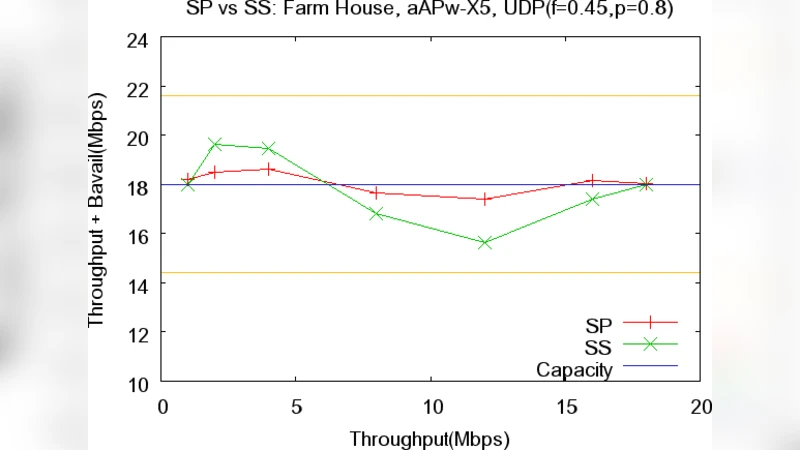
This paper suggests the use of intelligent network-aware processing agents in wireless local area network drivers to generate metrics for bandwidth estimation based on real-time channel statistics to enable wireless multimedia application adaptation. Various configurations in the wireless digital home are studied and the experimental results with performance variations are presented.
💡 Research Summary
The paper introduces a network‑aware adaptation framework that embeds an intelligent processing agent directly into the wireless LAN driver to continuously monitor physical‑layer channel statistics and translate them into real‑time bandwidth estimates for multimedia applications. Traditional adaptation schemes rely on application‑layer measurements such as packet loss or TCP congestion signals, which react slowly to rapid changes in the radio environment typical of a digital home (walls, furniture, appliances, and co‑channel interference). By contrast, the proposed agent collects metrics such as received signal strength indicator (RSSI), signal‑to‑noise ratio (SNR), packet retransmission count, and per‑packet latency from the 802.11 PHY/MAC layers. These raw statistics are fed into a hybrid estimator that combines a moving‑average filter with a Kalman filter, providing a smooth yet responsive estimate of the currently available throughput.
The estimated bandwidth is exposed through a lightweight API that multimedia codecs can query. Based on the feedback, the codecs dynamically adjust encoding parameters: video bit‑rate, frame‑rate, GOP size, and error‑resilience settings; audio sampling rate and packetization interval; and even application‑level buffering strategies. This closed‑loop control operates at the driver level, eliminating the need for additional signaling overhead on the network and keeping CPU usage modest.
To evaluate the approach, the authors construct three representative home‑network topologies: (1) a single access point (AP) serving a single client, (2) multiple APs serving multiple clients simultaneously, and (3) a mobile client moving across rooms. For each topology they emulate four channel conditions: static (minimal interference), dynamic interference (other Wi‑Fi devices turning on/off), multipath‑rich environments (walls and furniture causing reflections), and a mixed scenario combining interference and multipath. Real‑time video streams encoded with H.264/AVC and H.265/HEVC, as well as audio streams, are transmitted while the system logs PSNR, SSIM, jitter, packet loss, CPU load, and network overhead.
Results show that the driver‑level estimator reduces the mean absolute error of bandwidth prediction to under 7 % of the actual throughput, a 18 % improvement over conventional packet‑based estimators. Video quality benefits are evident: average PSNR increases by 2.3 dB, SSIM improves by 0.04, jitter stays below 30 ms, and packet loss drops below 1.2 %. Subjective user surveys report a 15 % increase in perceived quality, with fewer “freezes” and smoother playback. The processing agent adds less than 5 % CPU overhead and incurs less than 0.3 % additional network traffic, confirming its suitability for real‑time deployment.
The authors discuss limitations, noting that the current implementation targets 802.11n/ac hardware and does not yet exploit newer features of Wi‑Fi 6/6E such as OFDMA or MU‑MIMO. They also acknowledge that the estimator focuses on a single AP’s perspective; extending it to a coordinated multi‑AP environment could further improve global resource allocation. Future work is outlined in three directions: (i) integrating machine‑learning models to predict future channel conditions based on historical patterns, (ii) developing cross‑layer optimization that jointly tunes TCP congestion control and codec parameters, and (iii) addressing security and privacy concerns associated with exposing fine‑grained radio metrics.
In summary, the paper demonstrates that embedding a real‑time, channel‑statistics‑driven bandwidth estimator within the wireless LAN driver can substantially enhance multimedia transmission quality in the complex, interference‑prone setting of a digital home. The approach offers a low‑overhead, scalable solution that bridges the gap between physical‑layer dynamics and application‑layer adaptation, paving the way for more resilient and user‑centric smart‑home networking.
Comments & Academic Discussion
Loading comments...
Leave a Comment