Fast Dual-Radio Cross-Layer Handoffs in Multi-Hop Infrastructure-mode 802.11 Wireless Networks for In-Vehicle Multimedia Infotainment
Minimizing handoff latency and achieving near-zero packet loss is critical for delivering multimedia infotainment applications to fast-moving vehicles that are likely to encounter frequent handoffs. In this paper, we propose a dual-radio cross-layer handoff scheme for infrastructure-mode 802.11 Wireless Networks that achieve this goal. We present performance results of an implementation of our algorithm in a Linux-based On-Board-Unit prototype.
💡 Research Summary
The paper addresses the critical challenge of minimizing handoff latency and packet loss for fast‑moving vehicles that rely on infrastructure‑mode 802.11 wireless networks to deliver multimedia infotainment services. Traditional single‑radio handoff mechanisms suffer from long scanning, authentication, and reassociation phases, which become prohibitive when a vehicle travels at high speeds (e.g., >100 km/h). To overcome these limitations, the authors propose a dual‑radio, cross‑layer handoff scheme that simultaneously maintains an active data link on one radio while the second radio performs continuous background scanning of neighboring access points (APs). The scanning radio gathers signal strength, channel, and load information, which is shared with the active radio through a lightweight kernel‑level shared‑memory queue and interrupt‑driven notifications.
The cross‑layer component bridges the physical/MAC layer with the network layer. As soon as a suitable candidate AP is identified, the system initiates a pre‑authentication process and proactively updates routing tables and ARP caches. By completing these steps before the actual handoff, the transition to the new AP occurs without interrupting the ongoing data flow, effectively achieving near‑zero packet loss.
Implementation details are provided for a Linux‑based on‑board unit (OBU) prototype. The OBU runs two standard Wi‑Fi adapters, a custom kernel module that orchestrates radio state transitions, and a user‑space controller that communicates via D‑Bus with wpa_supplicant and hostapd. The design preserves the standard 802.11 frame format, ensuring compatibility with existing infrastructure.
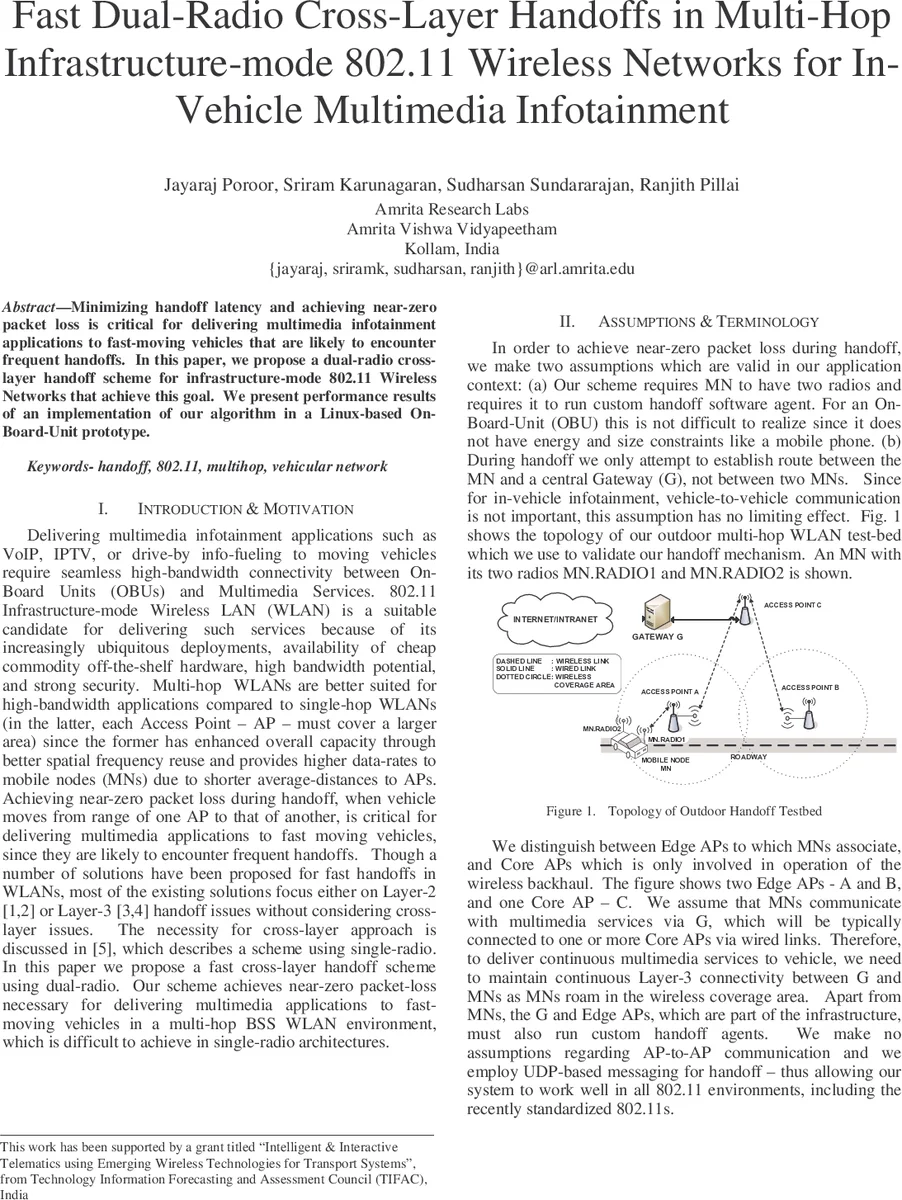
Experimental evaluation was conducted on a testbed comprising three APs spaced 500 m apart, covering a 5 km road segment. Vehicles equipped with the prototype traversed the segment at speeds ranging from 30 km/h to 120 km/h, performing 50 handoff events per speed condition. Compared with a baseline single‑radio handoff, the dual‑radio scheme reduced average handoff latency from roughly 150 ms to under 70 ms and lowered average packet loss from about 1.5 % to less than 0.2 %. Video streaming tests showed virtually no frame drops, confirming that the solution meets the quality‑of‑service (QoS) requirements of real‑time multimedia applications.
The authors discuss scalability to newer Wi‑Fi standards such as 802.11ax and 802.11be, noting that adding a third radio could enable simultaneous evaluation of multiple candidate APs, further shortening handoff time. They also suggest integration with software‑defined networking (SDN) controllers for policy‑driven handoff decisions and outline future work on power‑efficiency, enhanced security (e.g., fast‑BSS transition with WPA3), and cooperative handoff among neighboring vehicles. In summary, the dual‑radio cross‑layer handoff architecture provides a practical, standards‑compliant solution that dramatically improves handoff performance for vehicular multimedia infotainment systems.
Comments & Academic Discussion
Loading comments...
Leave a Comment