On Ergodic Sum Capacity of Fading Cognitive Multiple-Access and Broadcast Channels
This paper studies the information-theoretic limits of a secondary or cognitive radio (CR) network under spectrum sharing with an existing primary radio network. In particular, the fading cognitive multiple-access channel (C-MAC) is first studied, wh…
Authors: Rui Zhang, Shuguang Cui, Ying-Chang Liang
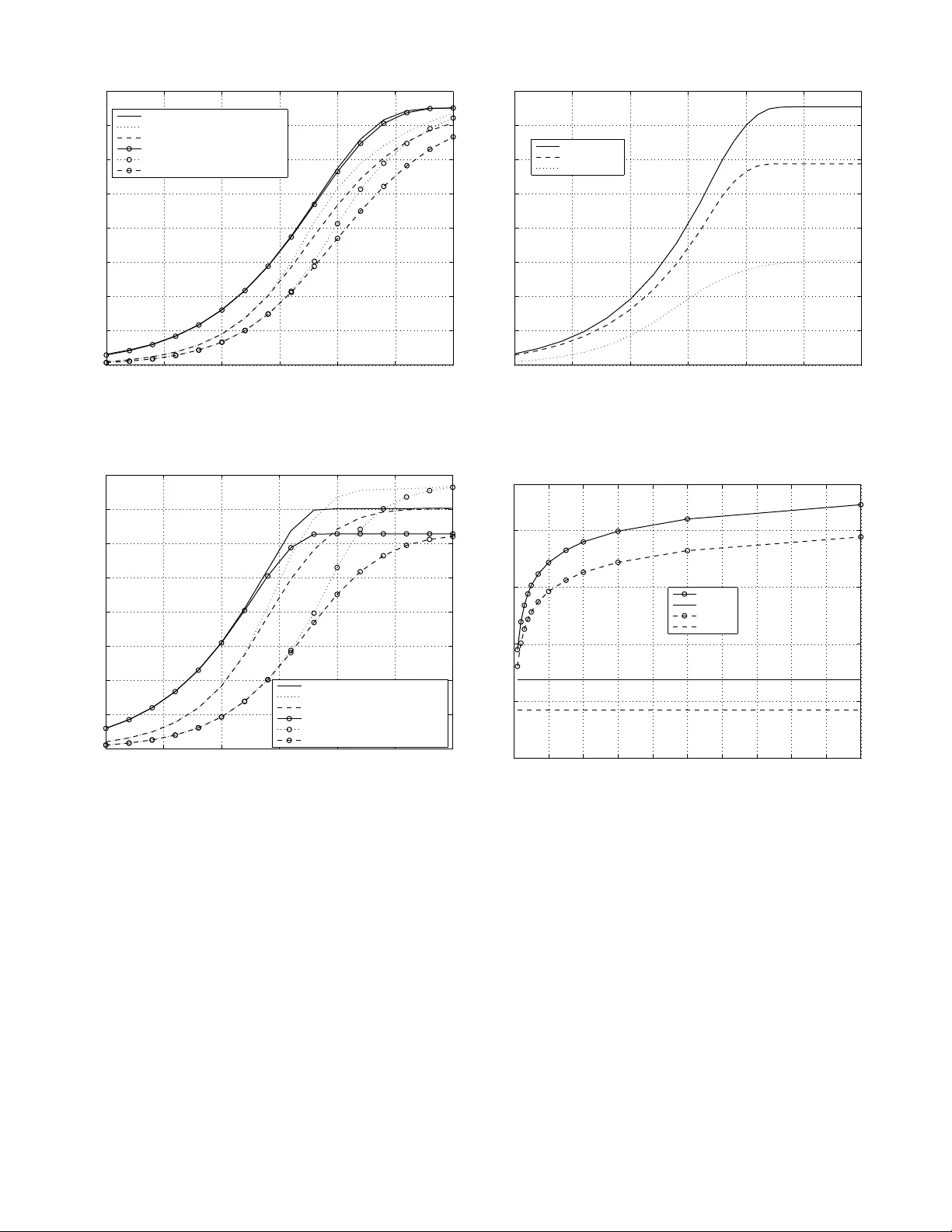
1 On Er godic Sum Capacity o f F ading Cogn iti v e Multiple-Ac cess and Broadcast Channels Rui Zhang, Member , I EE E, Shuguang Cui, Member , IEEE, and Y ing-Chang Lian g, S enior Me mber , IEEE Abstract — This paper studies the information-theore t ic limits of a secondary or cognitiv e radi o (CR) network under spectrum sharing with an e xisti ng primary r adi o networ k . In particular , the fading cognitive multiple-access channel (C-M A C) is first stu died, where multiple secondary users transmit to the second ary base station (BS) und er both individual transmit-powe r constraints and a set of interference-power constraints each applied at one of the p rimary receiv ers. This paper consid ers the long-term (L T) or the sh ort-term (ST) t ransmit-power constrain t o ver the fading states at each secondary transmitter , combined with the L T or ST interference-po wer constraint at each primary rec eiver . In each case , the optimal power allocation scheme is derived for the second ary users t o achi ev e the erg odi c sum capacity of t he fading C-MA C, as well as the conditions f or th e optimality of the dynamic time-division-multiple-access (D-TDM A) scheme in the secondary network. The fading cognitive broadcast channel (C- BC) that models the downlink transmission in the secondary n et- work is then stu died und er the L T/ ST transmit-power constraint at the secondary BS jointl y with the L T/ST interference-power constraint at each of the primary recei vers. It is shown that D- TDMA is indeed optimal for achieving the ergodic sum capacity of the fading C-BC f or all combinations of transmit-power and interference-power constraints. Index T erms — Broadcast chann el, cog n itive radio, conv ex op- timization, dynamic resour ce allocation, ergodic capacity , fadin g channel, interference temperature, multiple-access channel, spec- trum sharing, time-division-multiple-access. I . I N T RO D U C T I O N C Ognitive radio (CR), since th e name was coined b y Mitola in his seminal work [1], has drawn intensiv e attentions from b oth acade mic (see, e.g., [2] an d ref erences therein) and industrial (see, e.g. , [3] an d refere nces therein) commun ities; and to d ate, many interesting and importan t results hav e been obtained . In CR networks, the secon dary users o r CRs u sually commun icate over the same bandwidth originally allocated to an existing primary radio network . In such a scenario , the CR transmitters u sually n eed to deal with a fundam ental tradeoff between maximizing the secondary netw o rk thro ughpu t an d m inimizing th e resulted perfor mance degradation of the activ e pr imary transmissions. One common ly known techn ique used by the secondary users to protect the primary tr ansmissions is opportun istic spe ctrum access ( OSA), o riginally outlined in [1 ] a nd later in troduced by DARP A, wher eby the secondary user decides to transmit Manuscript recei ved June 27, 2008; re vised April 13, 2009. This paper has been presented in part at Annual Allerton Conferenc e on Communicatio n, Control and Computing, Monti cello, IL, USA, Septembe r 23-26, 2008. R. Zhang and Y .-C. Liang are with the Instit ute for Infocomm Research, A*ST AR, Singap ore. (e-mail s : { rzhan g, ycliang } @i 2r . a-star .edu . sg) S. Cui is with the Department of Electri cal and Computer Engineering, T ex as A&M Univ ersity , T e xas, USA. (e-mail: cui@ece.ta m u.edu) over a pa rticular channel only when all primar y transmissions are d etected to be off. For OSA, an enab ling techn ology is to detect the p rimary tr ansmission on/off status, also known as sp ectrum sensing , fo r which many algor ithms have been reported in the liter ature (see, e.g., [4] and references therein ). Howe ver , in pr actical situatio ns with a nonzero misde tection probab ility fo r an active p rimary tra nsmission, it is usually impossible to co mpletely avoid the perform ance degradation of the primary tr ansmission with the secondary user OSA. Another approach dif f erent from OSA for a C R to max imize its thr oughp ut and yet to provide sufficient pr otection to th e primary tr ansmission is allo win g the CR to access the channel ev en when the prima ry transmissions are acti ve, provided th at the resultan t interfer ence power , or th e so-called interfer ence temperatur e (IT) [5], [6], at each primary receiv er is lim ited below a p redefined value. This spectrum sharing strategy is also referred to as Spectru m Un derlay [2], [7] or Horizon tal Spectrum S h aring [5], [8]. W ith this strate g y , dynamic r esour ce allocation (DRA) becomes essential, whereb y the transmit powers, bit-rates, bandwidth s, and antenna beams of the sec- ondary transmitters are dy namically allo cated based upon the channel state information (CSI) in the primary and secondary networks. A n umber o f papers h av e recen tly add ressed the design of optimal DRA schemes to achieve the p oint-to-p oint CR channe l capa city u nder the IT co nstraints at the prim ary receivers (see, e.g., [9]-[14]). On the othe r h and, sin ce the CR network is in nature a multiuser communication environment, it w ill be more rele vant to consider DRA among mu ltiple secondary u sers in a CR network r ather than that for the case of one p oint-to-p oint CR channel. Deploying the inter ference- temperatur e constraint as a pra ctical means to protect the primary transmissions, the con vention al n etwork mode ls such as the multiple-access chann el (MA C), b roadcast chan nel (BC), interf erence chann el (I C), and r elay chann el ( RC) can all be c onsidered f or the seco ndary network, resu lting in various new cognitive netw o rk mod els and associated pr oblem formu lations fo r DRA (see, e.g., [1 5]-[18]). It is also noted that there has been study in the literature on the infor mation- theoretic limits of the CR chann els by exploiting other types of “cognition s” av ailab le a t the CR termin als d ifferent from the I T , such as the knowledge o f the prima ry user transmit messages at the CR tran smitter [8], [19], the distributed detection results on the primar y transmission status at the CR transmitter and r eceiv er [20], th e “soft” sensing results on the primary transmission [21], and the prim ary transmission o n-off statistics [22]. In this paper, we fo cus on the single-inp ut single- output (SISO) or single-anten na fading cognitive MA C (C-M A C) 2 and cognitive BC (C-BC) fo r the second ary network, where K seco ndary users co mmunicate with th e base station (BS) of the seco ndary network in the presen ce of M primary receivers. It is assume d that the BS h as the perfec t CSI on the channels between th e BS and all the seco ndary users, as well as the c hannels from the BS and each secondar y user to all the primary receivers. 1 Thereby , the BS can implement a c entralized dynamic p ower a nd ra te allo cation scheme in the secondary network so as to optimize its perf ormance and yet main tain the interf erence power le vels at all the p rimary receivers below the prescribed thresholds. An inf ormation - theoretic ap proach is taken in th is p aper to ch aracterize th e maximum su m-rate o f secon dary users av er aged over the channel fading states, termed as er godic sum capacity , for both the fading C-MA C and C-BC. The er g odic sum capacity can be a r elev ant m easure fo r the maxim um achiev ab le thr oughp ut of the secondary network when the data tr affic has a suf ficiently - large d elay tolerance . As usual (see, e.g., [23]), we conside r both the long-term ( L T) transmit-power constrain t (TPC) that regulates the a verag e tr ansmit power a cross all th e fading states at the BS or each of the secon dary user, as well as the shor t-term (ST) TPC that is more restrictive th an the L T - TPC by limiting the instantan eous transmit power at each fading state to be below a certain thr eshold. Similarly , we also consider both the L T interfer ence-power constraint (I PC) that regulates the resultant average interference power over fading at each pr imary receiv er, and the ST -IPC that imp oses a more strict instantaneou s limit on the resultan t in terference power at each fading state. The majo r prob lem to be a ddressed in this paper is then to characterize th e ergodic sum capacity of the secondary network under different comb inations of L T - /ST -TPC and L T -/ST -IPC. Apparently , such a problem setup is uniqu e for the fading CR networks. Mo reover , we are interested in in vestigating the con ditions over each case for the o ptimality of the dynam ic tim e-division-multiple-ac cess (D-TDMA) scheme in the seconda ry network, i.e., when it is optimal to s c hedule a s in gle secondary user at each fading state for transmission to ach iev e the ergo dic sum capacity . Th ese optimality condition s for D-TDMA are imp ortant to know as when they are satisfied, the single-user deco ding and enco ding at the secondar y BS becomes optimal for the C-MA C and C- BC, respectively . T his can lead to a significant co mplexity reduction compared with the cases where these condition s are not satisfied such th at the BS r equires more comp lex mu ltiuser decodin g and enc oding techniques to achie ve the ergodic su m capacity . Inform ation-theo retic studies can b e fo und for th e determin - istic (no fading) SISO-MA C and SISO-BC in , e.g., [24], and for the fading (parallel) SISO-MA C an d SISO-BC in, e.g., [25]-[27] and [ 28]-[30], resp ecti vely . In addition , D-TDMA has be en shown as the optim al transmission sche me to ach iev e the ergodic sum cap acity of the fading SISO-MAC under the 1 In pract ice, CSI on the chann els between the sec ondary users and their BS can be obtain ed by the cla ss ic channel training, estimation, and feedbac k mechanisms, while CSI on the channels between the seconda ry BS/users and the primary rec eiv ers can be obtai ned by the second ary BS/users via, e.g., estimati ng the recei ved signal power from each primary termina l when it transmits, under the assumptions of pre-kno wledge on the primary tran sm it po wer le vels and the channel reciprocit y . L T -T PC at each transm itter [26], [31]. Than ks to the duality result on th e capacity regio ns of the Gaussian MA C and BC [32], the op timality of D-TDMA is also provable for the fading SISO-BC to a chieve the ergodic sum capacity . Howe ver , to our best knowledge, character izations of the ergodic sum cap acities as well as the optim ality condition s for D-TDMA over the fading C-MA C and C-BC un der various mixed tra nsmit-power and interf erence-p ower con straints have not been addressed yet in the literature. In this paper, we will provide th e solutions to these pro blems. Th e main results of this paper are summarized belo w for a brief ov er view: • For the fading cognitive SISO-MAC, we sh ow that D- TDMA is optimal fo r achieving the ergodic sum cap acity when the L T -TPC is app lied jointly with the L T -IPC. This result is an extension of that ob tained earlier in [31] for the traditiona l fadin g SISO- MA C with out the L T -IPC. For the other three cases of mixed p ower co nstraints, i.e., L T -TPC with ST -IPC, ST -TPC with L T - IPC, and ST - TPC with ST -I PC, we show th at although D-TDM A is in general a subop timal scheme and th us does not achieve the ergodic sum capacity , it can be o ptimal under some special cond itions. W e f ormally derive these con ditions from the Karush-Kuhn- T ucker ( KKT) con ditions [33] associated with the ca pacity m aximization pro blems. In particular, fo r the case of L T - TPC with ST -IPC, we show that the optimal number of secondar y users that transmit at the same time should be n o gr eater than M + 1 . T herefor e, for small values of M , e. g., M = 1 correspo nding to a single p rimary receiver , D- TDMA is close to being optimal. Furth ermore, for all cases considered , we derive th e o ptimal transmit power-control policy for the seconda ry users to achieve the ergodic sum ca pacity . For the two cases o f L T -TPC with L T -IPC and ST -TPC with L T -IPC, we provide th e closed-form solutions fo r the op timal power allocation at each fading state. Particularly , in the case of ST -TPC with L T -IPC, we show th at for the a cti ve second ary user s at o ne particular fading state, there is at m ost one user tha t transmits with power lower tha n its ST power constrain t, wh ile all the other acti ve users transmit with their m aximum powers. • For the fading cognitive SISO-BC, we sh ow that for all considered cases of m ixed power con straints, D- TDMA is optima l for ach ie v ing the e rgodic sum cap acity . The optimal tran smit power allocations at the BS in these cases have closed-f orm solution s, wh ich resemble the single-user “water-filling (WF)” solutio ns for the well- known fading (parallel) Gaussian channels [ 24], [34]. The rest of this paper is organized as follows. Section II pr ovides th e system model f or the fading C-MA C and C-BC. Section III and Sectio n IV the n present the r esults on th e ergo dic sum -capacity , the associated optimal p ower - control policy , an d the op timality co nditions for D-T DMA, for th e fading C-MAC and C-BC, respec ti vely , und er dif - ferent mixed L T /ST transmit-p ower and interf erence-power constraints. Section V provides th e n umerical results on the ergodic sum capacities of th e fading C-MAC a nd C-BC u nder different mixed power constraints, the ca pacities with vs. 3 M M M M P S f r a g r e p l a c e m e n t s SU-1 SU-2 SU-K PR-1 PR-2 PR-M BS h 1 h 2 h K g 11 g 12 g K 2 g K M Fig. 1. The cognit ive SISO-MA C where K SUs transmit to the secondary BS while possibly inte rfering with each of M PRs. without the TDMA constraint, an d th ose with vs. without the optimal power control, and draws some insightful observations pertinent to the optima l DRA in CR networks. Finally , Section VI conclud es this paper . I I . S Y S T E M M O D E L Consider a fading C-MAC as shown in Fig. 1, where K CRs or second ary users (SUs) transmit to th e secondar y BS by sharing the same narrow band with M primar y re ceiv ers (PR s), and all terminals are assumed to be equip ped with a single antenna e ach. A bloc k- fading (BF) channel model is assumed for all th e channels inv olved. Furthermo re, since this paper considers coherent co mmunicatio ns, only the fading chan nel power gains (am plitude sq uares) are of interest. During e ach transmission b lock, the power gain of th e fading channel f rom the k -th SU to the secondary BS is d enoted by h k , while that of the fading ch annel from the k -th SU to the m -th PR is denoted b y g km , k = 1 , . . . , K, m = 1 , . . . , M . Th ese c hannel power gains are a ssumed to b e dr awn from a vector rand om process, which we assume to be ergod ic over transmission blocks and h av e a con tinuous, differentiable joint cumula - ti ve distribution fu nction (cd f), d enoted by F ( α ) , where α , [ h 1 · · · h K , g 11 · · · g 1 M , g 21 · · · g 2 M , . . . , g K 1 · · · g K M ] denotes the power gain vector for all the chann els of interest. W e further assume that h k ’ s and g km ’ s are indep endent. In addition, it is assumed that the additive noises ( including any additional inter ferences fro m the outside of the seconda ry network, e.g. , the p rimary tra nsmitters) at th e secondary BS are independen t circular symmetric complex Gaussian (CSCG) random variables, eac h having zero mean and u nit variance, denoted as C N (0 , 1) . Since in this p aper we are inter ested in the info rmation- theoretic limits o f the C-MA C, it is assumed that the optimal Gaussian c odeboo k is used by ea ch SU transmitter . It is assumed tha t the secondary BS knows a priori the channel d istribution informa tion F ( α ) and fu rthermo re the channel rea lization α at ea ch transm ission blo ck. T hereby , the secondary BS is ab le to sch edule tran smissions of SUs and allocate the ir transmit p ower levels an d rate values at each transmission block , so as to op timize the perform ance o f the secondary n etwork and y et p rovide a n ecessary protectio n to each of the PRs. W e de note the transmit p ower -co ntrol p olicy for SUs as P MAC , which specifies a map ping from the fading channel realization α to p ( α ) , [ p 1 ( α ) , . . . , p K ( α )] , where p k ( α ) denotes the transmit p ower assigned to th e k - th SU. The long-ter m (L T) transm it-power constraint (TPC) for the k -th SU, k = 1 , . . . , K , can then be described as E [ p k ( α )] ≤ P L T k (1) where the e xp ectation is taken over α with respect to (w .r . t.) its cdf, F ( α ) , and the short-term ( ST) transmit-power constraint (TPC) for the k -th SU is giv en as p k ( α ) ≤ P ST k , ∀ α . (2) Similarly , we consider both the L T and ST interferen ce-power constraints ( IPCs) at the m -th PR, m = 1 , . . . , M , describ ed as E " K X k =1 g km p k ( α ) # ≤ Γ L T m (3) K X k =1 g km p k ( α ) ≤ Γ ST m , ∀ α , (4) respectively . For a giv en P MAC , the max imum achievable sum- rate (in nats/complex dim ension) o f SUs averaged ov er all the fading states can be expressed as (see, e.g., [35]) R MAC ( P MAC ) = E " log 1 + K X k =1 h k p k ( α ) !# . (5) The ergod ic sum ca pacity of the fading C-MAC can then be defined as C MAC = max P MAC ∈F R MAC ( P MAC ) (6) where F is th e feasible set specified by a par ticular combina - tion of the L T -TPC, ST - TPC, L T -IPC and ST -I PC. Note tha t all of these power constraints a re affine a nd thus specify conve x sets of p k ( α ) ’ s, so does any o f their arbitrary com binations. Therefo re, the cap acity maximizatio n in ( 6) is in general a conve x op timization prob lem, and thus efficient num erical algorithm s are av ailable to obtain its solution s. In this paper, we co nsider F to b e g enerated by on e of the following four possible combina tions of power constraints, which are L T -TPC with L T -I PC, L T -TPC with ST -IPC, ST -TPC with L T -IPC, and ST -TPC with ST -IPC, for the purpose of exposition. Next, we consider the SI SO fadin g C-BC as sho wn in Fig. 2, whe re the secondary BS transmits to K SUs while po ssibly interfering with each of th e M PRs. Without loss of generality , we use th e same n otation, h k , to d enote the cha nnel power gain f rom the BS to the k - th SU, k = 1 , . . . , K , as for th e C-MA C. T he in terference chann el power gain s from th e BS to PRs are d enoted as f m , m = 1 , . . . , M , which are assumed to be mutu ally independ ent and also indepe ndent of h k ’ s. Similar to the C-MAC case, let β , [ h 1 · · · h K , f 1 · · · f M ] denote the power g ain vector for all the ch annels in volved in the C-BC, which we assume to be drawn f rom an ergod ic vector random 4 M M M M P S f r a g r e p l a c e m e n t s SU-1 SU-2 SU-K PR-1 PR-2 PR-M BS h 1 h 2 h K f 1 f 2 f M Fig. 2. The cognit ive SISO-BC where the secondary BS transmits to K SUs while possibly int erfering with each of M PRs. process with a continuou s, differentiable joint cdf, d enoted by G ( β ) . It is assumed that the additive noises at all SU r eceivers are independ ent CSCG random variables each distributed as C N (0 , 1) ; and the optimal Gaussian codebook is used b y the transmitter of the BS. W ith the available channel distrib u tion informa tion G ( β ) as well as the CSI on h k ’ s and f m ’ s at e ach transmission blo ck, the seco ndary BS designs its downlink transmissions to the SUs by dynamically allocating its transmit power levels and rate values. Let P BC denote the transmit power -c ontrol p olicy f or the secondary BS, which specifies a mapping fr om the fadin g chann el realization β to its transmit power q ( β ) . Similarly as for C-MAC, we define the L T -TPC and ST -TPC for the secondary BS as E [ q ( β )] ≤ Q L T (7) where the expecta tion is taken over β w .r .t. its cd f, G ( β ) , and q ( β ) ≤ Q ST , ∀ β , (8) respectively; and the L T -IPC an d ST -IPC at the m -th PR, m = 1 , . . . , M , as E [ f m q ( β )] ≤ Γ L T m (9) and f m q ( β ) ≤ Γ ST m , ∀ β , (10) respectively . Now , c onsider an auxiliary SISO fading C-MAC for the SISO fading C-BC of inter est, where h k ’ s rem ain the same as in the C-BC while g km = f m , ∀ k ∈ { 1 , . . . , K } , m ∈ { 1 , . . . , M } . Thus, the ch annel realization α in th is auxiliary C-MA C can be co ncisely rep resented by β in the C-BC. By applying the MAC-BC d uality r esult [32] at ea ch fading state, for a given q ( β ) , the m aximum sum -rate of the C-BC can be obtained from its auxiliary C-M A C as max P K k =1 p k ( β )= q ( β ) log 1 + K X k =1 h k p k ( β ) ! . (11) Therefo re, the ergodic sum ca pacity of the fading C-BC can be equiv alently obtained from its a uxiliary fading C-MAC as C BC = max P MAC ∈D R MAC ( P MAC ) . (12) where D is specified by a particular comb ination of (7)-(10), with q ( β ) b eing rep laced by P K k =1 p k ( β ) . Note th at we can obtain the op timal power -co ntrol policy P BC to achieve the ergodic sum cap acity of the C-BC from the corr esponding optimal P MAC by solving the maximization problem in (12). Similarly as for C MAC in (6), it can be sh own that the optimization problem for obtaining C BC in (12) is con vex. I I I . E R G O D I C S U M C A P AC I T Y F O R F AD I N G C O G N I T I V E M A C In this section, we conside r the SISO fadin g C-MAC under different mixed transmit-p ower and interfere nce-power constraints. F o r each case, we derive the optimal power-control policy for achieving the ergo dic sum capacity , as well as the condition s for the optimality of D-TDMA. A. Lon g-T erm T ransmit-P ower an d I nterfer ence- P o wer Con- straints From (5) and (6 ), the ergodic sum capacity und er th e L T - TPC and the L T -IPC can be o btained by solving the fo llowing optimization problem : Pr oblem 3.1: Maximi ze ( Max . ) { p k ( α ) } E " log 1 + K X k =1 h k p k ( α ) !# subjec t to ( s . t . ) ( 1 ) , ( 3 ) . The propo sed solution to the a bove problem is based on the Lagrang e du ality method . First, we w rite the Lagra ngian of this problem as in (1 3) (shown on the next pag e), whe re λ k and µ m are the no nnegative dual v ariab les associated with each correspo nding p ower con straint in (1) and (3), respectively , k = 1 , . . . , K , m = 1 , . . . , M . Then, the Lagran ge du al function , g ( { λ k } , { µ m } ) , is defined as max { p k ( α ) } : p k ( α ) ≥ 0 , ∀ k, α L ( { p k ( α ) } , { λ k } , { µ m } ) . (14) The dual fu nction serves a s an uppe r bound on the optim al value of the original ( primal) prob lem, denoted by r ∗ , i.e., r ∗ ≤ g ( { λ k } , { µ m } ) fo r any n onnegative λ k ’ s and µ m ’ s. The dual problem is then d efined as min { λ k } , { µ m } : λ k ≥ 0 ,µ m ≥ 0 , ∀ k,m g ( { λ k } , { µ m } ) . (15) Let the optim al value o f the du al problem be de noted by d ∗ , which is ac hiev able b y the o ptimal d ual solu tions { λ ∗ k } and { µ ∗ m } , i.e., d ∗ = g ( { λ ∗ k } , { µ ∗ m } ) . For a con vex optimization problem with a strictly feasible poin t as in our pr oblem, the Slater’ s co ndition [33] is satisfied and thus the duality gap, r ∗ − d ∗ ≤ 0 , is indeed zero. This result en sures that Problem 3.1 can b e equi valently solved from its dual p roblem, i.e., b y first maximizing its L agrangia n to obtain th e dual fu nction for some giv en dual variables, and then minimizin g the dual function over the dual v ar iables. 5 L ( { p k ( α ) } , { λ k } , { µ m } ) = E " log(1 + K X k =1 h k p k ( α )) # − K X k =1 λ k { E [ p k ( α )] − P L T k } − M X m =1 µ m ( E " K X k =1 g km p k ( α ) # − Γ L T m ) (13) Consider first the prob lem for obtaining g ( { λ k } , { µ m } ) with some given λ k ’ s and µ m ’ s. It is in teresting to observe that this dual function can a lso be written as g ( { λ k } , { µ m } ) = E [ g ′ ( α )] + K X k =1 λ k P L T k + M X m =1 µ m Γ L T m (16) where g ′ ( α ) = max { p k ( α ) } : p k ( α ) ≥ 0 , ∀ k log 1 + K X k =1 h k p k ( α ) ! − K X k =1 λ k p k ( α ) − M X m =1 µ m K X k =1 g km p k ( α ) . (17) Thus, the dual function can be o btained via solv ing fo r sub - dual-fu nction g ′ ( α ) ’ s, eac h for one fading state with channel realization, α . Notice tha t th e max imization pro blems in (17) with different α ’ s all ha ve the same structure and thus can be solved using the same computation al routin e. For conc iseness, we drop the α in p k ( α ) ’ s for the maximiza tion p roblem at each fading state a nd express it as Pr oblem 3.2: Max . { p k } log 1 + K X k =1 h k p k ! − K X k =1 λ k p k − M X m =1 µ m K X k =1 g km p k (18) s . t . p k ≥ 0 , ∀ k . (19) This problem is convex since its objectiv e function is concav e and its constrain ts are all linear . By intro ducing n onnega- ti ve du al variables δ k , k = 1 , . . . , K , for the co rrespon ding constraints on the no nnegativity of p k ’ s, we can write the following KKT cond itions [3 3] that nee d to be satisfied by the optimal primal and dua l solutio ns of Problem 3.2, denoted as { p ∗ k } and { δ ∗ k } , respectiv ely . h k 1 + P K l =1 h l p ∗ l − λ k − M X m =1 µ m g km + δ ∗ k = 0 , ∀ k (20) δ ∗ k p ∗ k = 0 , ∀ k (21) with p ∗ k ≥ 0 and δ ∗ k ≥ 0 , ∀ k . The following lemma can then be obtained from these KKT op timality conditions: Lemma 3.1: Th e op timal solution of Problem 3 .2 has at most one user indexed by i , i ∈ { 1 , . . . , K } , with p ∗ i > 0 , i.e., the solution follows a D-TDMA structure. Pr oof: Please refer to Appendix I. Giv en Lemma 3.1, the remain ing tasks for solv ing Proble m 3.2 ar e to fin d the u ser that transmits at each fadin g state as well as the o ptimal transmit power , which are g i ven by the following lemm a: Lemma 3.2: I n the op timal solution of Prob lem 3.2, let i denote the user that has p ∗ i > 0 , and j be any of the o ther users that has p ∗ j = 0 , i, j ∈ { 1 , . . . , K } . Then user i must satisfy h i λ i + P M m =1 µ m g im ≥ h j λ j + P M m =1 µ m g j m , ∀ j 6 = i. (22) The optimal power allocation of user i is p ∗ i = 1 λ i + P M m =1 µ m g im − 1 h i ! + (23) where ( x ) + = max(0 , x ) . Pr oof: Please refer to Appendix II. Solutions of Prob lem 3.2 across all the fading states ar e basically an op timal map ping betwe en an arb itrary chan nel realization and the transmit po wer allocation fo r any gi ven λ k ’ s and µ m ’ s, which can the n be used to ob tain the du al functio n g ( { λ k } , { µ m } ) . Next, the dual fun ction needs to be minimize d over λ k ’ s a nd µ m ’ s to obtain the op timal dual solutions λ ∗ k ’ s and µ ∗ m ’ s with which the du ality gap is zero. One m ethod to iterativ ely up date λ k ’ s and µ m ’ s tow ard their o ptimal values is the ellipsoid meth od [36], of which we o mit the details her e for brevity . Lemma 3.1 suggests that at each fading state, at mo st one SU ca n tran smit, i.e., D-TDMA is optima l. Since this result holds for any given λ k ’ s and µ m ’ s, it m ust be true for the optimal dual solutions λ ∗ k ’ s and µ ∗ m ’ s under which the optima l value of the original prob lem or the ergodic sum cap acity is achieved. Therefore , we have the following th eorem: Theor em 3.1: D- TDMA is optimal acro ss all the fading states for achieving the ergodic sum c apacity of the fading C- MA C un der the L T -TPC jointly with the L T -IPC. The optim al rules to select th e SU for transm ission at a particu lar fading state and to determin e its transmit po wer are g iv en by L emma 3.2 with all λ k ’ s and µ m ’ s replaced by their optimal du al solutions for Problem 3.1. Remark 3.1: Notice that if the L T -I PC g iv en b y ( 3) is n ot present in Pro blem 3.1, o r equiv alen tly , the L T -IPC values Γ L T m ’ s are sufficiently large such that these constraints a re inactive with the optimal power solution s of Problem 3.1, it is then easy to verify from its KKT condition s th at the o ptimal dual solutions f or a ll µ m ’ s must be equal to zero. From (22), it then follows that on ly user i with the largest h i λ i among all the users can pr obably transmit at a given fading state. This result is consistent with that obtained earlier in [31] for the traditional fading SISO-MA C without the L T -IPC. However , under the add itional L T -IPC, from ( 22) and (2 3) it is observed that the selected SU for transmission and its tr ansmit power depend o n the interference -power “prices” µ m ’ s for different PRs and th e instantaneou s in terference channe l p ower gains g km ’ s. 6 B. Lon g-T erm T ransmit-P ower an d Short-T erm Interfer ence - P o wer Constr a ints The ergo dic sum capacity u nder the L T -TPC but with the ST -IPC c an b e ob tained as the optimal value of the following problem : Pr oblem 3.3: Max . { p k ( α ) } E " log 1 + K X k =1 h k p k ( α ) !# s . t . ( 1 ) , ( 4 ) . Similar to Problem 3.1, w e apply the Lagr ange duality method to solve the above problem. Howe ver, different fro m Problem 3 .1 that has bo th the long-ter m tr ansmit-power a nd interferen ce-power constraints, it is no ted that in Problem 3.3, only the transmit-p ower c onstraints are lon g-term wh ile the interferen ce-power con straints are short-te rm. Ther efore, the dual variables associated with the lo ng-term constraints sho uld be introd uced first, in order to d ecompo se the problem into individual sub problem s over different fading states, to each of which th e correspond ing shor t-term co nstraints can then b e applied. L et λ k be the nonnegative dual variable associated with the corr espondin g L T -TPC in (1), k = 1 , . . . , K . The Lagrang ian of this problem can then be written as L ( { p k ( α ) } , { λ k } ) = E " log 1 + K X k =1 h k p k ( α ) !# − K X k =1 λ k E [ p k ( α )] − P L T k . (24) Let A denote the set of { p k ( α ) } specified by the remaining ST -IPC in (4). The Lag range dual f unction is the n expressed as g ( { λ k } ) = max { p k ( α ) }∈A L ( { p k ( α ) } , { λ k } ) . (25) The dual problem is accordingly defin ed as min λ k ≥ 0 , ∀ k g ( { λ k } ) . Similar to Proble m 3.1, it can be verified that the duality gap is z ero for the convex optimization problem addressed here; and thus solving its dual pr oblem is equiv alen t to solving the original problem. Consider first the p roblem fo r ob taining g ( { λ k } ) with some giv e n λ k ’ s. Similar to Problem 3.1, this du al function can be decomp osed into individual sub-dual-f unctions, each for o ne fading state, i.e. , g ( { λ k } ) = E [ g ′ ( α )] + K X k =1 λ k P L T k (26) where g ′ ( α ) = max { p k ( α ) }∈A ( α ) log(1 + K X k =1 h k p k ( α )) − K X k =1 λ k p k ( α ) (27) with A ( α ) d enoting the subset of A co rrespond ing to the fading state with c hannel realiza tion α . After dropp ing th e α in the co rrespond ing maxim ization pro blem in (27) for a particular fading state, we can express this problem a s Pr oblem 3.4: Max . { p k } log 1 + K X k =1 h k p k ! − K X k =1 λ k p k (28) s . t . K X k =1 g km p k ≤ Γ ST m , ∀ m (29) p k ≥ 0 , ∀ k . (30) The above p roblem is conve x , but in general doe s no t have a clo sed-form solution . Nevertheless, it ca n b e efficiently solved by standard conv ex optimizatio n techniqu es, e.g., the interior po int method [33], or alternatively , via solving its dual problem; and for brevity , we omit the details here. After solving Problem 3.4 f or all th e fadin g states, we can obtain the dual f unction g ( { λ k } ) . Next, th e m inimization of g ( { λ k } ) over λ k ’ s can be r esolved via the ellipsoid method, similar ly like that f or Problem 3 .1. For this case, we next focus on studying the c onditions under which D-TDMA is optimal across the fading states. Th is can b e don e by in vestigating the KK T o ptimality con ditions for Problem 3.4. First, we introduce nonnegativ e d ual v ariab les µ m , m = 1 , . . . , M , a nd δ k , k = 1 , . . . , K , for their associated constraints in (29) and (30), respectively . Th e KKT conditions for the optima l primal and du al solutio ns of this pr oblem, denoted as { p ∗ k } , { µ ∗ m } , and { δ ∗ k } , can then be e x pressed a s h k 1 + P K l =1 h l p ∗ l − λ k − M X m =1 µ ∗ m g km + δ ∗ k = 0 , ∀ k (31) µ ∗ m K X k =1 g km p ∗ k − Γ ST m ! = 0 , ∀ m (32) δ ∗ k p ∗ k = 0 , ∀ k (33) K X k =1 g km p ∗ k ≤ Γ ST m , ∀ m (3 4) with p ∗ k ≥ 0 , ∀ k , δ ∗ k ≥ 0 , ∀ k , and µ ∗ m ≥ 0 , ∀ m . Notice that in this case µ m ’ s ar e local variables for ea ch fading state instead of b eing fixed as in (20) fo r Problem 3.2. From these KKT condition s, the following lem ma can th en be obtained: Lemma 3.3: Th e optimal solution of Problem 3.4 has at most M + 1 second ary users th at tran smit with strictly po siti ve power levels. Pr oof: Please refer to Appendix III. Lemma 3.3 suggests that th e op timal nu mber of SUs that can tran smit at e ach fading state may d epend on th e num ber of PRs or interfer ence-power constraints. For small v alue s of M , e. g., M = 1 corr espondin g to a single PR, the num ber of activ e SUs at each fading state can be at most two, suggesting that D- TDMA may b e very close to being optim al in th is case. In the theo rem below , we pr esent th e general conditio ns, for any K and M , u nder w hich D-TDMA is both necessary and sufficient to be optimal at a particular fading state. Again , without loss of generality , h ere we use λ k ’ s instead of their optimal dual solutions o btained by the ellipsoid m ethod. Theor em 3.2: D- TDMA is optimal at a n arbitrary fading state for achieving the ergodic sum capacity of the fading C- MA C und er the L T -TPC jointly with the ST -IPC if and only 7 if there exists one user i ( the user that tran smits) that satisfies either one of the f ollowing two sets of con ditions. Let j be any of the other users, j ∈ { 1 , . . . , K } , j 6 = i ; an d m ′ = arg min m ∈{ 1 ,...,M } Γ ST m g im . • 1 λ i − 1 h i ≤ Γ ST m ′ g im ′ and h i λ i ≥ h j λ j , ∀ j 6 = i . In th is case, p ∗ i = 1 λ i − 1 h i + ; • 1 λ i − 1 h i > Γ ST m ′ g im ′ and ( h j g im ′ − h i g j m ′ ) g im ′ g im ′ + h i Γ ST m ′ ≤ ( λ j g im ′ − λ i g j m ′ ) , ∀ j 6 = i . In this case, p ∗ i = Γ ST m ′ g im ′ . Pr oof: Please refer to Appendix IV. Remark 3.2: Notice th at in Theorem 3.2, the fir st set of condition s holds when th e op timal transmit power of the user with the largest h i λ i among all the u sers satisfies the ST -IPC at all the PRs; the second set of con ditions h olds when the first set fails to be true, and in this case any o f K SUs can be the selected u ser for transmission provided that it satisfies the giv e n K − 1 in equalities. Remark 3.3: I n the special case where on ly the ST -IPC giv e n by (4) is pr esent or active in Prob lem 3.3, all λ k ’ s in Theorem 3.2 can be taken as zero s. As a result, the first set of condition s can never be true, while the second s et of conditio ns are simp lified as h j g im ′ − h i g j m ′ ≤ 0 , ∀ j 6 = i , an d th e op timal power of user i that tr ansmits is still p ∗ i = Γ ST m ′ g im ′ . W e thus have the following corollary if it is further assume d that there is only a single PR. For conciseness, the index m for this PR is dropp ed below . Cor ollary 3.1: I n the case that only the ST -I PC giv en by (4) is present in Problem 3.3 and, furthermor e, M = 1 , D-TDMA is optima l; and the selected user i fo r transmission satisfies that h i g i ≥ h j g j , ∀ j 6 = i , with transmit power p ∗ i = Γ ST g i . C. Short-T erm T ransmit-P o wer a nd Long -T erm I nterfer ence- P o wer Constr a ints In the case of ST -TPC co mbined with L T - IPC, the ergodic sum capacity is the optimal v alue of the follo wing optimization problem : Pr oblem 3.5: Max . { p k ( α ) } E " log 1 + K X k =1 h k p k ( α ) !# s . t . ( 2 ) , ( 3 ) . Again, we ap ply the Lagrange duality meth od for th e above problem . Let µ m ’ s be the no nnegative dual v ariab les associated with the L T -IPC in ( 3), m = 1 , . . . , M . The Lagrang ian of Problem 3.5 can then be wr itten as L ( { p k ( α ) } , { µ m } ) = E " log 1 + K X k =1 h k p k ( α ) !# − M X m =1 µ m ( E " K X k =1 g km p k ( α ) # − Γ L T m ) . (35) Let B d enote the set of { p k ( α ) } sp ecified by the r emaining ST -TPC in (2). The Lagrange dual f unction is e x pressed as g ( { µ m } ) = max { p k ( α ) }∈B L ( { p k ( α ) } , { µ m } ) . (36) The dual problem is accordingly defin ed as min µ m ≥ 0 , ∀ m g ( { µ m } ) . Similar to the previous two cases, th is dual function can be eq uiv alently written as g ( { µ m } ) = E [ g ′ ( α )] + m X m =1 µ k Γ L T m (37) where g ′ ( α ) = max { p k ( α ) }∈B ( α ) log 1 + K X k =1 h k p k ( α ) ! − K X m =1 µ m K X k =1 g km p k ( α ) (38) with B ( α ) den oting the subset o f B corresp onding to the fading state with chann el realization α . After dropp ing α in the maximization problem in ( 38), for each particular fading state we can e x press this problem a s Pr oblem 3.6: Max . { p k } log 1 + K X k =1 h k p k ! − K X m =1 µ m K X k =1 g km p k (39) s . t . p k ≤ P ST k , ∀ k (40) p k ≥ 0 , ∀ k . (41) After so lving Problem 3 .6 for all the fading states, we obtain the dual fu nction g ( { µ m } ) . The du al problem that minimizes g ( { µ m } ) over µ m ’ s can the n b e solved ag ain v ia the ellipsoid method. Next, we presen t the closed -form solution of Problem 3 .6 based o n its KKT optimality c onditions. Le t λ k and δ k , k = 1 , . . . , K , be the du al variables f or the correspon ding user power constraints in (40) and (4 1), respectively . T he KKT cond itions for the optimal primal and dual solution s of this problem , deno ted as { p ∗ k } , { λ ∗ k } , and { δ ∗ k } , can then be expressed as h k 1 + P K l =1 h l p ∗ l − λ ∗ k − M X m =1 µ m g km + δ ∗ k = 0 , ∀ k (42) λ ∗ k p ∗ k − P ST k = 0 , ∀ k (43) δ ∗ k p ∗ k = 0 , ∀ k (44) p ∗ k ≤ P ST k , ∀ k (45) with p ∗ k ≥ 0 , λ ∗ k ≥ 0 , and δ ∗ k ≥ 0 , ∀ k . From the se KKT condition s, the following lem ma can b e first obtained: Lemma 3.4: Le t i and j be any two arb itrary users, i , j ∈ { 1 , 2 , . . . , K } , with p ∗ i > 0 and p ∗ j = 0 in the optimal solu tion of Pro blem 3.6. Then, it must be true that h i P M m =1 µ m g im ≥ h j P M m =1 µ m g jm . Pr oof: Please refer to Appendix V. Let π be a p ermutation over { 1 , . . . , K } suc h tha t h π ( i ) P M m =1 µ m g π ( i ) m ≥ h π ( j ) P M m =1 µ m g π ( j ) m if i < j, i, j ∈ { 1 , . . . , K } . Supposing th at there are |I | users that can transmit with I ⊆ { 1 , . . . , K } denoting this set of users, fr om Lemma 3.4 it is easy to verif y that I = { π (1) , . . . , π ( |I | ) } . The following lemma th en p rovides th e c losed-form solutio n to Problem 3 .6: 8 Lemma 3.5: Th e optimal solution of Pro blem 3.6 is p ∗ π ( a ) = P ST π ( a ) a < |I | min P ST π ( |I | ) , h π ( |I ) | P M m =1 µ m g π ( |I | ) m − 1 − P |I |− 1 b =1 h π ( b ) P ST π ( b ) 1 h π ( |I | ) a = |I | 0 a > |I | where |I | is the largest value o f x such that h π ( x ) P M m =1 µ m g π ( x ) m > 1 + P x − 1 b =1 h π ( b ) P ST π ( b ) . Pr oof: Please refer to Appendix VI. From L emma 3.5, it fo llows that in the case of ST -TPC along with L T -IPC, for the active second ary users at one fading state, there is at mo st one user th at transm its with power lower than its ST power con straint, while all the o ther active users transmit with their maximum po wer s. Furthermo re, from Lemma 3.5, we can derive the cond itions for the op timality o f D-TDMA at any fading state, wh ich are stated in the following th eorem. Again, withou t loss of generality , we use µ m ’ s instead of their o ptimal d ual solutio ns for Problem 3.5 in e x pressing these co nditions. Theor em 3.3: D- TDMA is optimal at a n arbitrary fading state for achieving the ergo dic sum capacity of the fading C- MA C und er the ST -TPC join tly with th e L T -IPC if an d o nly if user π (1) satisfies 1 + h π (1) P ST π (1) ≥ h π (2) P M m =1 µ m g π (2) m . (46) User π (1) is then selected for tr ansmission an d its optim al transmit power is p ∗ π (1) = min P ST π (1) , 1 P M m =1 µ m g π (1) m − 1 h π (1) ! + . (47) Pr oof: From L emma 3.5, it follows that D-TDMA is optimal, i.e., |I | ≤ 1 , occurs if and only if (46) ho lds. Then, (47) is obtain ed from Lem ma 3.5 b y comb ining the cases of |I | = 0 an d |I | = 1 . Remark 3.4: In the c ase of the trad itional fading SISO- MA C with the user ST -TPC given in (2), but without the L T - IPC given in (3), it can be easily verified that the ergod ic sum capacity is ac hiev e d when all user s transmit with their maximum av ailab le p ower values given by P ST k ’ s a t each fading state. This is co nsistent with the results obtain ed in (46) b y ha v ing all µ m ’ s associated with th e L T -IPC take zero values. W ith zero µ m ’ s, it can be easily verified that the condition given in The orem 3.3 is n ev er satisfied, an d thus D-TDMA cannot be optimal in this special case. D. Sh ort-T erm T ransmit-P ower and Interference-P ower Con- straints The ergod ic sum capacity und er both the ST - TPC and ST - IPC can b e obtain ed by solving the f ollowing o ptimization problem : Pr oblem 3.7: Max . { p k ( α ) } E " log 1 + K X k =1 h k p k ( α ) !# s . t . ( 2 ) , ( 4 ) . Notice th at this case dif fe rs fro m all three previous cases in th at all of its power con straints ar e short-term constraints and thus separable over fading states. Therefor e, we can d ecompose the original pro blem in to in dividual subp roblems each for one fading state. For con ciseness, we d rop again the α and express the rate m aximization problem at a particular fading state as Pr oblem 3.8: Max . { p k } log 1 + K X k =1 h k p k ! (48) s . t . p k ≤ P ST k , ∀ k (49) K X k =1 g km p k ≤ Γ ST m , ∀ m (50) p k ≥ 0 , ∀ k . (51) The above problem is con vex, but in gen eral d oes not ha ve a closed-for m solu tion. Similar to Pro blem 3.4, the interior po int method [33] or the Lagr ange duality method can be used to solve th is problem and thus we om it th e details here. For this case, we next presen t in the following theorem the condition s for D -TDMA to b e op timal at an arbitrar y fading state: Theor em 3.4: D- TDMA is optimal at a n arbitrary fading state f or achieving the ergodic sum cap acity of the fading C-MA C und er the ST -T PC jointly with the ST -I PC if a nd only if th ere exists o ne u ser i (the user that transmits) that satisfies both of the fo llowing two condition s. Let j be any of the o ther users, j ∈ { 1 , . . . , K } , j 6 = i , and m ′ = arg min m ∈{ 1 ,...,M } Γ ST m g im . • Γ ST i g im ′ ≤ P ST i ; • h i g im ′ ≥ h j g jm ′ , ∀ j 6 = i . The optimal transmit po wer of user i is p ∗ i = Γ ST i g im ′ . Pr oof: Please refer to Appendix VII. I V . E R G O D I C S U M C A PAC I T Y F O R F A D I N G C O G N I T I V E B C From (12), the ergodic sum capacities for the SISO fading C-BC under different m ixed TPC and IPC con straints can be obtained as the op timal values of the f ollowing optimizatio n problem s: Pr oblem 4.1: Max . { p k ( β ) } E " log 1 + K X k =1 h k p k ( β ) !# s . t . ( 7 ) , ( 9 ) (Case I : L T − TPC and L T − IP C) or ( 7 ) , ( 10 ) (Case I I : L T − TPC and ST − IPC) or ( 8 ) , ( 9 ) (Case I I I : ST − TPC and L T − IPC) or ( 8 ) , ( 10 ) (Case IV : ST − TPC and ST − IPC) . Notice that in (7)-(10), the tran smit power o f th e secondary BS at a g iv en fading state, q ( β ) , need s to b e replaced b y the 9 user sum-p ower in the dual C-MA C, P K k =1 p k ( β ) . Compa red with the problem s addr essed in Section I II for the C-MAC , it is easy to see that the corre sponding prob lems in th e C- BC case are very similar, e.g ., both have the same objective function , and similar affine co nstraints in term s of p k ( α ) ’ s or p k ( β ) ’ s. Thu s, we skip the details of d eriv ations and p resent the results directly in the fo llowing theore m: Theor em 4.1: I n each of Cases I- IV , D-TDMA is o ptimal across all th e fadin g states fo r ach ie v ing the ergodic su m capacity of th e fading C-BC. In ea ch case, the user i with the largest h i among all the users should be selected for transmission at a particular fading state. The optimal rule f or assigning the transmit power o f the BS at each fading state (for co nciseness β is dro pped in the following expressions) in each case is g iv en below . Let j be any of the users oth er than i , j ∈ { 1 , . . . , K } , j 6 = i ; m ′ = arg min m ∈{ 1 ,...,M } Γ ST m f m ; and λ an d µ m ’ s are the optimal dual variables associated with the L T -TPC in ( 7) a nd the L T -IPC in ( 9), respecti vely , if they appear in any o f the fo llowing cases. • Case I: q ∗ = 1 λ + P M m =1 µ m f m − 1 h i ! + ; (52) • Case II: q ∗ = min Γ ST m ′ f m ′ , 1 λ − 1 h i + ! ; (53) • Case III: q ∗ = min Q ST , 1 P M m =1 µ m f m − 1 h i ! + ; ( 54) • Case IV : q ∗ = min Q ST , Γ ST m ′ f m ′ . (55) Remark 4.1: I n the case o f th e trad itional fading SI SO-BC without the L T - or ST -IPC, by combining the results in [31] for the fading SISO-MA C and the MA C-BC duality results in [32], it can be inf erred that it is op timal to deploy D-TDMA by tran smitting to the u ser with th e largest h i at each time in terms o f maximizin g the ergodic sum ca pacity , r egardless of the L T - or ST - TPC a t the BS. Th eorem 4 .1 ca n thus be considered as the extensions o f such result to the SISO fading C-BC u nder the additional L T - o r ST - IPC. Also notice th at the optimal power allocation strategies in (52)- (54) resemb le th e well-known “water-filling (WF)” solutio ns for the single- user fading channels [24], [3 4]. V . N U M E R I C A L E X A M P L E S In this section , we present numer ical results on the per- forman ces of the proposed mu ltiuser DRA schemes for some example fading CR networks un der different mixed transmit- power and inter ference- power co nstraints, n amely: Case I: L T - TPC with (w/) L T -IPC; Case II: L T -TPC w/ ST -IPC; Case III: ST -TPC w/ L T -I PC; and Case IV : ST -TPC w/ ST -IPC. For simplicity , we con sider symm etric mu ltiuser channels where all c hannel co mplex coefficients are indep endent CSCG random variables d istributed as C N (0 , 1) . In total, 10 , 00 0 random ly gen erated channel power gain vectors for α or β are used to appro ximate th e actual ergodic sum-r ate of th e secondary network in ea ch simulation result. Furthermor e, we assume tha t the TPC (L T or ST) values are identica l for all SUs, and the IPC (L T o r ST) values are identically eq ual to one, the same as the additive Gaussian noise variance, at all PRs. For c on venie nce, we use P to stan d for all P ST k ’ s and P L T k ’ s, Q for both Q ST and Q L T , and Γ fo r all Γ ST m ’ s and Γ L T m ’ s. The simulation results are p resented in the following subsections. A. Effects of L T/ST TPC/IPC on Er g odic Sum Ca pacity First, we compare the achie vable e rgodic su m capacities for the fading CR n etwork un der fo ur d ifferent cases o f mixed TPC and IPC. Fig. 3 shows the r esults for the fading C-MA C with K = 2 an d M = 1 , and Fig. 4 for the fading C-BC with K = 5 and M = 2 . For the C-MA C case, it is observed in Fig. 3 that the ergodic sum ca pacity C MAC in Case I is always the largest while that in Case IV is the smallest for any giv en SU transmit power constraint P . Th is is as expected sin ce both the ST - TPC and ST - IPC are less fa vorable from the SU’ s p erspective as compa red to th eir L T cou nterparts: The for mer one impo ses more stringe nt p ower co nstraints than the latter one over the DRA in the SU network. It is also observed that as P increases, eventually C MAC becomes saturated a s the IPC (L T or ST) becom es m ore dom inant than the TPC. On the other hand, for small values of P where the TPC is more dominan t th an the IPC, it is observed that the L T -TPC (where D-TDMA is optim al in Case I an d close to being op timal in Case II ) leads to a capa city gain over the ST -TPC (where D-TDMA is non-op timal in Case II I or IV) due to the well- known multiuser diversity effect exploited by D-TDMA [37]. Furthermo re, C MAC in Case II is ob served to be initially larger than that in Case II I for small values of P , but beco mes equal to and ev en tually smaller than that in Case III as P increases. This is due to the facts that fo r small v a lues of P , TPC dom inates IPC and fur thermore L T -TPC is more flexible over ST -TPC; while for large values o f P , IPC becom es mo re dominan t over T PC and L T -I PC is more flexible over ST -IPC. For the C-BC case, similar re sults like th ose in the C- MA C are observed. Howe ver, there exists one quite different pheno menon for the C-BC. As the secondary BS transmit power Q becomes large, the achiev ab le ergod ic sum capacity C BC shown in Fig. 4 under th e L T -I PC is much larger than that u nder the ST -IPC, regardless of the L T - or ST -TPC, as compare d with C MAC shown in Fig. 3 . This is du e to the fact that fo r th e C-BC with M = 2 and a single BS transmitter , the ST -IPC can lim it the tr ansmit power of the secondar y BS more stringently th an the c ase o f C-MA C shown in Fig. 3, wher e there are two SU tran smitters b u t only a single PR. Since it is not always th e case that both channels from the two SUs to the PR hav e very large gains at a given time, in the C-MAC case the SU with the smallest in stantaneous chann el gain to the PR can b e selected for transm ission, i.e., th ere exists an interesting new form o f multiuser diversity effect in th e fading 10 −10 −5 0 5 10 15 20 0 0.2 0.4 0.6 0.8 1 1.2 1.4 1.6 SU Transmit Power Constraint (dB) Ergodic Sum Capacity (nats/sec/Hz) LT−TPC w/ LT−IPC LT−TPC w/ ST−IPC ST−TPC w/ LT−IPC ST−TPC w/ ST−IPC Fig. 3. Comparison of the ergodi c sum capacity under diffe rent combination s of TPC and IPC for the fading C-MA C with K = 2 , M = 1 . −10 −5 0 5 10 15 0 0.5 1 1.5 Secondary BS Transmit Power Constraint (dB) Ergodic Sum Capacity (nats/sec/Hz) LT−TPC w/ LT−IPC LT−TPC w/ ST−IPC ST−TPC w/ LT−IPC ST−TPC w/ ST−IPC Fig. 4. Comparison of the ergodi c sum capacity under diffe rent combination s of TPC and IPC for the fading C-BC with K = 5 , M = 2 . C-MA C. I n co ntrast, f or the C-BC, the BS is likely to tr ansmit with large power only if both chan nel gains fro m the BS to the two PRs are r easonably low . B. F ading C-MAC W ith (w/) vs. W itho ut (w/o ) TDMA Con - straint Next, we consider the fadin g C-MA C and examine the effect of th e TDMA constraint on its achiev able ergodic sum capacity . Notice that fo r the fading C-BC, it has bee n shown in Theorem 4.1 that D-TDMA is optimal for all cases o f mixed TPC an d IPC; and f or th e fading C-MAC, it h as also been shown in T heorem 3.1 that D-T DMA is optim al in Case I. Therefo re, in this subsection, w e only conside r the fading C-MA C in Cases II, III, and IV . W e compar e the ergo dic sum ca pacity C MAC achiev able in each of these cases via the optimal DRA r ule proposed in th is paper w /o the TDMA constraint against th at with an explicit TDMA con straint, i.e., at mo st one SU is selected for tr ansmission at any time. Howe ver , for the cases with the explicit TDMA constrain t, we still allo w DRA over the SU network to optim ally select the SU ( i.e., u sing D-TDMA) and set its p ower lev el for transmission at each fadin g state, so as to maximize the long- term a verage sum-rate. For conciseness, we discuss the optimal DRA s ch emes for the fading C -M A C under the explicit TDMA constraint in Appendix VI II. In Figs. 5 and 6, we compare the achie vable C MAC w/ vs. w/o the T DMA constraint for Cases II- IV with K = 2 , M = 1 , an d K = 4 , M = 2 , respec ti vely . It is observed in b oth figures that the achiev ab le C MAC in each case of mixed TPC and IPC is larger without the TDMA con straint. This is as expected since TDMA is an additional constraint that limits the flexibility of DRA in the SU network. In Fig. 5, it is o bserved th at the gap between th e ach iev able C MAC ’ s w/ and w/o the T DMA con straint in each o f Cases II-IV dim inishes as the SU transmit power constraint P becomes sufficiently large. This phen omenon can be explaine d as follows. First, note that as P increases, ev en tually the TPC will become inactive and the IPC becomes the only active power constraint in each case. As a result, Case II and Case IV o nly h av e the (same) ST -IPC and Case III on ly h as the L T -I PC as active constraints. Thus, th e ob served p henom enon is justified since D-TDMA has been shown to be o ptimal for the ab ove two cases, according to Corollary 3.1 ( notice that M = 1 fo r Fig. 5) and Th eorem 3.1 (with all λ k ’ s taking a zero value), respectively . Howe ver, in Fig. 6 with M > 1 , only Case III h as the same converged C MAC w/ and w/o the TDMA co nstraint as P becomes large, according to Th eorem 3.1. In g eneral, the capa city gap between cases w/ and w/o the TDMA con straint becom es larger as K or M incr eases, as o bserved b y com paring Figs. 5 and 6. For example, fo r Case II, in Fig. 5 with M = 1 , the capacity gap is negligible for all values of P , which is consistent with Lemma 3.3; but it becomes notably large in Fig. 6 with M = 2 . C. Dyna mic vs. Fixed Resour ce A llocation At last, we compare the ergo dic sum cap acity achievable with the o ptimal DRA against the achiev ab le average sum- rate of users via some heu ristic fixed resource allocatio n (FRA) schemes f or the same fading CR network . For DRA, we select the most flexible power allocation scheme for th e SU n etwork under the L T -T PC and the L T -I PC (i.e., Case I), which is D - TDMA based a nd gives the largest C MAC and C BC among all cases of mixed power constrain ts under the same p ower - constraint v alues P ( Q ) and Γ for the fadin g C-MAC ( C-BC). For FRA, we also consider TDM A, which uses the simp le “round -robin ” user schedulin g rule, u nder th e ST -TPC and the ST -I PC. More specifically , for the fadin g C-MA C, at each time the SU, say user i , which is schedu led fo r tra nsmission, will transmit a power equal to min( P, Γ max m g im ) , while f or the fading C-BC, the BS tran smits with the power equal to min( Q, Γ max m f m ) . No tice that the considere d FRA can b e much mor e easily implemen ted as compared to th e prop osed optimal DRA. Therefor e, we need to examine the capac ity gains by the o ptimal DRA ov er the FRA. 11 −20 −15 −10 −5 0 5 10 0 0.2 0.4 0.6 0.8 1 1.2 1.4 1.6 SU Transmit Power Constraint (dB) Ergodic Sum Capacity (nats/sec/Hz) LT−TPC w/ ST−IPC ST−TPC w/ LT−IPC ST−TPC w/ ST−IPC LT−TPC w/ ST−IPC, w/ TDMA Constraint ST−TPC w/ LT−IPC, w/ TDMA Constraint ST−TPC w/ ST−IPC, w/ TDMA Constraint Fig. 5. Comparison of the ergodic sum capa city w/ vs. w/o the TDMA constrai nt for the fad ing C-MA C with K = 2 , M = 1 . −20 −15 −10 −5 0 5 10 0 0.2 0.4 0.6 0.8 1 1.2 1.4 1.6 SU Transmit Power Constraint (dB) Ergodic Sum Capacity (nats/sec/Hz) LT−TPC w/ ST−IPC ST−TPC w/ LT−IPC ST−TPC w/ ST−IPC LT−TPC w/ ST−IPC, w/ TDMA Constraint ST−TPC w/ LT−IPC, w/ TDMA Constraint ST−TPC w/ ST−IPC, w/ TDMA Constraint Fig. 6. Comparison of the ergodic sum capa city w/ vs. w/o the TDMA constrai nt for the fad ing C-MA C with K = 4 , M = 2 . In Fig. 7, cap acity c omparison s between DRA and FRA are shown for the fading C-MA C with K = 2 or 4 , and M = 2 . Notice that for the DRA case we have no rmalized the SU L T - TPC for K = 4 b y a factor of 2 su ch that th e sum of user transmit power constraints for both K = 2 and K = 4 are identical. Furthermor e, for fair comparison between DRA and FRA, the SU ST -TPC values in the FRA case are 4 and 2 times the L T - TPC value in the DRA fo r K = 4 and K = 2 , respectively . I t is o bserved that DRA a chieves sub stantial throug hput gain s over FRA for both K = 2 an d K = 4 . Notice that fo r FRA, it can b e easily shown that with the user power normalization , the average sum-rate is statistically indepen dent of K . Further more, multiuser diversity gains in the achievable er g odic sum-rate for the DRA a re also observed by compa ring K = 4 ag ainst K = 2 , g i ven the same sum of user power con straints. −20 −15 −10 −5 0 5 10 0 0.2 0.4 0.6 0.8 1 1.2 1.4 1.6 SU Transmit Power Constraint (dB) Average Achievable Throughput (nats/sec/Hz) DRA, K=4 DRA, K=2 FRA, K=2 or K=4 Fig. 7. Comparison of the av erage achie vable throughput with DRA vs. with FRA for the f ading C-MA C with K = 2 or 4 , M = 2 . 0 10 20 30 40 50 60 70 80 90 100 0 0.5 1 1.5 2 Number of SUs Average Achievabe Throughput (nats/sec/Hz) DRA, M=1 FRA, M=1 DRA, M=4 FRA, M=4 Fig. 8. Comparison of the av erage achie vable throughput with DRA vs. with FRA for the f ading C-BC with M = 1 or 4 , and Q L T = Q ST = 3 dB. In Fig. 8, we show th e capacity com parisons between th e fading C-BC with DRA and that with FRA, for a fixed secondary BS transmit po wer constraint Q = 3 dB, M = 1 or 4 , and different v alues of K . Since there is o nly one tran smitter at the BS for the C-BC, th ere is no u ser p ower normaliza tion required as in th e C-MA C case. Th e capacity gains by DRA over FRA are ob served to be come more significan t for both M = 1 and M = 4 c ases, as K increases, d ue to the m ultiuser div e rsity effect. As an examp le, at K = 20 , the capa cities with DRA are 2 . 75 an d 3 . 83 times o f that with FRA, for M = 1 and M = 4 , resp ectiv ely . This suggests that in contr ast to the conventional fading BC witho ut any IPC, the multiuser div e rsity gain s obtain ed b y the optim al DRA b ecome more crucial to the fading C-BC as the num ber of PRs, M , be comes larger . 12 V I . C O N C L U D I N G R E M A R K S In this pap er , we have studied th e infor mation-th eoretic limits of the CR n etwork u nder wire less spectrum sharing with an existing primary radio network. By applying the interferen ce-power constraint as a practical means to protect each pr imary link, we ch aracterize the achiev able ergodic sum capacity of the fading C-MA C and C-BC under different mixed L T -/ST - TPC and L T -/ST - IPC. Optimal DRA schemes for both cases w/ and w/o a TDMA con straint are presented. Interestingly , except the cases where th e o ptimality of D- TDMA can be analytically proved, it is verified by simulation that there are also many circumstances where D -TDMA with the optimal user scheduling an d power contr ol pe rforms very closely to the optimal non-T DMA-based schem es in the fading C-MA C. Furthermo re, an in teresting new fo rm o f multiuser div e rsity is observed for the fadin g C-MA C by e x ploiting th e additional CSI of channe ls b etween secondary transmitters and primary rece i vers, w hich differs from that in the con vention al fading MA C by exploiting only the CSI of channels between secondary users and BS. Finally , it is worth pointin g out that with the techniqu es introdu ced in this paper, it is possible to der iv e the optimal resource allocation for the m ore general cases wh ere all L T/ST TPC and IPC a re present, and /or secondary u sers have different priorities for rate allocation (i.e ., characterizatio n o f the cap acity region instead of the sum capacity) . Moreover, the r esults in this pap er are also applicable to the g eneral channel models co nsisting o f parallel Gaussian chann els over which th e average and instantaneous (tran smit o r interf erence) power con straints can be applied, e.g., the frequen cy-selecti ve fading bro adband ch annel which is decom posable into para llel narrow-band ch annels at each fading state v ia the well-known orthog onal-fre quency-di v ision-multiplexing (OFDM) modu la- tion/demo dulation. A P P E N D I X I P R O O F O F L E M M A 3 . 1 Suppose th at there are two ar bitrary u sers i and j with p ∗ i > 0 and p ∗ j > 0 . From (2 1), it fo llows that δ ∗ i = 0 an d δ ∗ j = 0 . Applying this fact to (2 0), the follo win g eq uality must hold: h i λ i + P M m =1 µ m g im = h j λ j + P M m =1 µ m g j m . (56) Since h i and g im ’ s are in depend ent of h j and g j m ’ s, an d further more λ i , λ j , an d µ m ’ s are all constants in Pro blem 3.2, it can be inferred that the above equality is satis fied with a zero probab ility . Thus, it is conclud ed that there is at most one user with a strictly positi ve p ower value. A P P E N D I X I I P R O O F O F L E M M A 3 . 2 Let user i be th e user th at can tr ansmit, i.e, p ∗ i > 0 , w hile for the o ther users j 6 = i , p ∗ j = 0 . Prob lem 3.2 then beco mes the max imization of log (1 + h i p i ) − λ i p i − P M m =1 µ m g im p i subject to p i ≥ 0 , fo r which p ∗ i giv e n in (23) can be easily shown to be the op timal solution . Next, we need to show that for the selected u ser i fo r tran smission, if p ∗ i > 0 , it must satisfy (22). Since p ∗ i > 0 , fro m (21) it fo llows that δ ∗ i = 0 . Since δ ∗ j ≥ 0 , ∀ j 6 = i , from (20), it follows that h i 1 + h i p ∗ i − λ i − M X m =1 µ m g im = 0 (57) h j 1 + h i p ∗ i − λ j − M X m =1 µ m g j m ≤ 0 , ∀ j 6 = i (58) from which (22) can b e obtained. A P P E N D I X I I I P R O O F O F L E M M A 3 . 3 Suppose that there are |J | users with p ∗ j > 0 , where j ∈ J and J ⊆ { 1 , 2 , . . . , K } . Th en from ( 33), it follo ws that δ ∗ j = 0 , if j ∈ J . L et c ∗ = 1 + P K l =1 h l p ∗ l . From (3 1), the f ollowing equalities must hold: h j c ∗ − λ j − M X m =1 µ ∗ m g j m = 0 , ∀ j ∈ J . (59) Removing c ∗ in the above equation s yields λ i + P M m =1 µ ∗ m g im h i = λ j + P M m =1 µ ∗ m g j m h j , ∀ j ∈ J , j 6 = i (60) where i is an arb itrary user index in J . No tice that in (6 0) there are M variables µ ∗ 1 ,. . . , µ ∗ M , but |J | − 1 indep endent equations (with probab ility on e). Th erefore, M ≥ |J | − 1 must h old in order fo r the above equations to have at least one set of so lutions. It then co ncludes that |J | must b e no greater than M + 1 . A P P E N D I X I V P R O O F O F T H E O R E M 3 . 2 Suppose that user i tra nsmits with p ∗ i > 0 , wh ile for the other u sers j ∈ { 1 , . . . , K } , j 6 = i , p ∗ j = 0 . W e will consider the following two cases: i) All µ ∗ m ’ s ar e equal to ze ro; ii) There is on e and on ly one µ ∗ m , de noted as µ ∗ m ′ , which is strictly p ositiv e. Notice that it is impossible for mor e than one µ ∗ m ’ s to be strictly positive at the same time, which c an be shown as follows. For u ser i , from (32), µ ∗ m ′ > 0 suggests that g im ′ p ∗ i = Γ ST m ′ . Sup posing that ther e is ˜ m 6 = m ′ such that µ ∗ ˜ m > 0 and thu s g i ˜ m p ∗ i = Γ ST ˜ m , a con tradiction then occurs as g im ′ Γ ST m ′ = g i ˜ m Γ ST ˜ m holds with a z ero probability . First, we will prove the “only if ” part o f Th eorem 3 .2. Consider initially the case where all µ ∗ m ’ s are equal to zero. Suppose that p ∗ i > 0 , from (33) it follows that δ ∗ i = 0 . Since δ ∗ j ≥ 0 , ∀ j 6 = i , from (31) the followings must be true: h i 1 + h i p ∗ i − λ i = 0 (61) h j 1 + h i p ∗ i − λ j ≤ 0 , ∀ j 6 = i. (62) Thus, user i m ust satisfy h i λ i ≥ h j λ j , ∀ j 6 = i . Fr om (61), it follows that p ∗ i = 1 λ i − 1 h i + in this case. Also notice that from (34) g im p ∗ i ≤ Γ ST m must ho ld for ∀ m = 1 , . . . , M . 13 Therefo re, we conclud e th at p ∗ i ≤ Γ ST m ′ g im ′ , where m ′ = arg min m ∈{ 1 ,...,M } Γ ST m g im , and th us 1 λ i − 1 h i + ≤ Γ ST m ′ g im ′ . There- fore, the first set of c onditions in T heorem 3.2 is obtained. In the second case where there is on e and only one µ ∗ m ′ > 0 , it follows from (3 2) that g im ′ p ∗ i = Γ ST m ′ . Sinc e fr om (3 4) we have g im p ∗ i ≤ Γ ST m , ∀ m 6 = m ′ , it follows that Γ ST m ′ g im ′ ≤ Γ ST m g im , and thus, again, m ′ = arg min m ∈{ 1 ,...,M } Γ ST m g im , and p ∗ i = Γ ST m ′ g im ′ in this case. From (31), we ha ve µ ∗ m ′ = h i 1 + h i p ∗ i − λ i 1 g im ′ . (63) Since µ ∗ m ′ > 0 , from ( 63) it follows that 1 λ i − 1 h i > p ∗ i = Γ ST m ′ g im ′ . Furthermo re, fro m (3 1), the followings must be true: h i 1 + h i p ∗ i − λ i − µ ∗ m ′ g im ′ = 0 (64) h j 1 + h i p ∗ i − λ j − µ ∗ m ′ g j m ′ ≤ 0 , ∀ j 6 = i. (65 ) Thus, we hav e h i λ i + µ ∗ m ′ g im ′ ≥ h j λ j + µ ∗ m ′ g j m ′ , ∀ j 6 = i. (66) Substituting µ ∗ m ′ in (63) into the above inequalities yields ( h j g im ′ − h i g j m ′ ) g im ′ g im ′ + h i Γ ST m ′ ≤ ( λ j g im ′ − λ i g j m ′ ) , (67) ∀ j 6 = i . The secon d set of con ditions in Theorem 3.2 is thus obtained. Next, the “if ” p art of Th eorem 3.2 can be sh own easily by the fact that for a strictly-co n vex optimiza tion pr oblem, the KKT cond itions are not only necessary but also sufficient to be satisfied by the uniq ue set of primal and d ual optimal solutions [33]. A P P E N D I X V P R O O F O F L E M M A 3 . 4 Since p ∗ j = 0 , p ∗ i > 0 , from ( 43) and (44) it follows th at λ ∗ j = 0 and δ ∗ i = 0 , respectively . Then, from (4 2) it follows that h i 1 + P K l =1 h l p ∗ l − M X m =1 µ m g im ≥ 0 (68) h j 1 + P K l =1 h l p ∗ l − M X m =1 µ m g j m ≤ 0 . (69) From the above two inequalities, Lem ma 3.4 can b e easily shown. A P P E N D I X V I P R O O F O F L E M M A 3 . 5 The following lemma is requ ired for the proof of Lemma 3.5: Lemma 6.1: Th e op timal solution of Problem 3 .6 has at most one user, indexed by i , which satisfies 0 < p ∗ i < P ST i , where i = π ( |I | ) ; and the o ptimal sum -power of transmitting users must satisfy P |I | a =1 h π ( a ) p ∗ π ( a ) = h π ( |I | ) P M m =1 µ m g π ( |I | ) m − 1 . Pr oof: Suppo se that there are two users i and j with 0 < p ∗ i < P ST i and 0 < p ∗ j < P ST i . From (4 3) and (44), it follows that λ ∗ i = λ ∗ j = 0 an d δ ∗ i = δ ∗ j = 0 , r espectively . Using these facts, from (42), it fo llows tha t the following two equalities must hold a t the same time: h i 1 + P K l =1 h l p ∗ l − M X m =1 µ m g im = 0 (70) h j 1 + P K l =1 h l p ∗ l − M X m =1 µ m g j m = 0 . (71) Thus, we ha ve h i P M m =1 µ m g im = h j P M m =1 µ m g j m . (72) Since h i and g im ’ s are ind ependen t of h j and g j m ’ s, and µ m ’ s are co nstants, it is inferred that the ab ove equality is satisfied with a zero pr obability . Thus, we conclude that there is at m ost one user i with 0 < p ∗ i < P ST i . From (70), we ha ve K X l =1 h l p ∗ l = |I | X a =1 h π ( a ) p ∗ π ( a ) = h i P M m =1 µ m g im − 1 . (73) Using (4 2) a nd (7 3), it is easy to see that for any user k ∈ I , k 6 = i with p ∗ k > 0 , it must satisfy h k P M m =1 µ m g km ≥ h i P M m =1 µ m g im . (74 ) Thus, we conclude th at i = π ( |I | ) . Lemma 6.1 suggests that only one of th e following two sets of solutions for p ∗ k , k ∈ I , can be tru e, which are • Case I: p ∗ π ( a ) = P ST π ( a ) , a = 1 , . . . , |I | ; • Case II : p ∗ π ( a ) = P ST π ( a ) , a = 1 , . . . , |I | − 1 , and p ∗ π ( |I | ) = h π ( |I ) | P M m =1 µ m g π ( |I | ) m − 1 − P |I |− 1 b =1 h π ( b ) P ST π ( b ) 1 h π ( |I | ) . Since p ∗ π ( |I | ) ≤ P ST π ( |I | ) , it then follows that p ∗ π ( |I | ) = min P ST π ( |I | ) , h π ( |I ) | P M m =1 µ m g π ( |I | ) m − 1 − |I |− 1 X b =1 h π ( b ) P ST π ( b ) 1 h π ( |I | ) . (75) The remaining part to be sho wn for Lemma 3.5 is that the optimal number of ac ti ve users |I | is the largest value of x such that h π ( x ) P M m =1 µ m g π ( x ) m > 1 + x − 1 X b =1 h π ( b ) P ST π ( b ) . (76) First, we show th at in both Case I and Case II, for any user π ( a ) ∈ I , a = 1 , . . . , |I | , the above inequality hold s. Sinc e for (76), from Le mma 3. 4 it f ollows th at its left-han d side decreases as x increases, while its righ t-hand side increases with x , it is sufficient to sh ow that (76) hold s for a = |I | . This 14 is the case since from (42) with δ ∗ π ( |I | ) = 0 an d λ ∗ π ( |I | ) ≥ 0 , we hav e h π ( |I | ) P M m =1 µ m g π ( |I | ) m ≥ 1 + |I | X b =1 h π ( b ) p ∗ π ( b ) (77) > 1 + |I |− 1 X b =1 h π ( b ) P ST π ( b ) . (78) Next, we show that for any user π ( j ) , j ∈ { |I | + 1 , . . . , K } , (76) does not h old. Again, it is sufficient to consider user π ( |I | + 1 ) since if it does not satisfy (7 6), neither do es any of the other users π ( |I | + 2) , . . . , π ( K ) . For user π ( |I | + 1) , from (42) with δ ∗ π ( |I | +1) ≥ 0 and λ ∗ π ( |I | +1) = 0 , it fo llows that h π ( |I | +1) P M m =1 µ m g π ( |I | +1) m ≤ 1 + |I | X b =1 h π ( b ) p ∗ π ( b ) (79) ≤ 1 + |I | X b =1 h π ( b ) P ST π ( b ) . (80) Therefo re, it is co ncluded that (76) can be used to determ ine |I | . A P P E N D I X V I I P R O O F O F T H E O R E M 3 . 4 The proof o f Theo rem 3 .4 is also based on the KKT optimality co nditions for Problem 3.8. L et λ ∗ k , µ ∗ m , and δ ∗ k , k = 1 , . . . , K, m = 1 , . . . , M be th e optimal d ual variables associated with the constraints in (49), ( 50), and (51), respec- ti vely . The KK T conditions can then b e expressed as h k 1 + P K l =1 h l p ∗ l − λ ∗ k − M X m =1 µ ∗ m g km + δ ∗ k = 0 , ∀ k (81) λ ∗ k p ∗ k − P ST k = 0 , ∀ k (82) µ ∗ m K X k =1 g km p ∗ km − Γ ST m ! = 0 , ∀ m (83) δ ∗ k p ∗ k = 0 , ∀ k (84) p ∗ k ≤ P ST k , ∀ k (8 5) K X k =1 g km p ∗ km ≤ Γ ST m , ∀ m (86) with p ∗ k ≥ 0 , λ ∗ k ≥ 0 , µ ∗ m ≥ 0 , and δ ∗ k ≥ 0 , ∀ k , m . First, we will p rove the “o nly if ” part of T heorem 3.4. Sup pose th at user i shou ld transmit with p ∗ i > 0 , while for th e other u sers j ∈ { 1 , . . . , K } , j 6 = i , p ∗ j = 0 . From (82) and (84), it follo ws that λ ∗ j = 0 , ∀ j 6 = i and δ ∗ i = 0 , respectively . W e will show that there is on e and on ly o ne µ ∗ m , deno ted as µ ∗ m ′ , which is strictly po siti ve. Notice that it is im possible for more than one µ ∗ m ’ s to be strictly positiv e a t the same time. For user i , from (83), µ ∗ m ′ > 0 suggests tha t g im ′ p ∗ i = Γ ST m ′ . Supposing that there is ˜ m 6 = m ′ such that µ ∗ ˜ m > 0 and thus g i ˜ m p ∗ i = Γ ST ˜ m , a co ntradiction th en oc curs as g im ′ Γ ST m ′ = g i ˜ m Γ ST ˜ m holds with a zer o pr obability . Second, we will show that it is also im possible for all µ ∗ m ’ s to be zer o. If this is the case, (81) for a ny u ser j 6 = i , becom es h j 1+ h i p ∗ i + δ ∗ j = 0 . This can be true only when h j = 0 , which o ccurs with a zero probab ility . Therefore, we conclude that there is one and only one µ ∗ m ′ > 0 . Since g im ′ p ∗ i = Γ ST m ′ and fro m (8 6) we h av e g im p ∗ i ≤ Γ ST m , ∀ m 6 = m ′ , it follows th at Γ ST m ′ g im ′ ≤ Γ ST m g im , and thus m ′ = arg min m ∈{ 1 ,...,M } Γ ST m g im and p ∗ i = Γ ST m ′ g im ′ . Also notice from (85) that in this c ase Γ ST m ′ g im ′ ≤ P ST i must hold. At last, considering (81) for user i an d any o ther u ser j , we have h i 1 + h i p ∗ i − µ m ′ g im ′ = 0 (87) h j 1 + h i p ∗ i − µ m ′ g j m ′ ≤ 0 . (88) Thus, we conclude th at h i g im ′ ≥ h j g jm ′ , ∀ j 6 = i , must hold. Next, the “if ” p art of Theo rem 3.4 follows due to th e fact th at for a strictly-convex op timization pr oblem, th e KKT condition s a re both necessary and sufficient for the uniq ue set of primal and dual optimal so lutions [ 33]. A P P E N D I X V I I I E R G O D I C S U M C A PAC I T Y F O R F A D I N G C - M AC U N D E R T D M A C O N S T R A I N T In th is appendix , we form ally der iv e the op timal rule of user selection an d power con trol to achieve the ergo dic su m capacity for th e SISO fading C-MAC under an e xp licit TDMA constraint , in add ition to any c ombination of transmit-power and in terferenc e-power constrain ts. The TDMA con straint implies that at each fading state th ere is only one SU that can transmit. Let Π( α ) be a mapp ing f unction that gives the index of the SU selected fo r transm ission at a fading state with c hannel realizatio n α . Note th at fo r this p articular fading state, p Π( α ) ≥ 0 , while for the oth er SUs k ∈ { 1 , . . . , K } , k 6 = Π( α ) , p k = 0 . Th e ergod ic sum capacity of the fading C-MA C unde r TDMA constrain t c an be o btained as C TDMA MAC = max Π( α ) max { p k ( α ) }∈F E log 1 + h Π( α ) p Π( α ) ( α ) (89) where F is specified by a pa rticular combinatio n of power constraints described in (1)- (4). Clearly , for any given function Π( α ) , the capacity maximizatio n in (89) over F is a conve x optimization problem . Howe ver, the maxim ization over the function Π( α ) may not be nece ssarily conve x , an d thu s standard conv ex optimization techniques may n ot a pply di- rectly . Fortun ately , it will b e shown next that the op timization problem in (89) can be efficiently solved f or all consider ed cases of mixed L T -/ST - TPC and L T -/ST -IPC. A. Lon g-T erm T ransmit-P ower an d I nterfer ence- P o wer Con- straints From (8 9), th e ergodic sum capacity under the TDMA constraint, a s well as the L T -TPC in ( 1) an d the L T -IPC in (3) can b e obtain ed b y solvin g th e following optimization problem : 15 Pr oblem 8.1: Max . Π( α ) , { p k ( α ) } E log 1 + h Π( α ) p Π( α ) ( α ) s . t . E [ p k ( α ) · 1 (Π( α ) = k )] ≤ P L T k , ∀ k (90) E g Π( α ) m p Π( α ) ( α ) ≤ Γ L T m , ∀ m ( 91) where 1 ( A ) is the indicator functio n takin g the v alues of 1 or 0 depend ing on the trueness or falseness of e vent A , respecti vely . First, we write th e Lagran gian of this prob lem, L (Π( α ) , { p k ( α ) } , { λ k } , { µ m } ) , as in (92) (shown on the next p age), wher e λ k and µ m are th e nonnegative dual variables associated with the corresp onding c onstraints in (90) an d (91), r espectively , k = 1 , . . . , K , m = 1 , . . . , M . Then, the Lagrange dual fu nction, g ( { λ k } , { µ m } ) , is defined as max Π( α ) , { p k ( α ) } L (Π( α ) , { p k ( α ) } , { λ k } , { µ m } ) . (93) The dual problem is accordingly defin ed as min { λ k } , { µ m } g ( { λ k } , { µ m } ) . Since th e p roblem at hand may not be con vex, the duality gap between the o ptimal values of the original and the du al p roblems m ay not be zero . Ho wever , it will be shown in the later p art of this sub section that the duality gap for Pr oblem 8.1 is indeed zer o. W e consider o nly th e maximization p roblem in (93) f or obtaining g ( { λ k } , { µ m } ) with some given λ k ’ s and µ m ’ s, while the minimization of g ( { λ k } , { µ m } ) over λ k ’ s an d µ m ’ s can b e obtained by the ellipsoid method , since it is always a c on vex optimization p roblem. For eac h fading state, the maximization pr oblem in (93) ca n be expressed as (with α dropp ed for brevity) Pr oblem 8.2: Max . Π ,p Π log (1 + h Π p Π ) − λ Π p Π − M X m =1 µ m g Π m p Π (94) s . t . p Π ≥ 0 . (95) For any gi ven user Π , the optimal power solution for the above problem can be o btained as p ∗ Π = 1 λ Π + P M m =1 µ m g Π m − 1 h Π ! + . (96) Substituting this solu tion into the objective function of Prob- lem 8.2 yields (log( h Π λ Π + P M m =1 µ m g Π m )) + − (1 − λ Π + P M m =1 µ m g Π m h Π ) + . (97) It is easy to verify that th e max imization of th e ab ove function over Π is attained with user i th at satisfies h i λ i + P M m =1 µ m g im ≥ h j λ j + P M m =1 µ m g j m , ∀ j 6 = i. (98) From (9 6) an d (98), it follows that the same set of solutions for Problem 3 .2 witho ut th e T DMA co nstraint, wh ich is given in Lem ma 3.2, also holds f or Problem 8 .2 with the TDMA constraint. No te that the op timal solutions of Problem 3.1 without the TDMA con straint are also TDMA- based, and thus they are also feasible solu tions to Problem 8.1 with the TDM A constraint. Since these solutions ha ve also been shown in the above to b e optimal for the dual pro blem of Problem 8 .1, w e conclud e that the d uality gap is zero for Problem 8.1; and both Problem 3.1 and Problem 8. 1 ha ve the same set of solutions. B. Lon g-T erm T ransmit-P ower an d Short-T erm Interfer ence - P o wer Constr a ints The ergod ic sum capacity un der the TDMA constraint plus the L T -TPC and the ST -IPC can be obtained as the optim al value of the following pr oblem: Pr oblem 8.3: Max . Π( α ) , { p k ( α ) } E log 1 + h Π( α ) p Π( α ) ( α ) s . t . ( 90 ) g Π( α ) m p Π( α ) ( α ) ≤ Γ ST m , ∀ α , m. (99) Similarly as fo r Pro blem 8 .1, we apply the L agrang e duality method for solvin g the above proble m by intr oducing the nonnegative dual variables λ k , k = 1 , . . . , K , associated with the L T -TPC given in (90). Howev er, since Problem 8.3 is not necessarily con vex, the duality gap for this pr oblem may not be zero. N e verth eless, it can b e verified th at Pro blem 8.3 satisfies the so-c alled “time-sharin g” co nditions [38] an d thus h as a zero duality gap. For b revity , we skip the details of derivations here and present the optim al power -con trol p olicy in this case as follows: Lemma 8.1: I n the op timal solutio n o f Problem 8.3, the user Π( α ) that tran smits a t a fading state with channel rea lization α m aximizes the following expression amo ng all the users (with α dropped f or brevity): log (1 + h Π p ∗ Π ) − λ Π p ∗ Π (100) where p ∗ Π = min min m ∈{ 1 ,...,M } Γ ST m g Π m , 1 λ Π − 1 h Π + ! (101) and λ k , k = 1 , . . . , K , ar e the optimal dual solutions obtained by the ellipsoid m ethod. C. Sho rt-T erm T ransmit-P o wer a nd Long -T erm I nterfer ence- P o wer Constr a ints The ergodic sum capacity und er th e TDMA constraint, th e ST -TPC, and the L T - IPC can be obtained as the optimal value of the following problem : Pr oblem 8.4: Max . Π( α ) , { p k ( α ) } E log 1 + h Π( α ) p Π( α ) ( α ) s . t . p Π( α ) ( α ) ≤ P ST Π( α ) , ∀ α (102) ( 91 ) . By in troducin g the nonnegative dual variables µ m , m = 1 , . . . , M , associated with the L T -IPC given in (9 1), Problem 8.4 can be solved similarly as f or Problem 8.3 by the Lagr ange duality meth od. For b revity , we presen t th e optim al power - control policy in this case directly as follows: Lemma 8.2: I n the op timal solutio n o f Problem 8.4, the user Π( α ) that tran smits a t a fading state with channel rea lization 16 E log 1 + h Π( α ) p Π( α ) ( α ) − K X k =1 λ k E [ p k ( α ) · 1 (Π( α ) = k )] − P L T k − M X m =1 µ m E g Π( α ) m p Π( α ) ( α ) − Γ L T m (92) α m aximizes the following expression amo ng all the users (with α droppe d for brevity): log (1 + h Π p ∗ Π ) − M X m =1 µ m g Π m p ∗ Π (103) where p ∗ Π = min P ST Π , 1 P M m =1 µ m g Π m − 1 h Π ! + (104) and µ m , m = 1 , . . . , M , are the o ptimal dual so lutions obtained by the ellipsoid method. D. Sh ort-T erm T ransmit-P ower and Interference-P ower Con- straints At last, the ergodic sum capacity u nder the T DMA con - straint, the ST -TPC, and th e ST -IPC can be obtain ed as the optimal value of the following pro blem: Pr oblem 8.5: Max . Π( α ) , { p k ( α ) } E log 1 + h Π( α ) p Π( α ) ( α ) s . t . ( 102 ) , ( 99 ) . In this case, all the co nstraints are sepa rable over the fading states and, thus, this problem is decom posable in to indepe n- dent subpro blems each for one fading state. For brevity , we present the o ptimal power-control po licy in this case directly as follows: Lemma 8.3: I n the op timal solutio n o f Problem 8.5, the user Π( α ) that transmits at a fading state with channel realization α m aximizes the following expression amo ng all the users (with α droppe d for brevity): p ∗ Π h Π (105) where p ∗ Π = min P ST Π , min m ∈{ 1 ,...,M } Γ ST m g Π m . (106) R E F E R E N C E S [1] J. Mitola III, “Cogniti ve radio: an inte grated agent architec ture for softwar e defined radio, ” PhD Dissertation, KTH, Stockholm, Sweden, Dec. 2000. [2] A. Goldsmith, S. A. Jafar , I. Mari ´ c , and S. S rini vasa , “Breaking spectrum gridloc k with cogniti ve radios: an info rm ation theoret ic perspecti ve, ” to appear in Proc. IEEE , 2009. [3] C. Cordeiro, K . Challapa li, D. Birru, and N. S. Shankar , “IEEE 802.22: the first worl dwide wireless standard based on cogniti ve radios, ” in Pr oc. IEEE Symp. New F ronti ers in Dynamic Spectrum Access Network s (DySP AN) , pp. 328-337, Nov . 2005. [4] J. Ma, Y . Li, and B. H. Juang, “Signal processing in cogniti ve radio, ” to appear in Proc. IEEE , 2009. [5] S. Haykin, “Cogniti ve radio: brain- empowered wirele ss communicati ons, ” IEEE J. Sel. Areas Commun. , vol. 23, no. 2, pp. 201-220, Feb . 2005. [6] M. Gastpar , “On capac ity under recei ve and spatial spectrum-sha ring constrai nts, ” IEEE T rans. Inf. Theory , vol. 53, no. 2, pp. 471-487, Feb . 2007. [7] Q. Zhao and B. M. Sadler , “ A surve y of dynamic spectrum acce ss , ” IEEE Sig. P r oces. Ma g. , vol. 24, no. 3, pp. 79-89, May 2007. [8] N. Devro ye, P . Mitran, and V . T arokh, “ Achie vable rates in cognit ive radio channe ls, ” IE EE T rans. Inf. Theory , vol. 52, no. 5, pp. 1813-1827, May 2006. [9] A. Ghasemi and E. S. Sousa, “Fundamenta l limits of s pectrum-sha ring in fading en vironments, ” IEEE T rans. W ire less Commun. , vol . 6, no. 2, pp. 649-658, Feb . 2007. [10] L. Musavi an and S . Aissa, “Capacity and power allocat ion for spectrum- sharing communication s in fadi ng cha nnels, ” IEEE T rans. W ire less Com- mun. , vol. 8, no. 1, pp. 148-156, Jan. 2009. [11] X. Kang, Y . C. Liang, A. Nallanatha n, H. Garg, and R. Z hang, “Optimal po wer alloc ation for fading channels in cogniti ve radio networks: ergodic capac ity and outage capacit y , ” IEE E T rans. W ir eless Commun. , vol. 8, no. 2, pp. 940-9 50, Feb . 2009. [12] R. Zhang, “Optimal power control ov er fading cogniti ve radi o channe ls by e xploiting primary user CSI, ” in Pr oc. IEEE Global Commun. Conf . (Globeco m) , Nov . 2008. [13] R. Zhang and Y . C. Liang, “Exploiting multi-an tennas for opportunistic spectrum sharing in cogniti ve radio network s , ” IEEE J . Sel. T opics Sig. Pr oces. , v ol. 2, no. 1, pp. 88-102, Feb . 2008. [14] R. Zhang, “On peak versus avera ge interfe rence power constraints for protecting primary users in cogniti ve radio networks, ” IEEE T rans. W ireless Commun. , vol. 8, no. 4, pp. 2112-2120, Apr . 2009. [15] L. Zhang, Y . C. Liang, and Y . Xin, “Joint beamforming and power control for multiple access channe ls in cogniti ve ra dio networks, ” IEEE J . Sel. Areas Commun. , v ol.26, no.1, pp.38-51, Jan. 2008. [16] J. Huang, R. Berry , and M. L . Honig, “ Auction-b ased spectru m sharing, ” ACM /Springer Mobile Networks and Applicat ions Journal (MONET) , vol. 11, no. 3, pp. 405-418, Jun. 2006. [17] Y . Xing, C. N. Mathur , M. A. Haleem, R. Chandramouli, and K. P . Subbalak shm i, “Dynamic spectrum acce ss with Q oS and interfe rence temperat ure constraint s, ” IEEE T rans. Mobile Computing , vol. 6, no. 4, pp. 423-433, Apr . 2007. [18] M. V u, N. Devro ye, M. Sharif, and V . T arokh, “Scaling laws of cogniti ve netw orks, ” in Proc . Cr ownCom , Aug. 2007. [19] A. Jovi ˇ c i ´ c and P . V iswanath, “Cogniti ve radio: an informati on-theoretic perspect ive , ” in Pr oc. IEE E Int. Symp. Inf . Theory (ISIT) , Jul. 2006. [20] S. A. Jafa r and S. Srini vasa, “Capaci ty limits of cog nitiv e radio with distrib uted and dynamic spectr al acti vity , ” IEEE J. Sel. Ar eas Commun. , vol. 25, no. 3, pp. 529-53 7, Apr . 2007. [21] S. Srin iv asa and S. A. Jafar , “Soft sensing and opti mal powe r control for cogniti ve radio, ” in Pr oc. IE EE Global Commun. Conf. (Globecom) , Dec. 2007. [22] M. Zeng, R. Zhang, and S. Cui , “On the outage capaci ty of a dying channe l, ” in Proc. IEEE Global Commun. Conf. (Globec om) , Dec. 2008. [23] G. Caire, G. T aricco, and E. Biglie ri, “Optimal power cont rol ov er fading channe ls, ” IEEE T rans. Inf . Theory , vol. 45, no. 5, pp. 1468-1489, Jul. 1999. [24] T . Cove r and J. Thomas, Elements of information theory , New Y ork: W iley , 1991. [25] R. S. Cheng and S. V erd ´ u, “Gaussian multiacess channels with ISI: capac ity region and multi-use r water-fil ling, ” IEE E T rans. Inf. Theory , vol. 39, no. 3, pp. 773-78 5, Mar . 1993. [26] D. Tse and S. Hanly , “Multi-acc ess fading channe ls-Part I: polymatroi d structure , optimal resource allocation and throughput capa cities, ” IEE E T rans. Inf. Theory , vol. 44, no. 7, pp. 2796-2815, No v . 1998. [27] S. Hanly and D. Tse, “Multi -access fading chann els-Part II: D elay- limited capa cities, ” IEEE T rans. Inf . T heory , vol . 44, no. 7, pp. 2816- 2831, Nov . 1998. [28] D. Hughes-Hartogs, “The capac ity of a degraded s pectra l Gaussian broadca st channel , ” Ph.D. disserta tion, Inform. Syst. Lab., Ctr . Syst. Res., Stanford Univ ., Stanford, CA, Jul. 1975. [29] D. Tse, “Optimal power allocation over parallel Gaussian broadcast channe ls, ” in Proc. Int. Symp. Inform. Theory (ISIT) , p. 27, Ulm, Germany , Jun. 1997. [30] L. Li and A . Goldsmith, “Capaci ty and optimal resource alloca tion for fadin g broadca st channels-Pa rt I: Ergodic capac ity , ” IEEE T rans. Inf. Theory , vol. 47, no. 3, pp. 1083-1102, Mar . 2001. 17 [31] R. Knopp and P . A. Humblet , “Informati on capac ity and po wer control in single-c ell multi-user communications, ” in P r oc. IEEE Int. Conf. Comm. (ICC) , pp. 331-335, 1995. [32] N. Jindal , S. V ishwanat h, and A. Goldsmith, “On the duality of Gaussian multiple -access and broadcast channels, ” IE EE T rans. Inf. Theory , vol. 50, no. 5, pp. 768-783, May 2004. [33] S. Boy d and L. V andenber ghe, Con vex Opti mization , Cambridge Uni- versi ty Press, 2004. [34] A. Goldsmith and P . P . V araiya, “Capac ity of fading channels with channe l side information, ” IEEE Tr ans. Inf . Theory , vol. 43, no. 6, pp. 1986-1992, Nov . 1997. [35] S. Shamai an d A. D. W yner , “Information theoretic consideratio ns for symmetric, cellular , multiple access fad ing channels-part I, ” IE EE T rans. Inf. Theory , vol. 43, no. 6, pp. 1877-1894, Nov . 1997. [36] R. G. Bland, D. Gol dfarb, and M. J. T odd, “The elli psoid method: a surve y , ” Operations Resear ch, vol. 29, no. 6, pp. 1039-1091, 1981. [37] P . V iswanath, D. Tse, and R. Laroia, “Opportunistic beamforming using dumb ante nnas, ” IEEE Tr ans. Inf. Theory , vo l. 48, no. 6, pp. 1277-1294, Jun. 2002. [38] W . Y u and R. Lui, “Dual methods for noncon vex spect rum optimizat ion of multicar rier systems, ” IEEE T rans. Commun. , vol. 54. no. 7. pp. 1310- 1322, Jul. 2006.
Original Paper
Loading high-quality paper...
Comments & Academic Discussion
Loading comments...
Leave a Comment