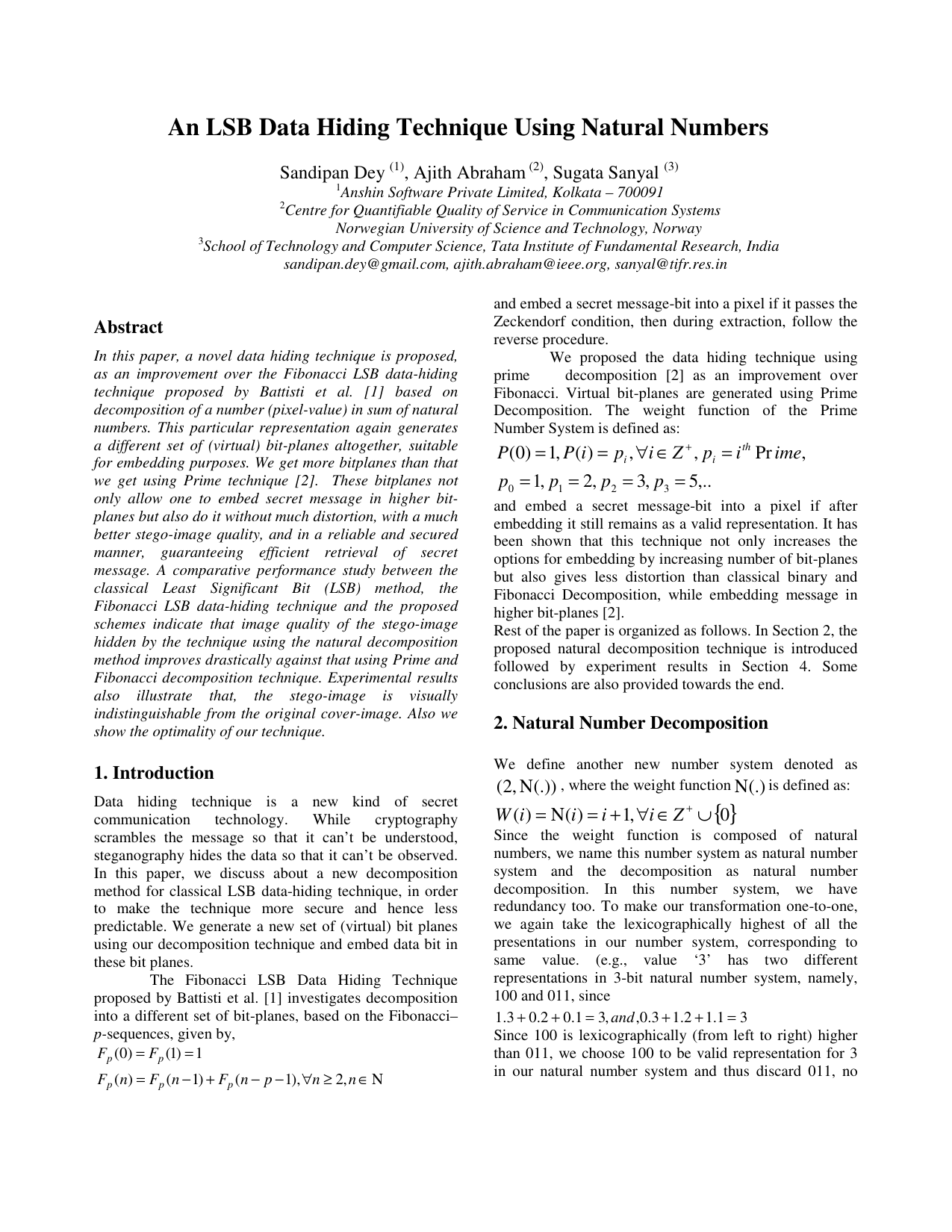
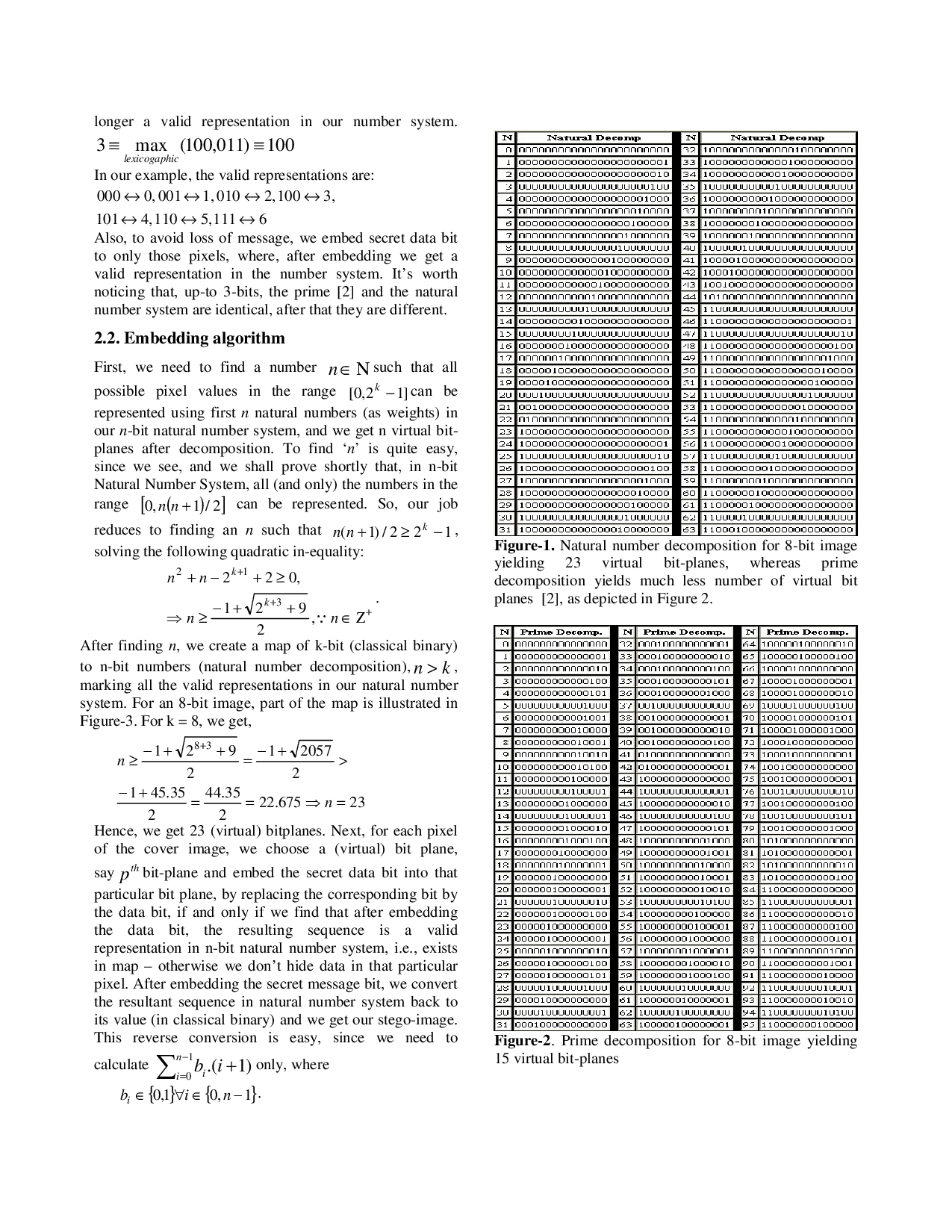
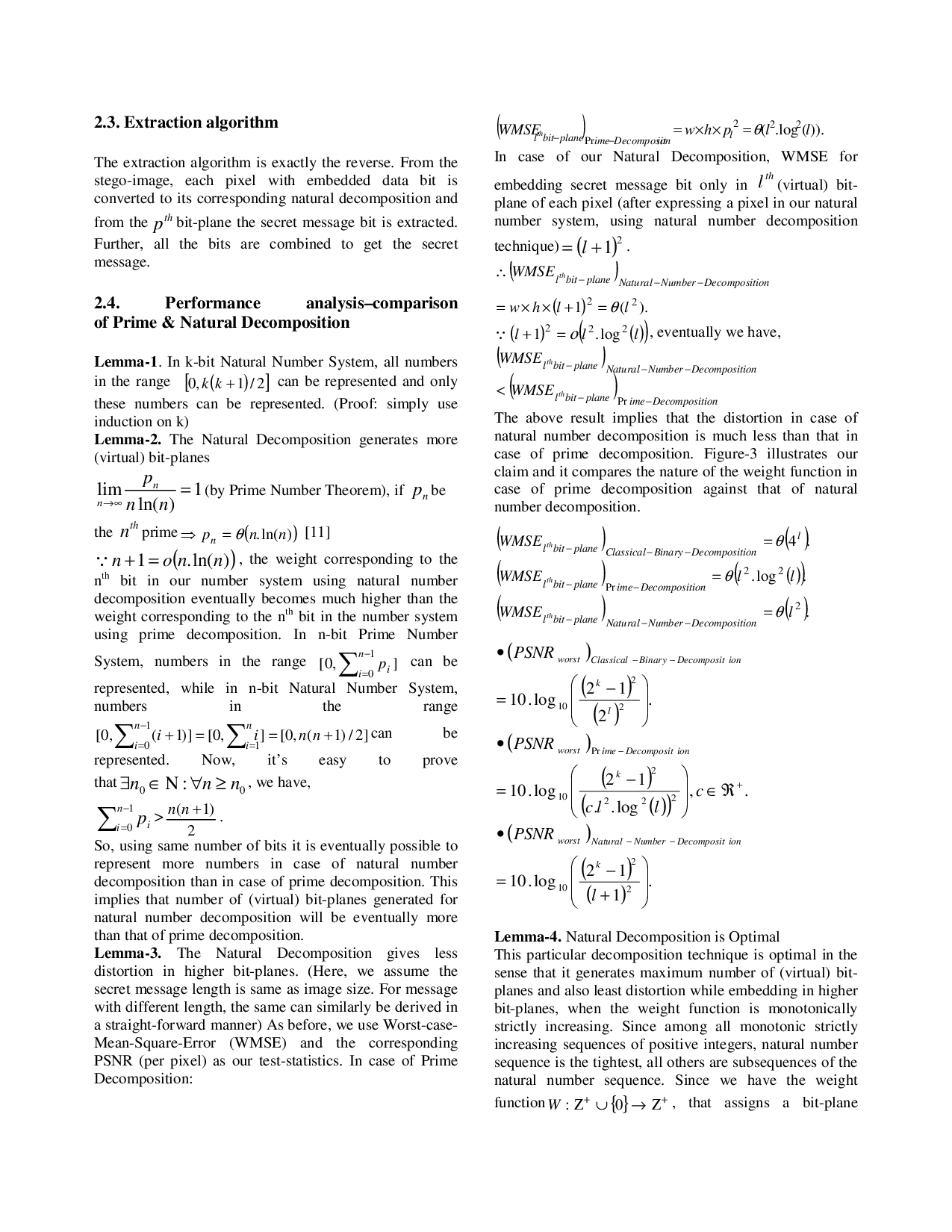
In this paper, a novel data hiding technique is proposed, as an improvement over the Fibonacci LSB data-hiding technique proposed by Battisti et al,based on decomposition of a number (pixel-value) in sum of natural numbers. This particular representation again generates a different set of (virtual) bit-planes altogether, suitable for embedding purposes. We get more bit-planes than that we get using Prime technique.These bit-planes not only allow one to embed secret message in higher bit-planes but also do it without much distortion, with a much better stego-image quality, and in a reliable and secured manner, guaranteeing efficient retrieval of secret message. A comparative performance study between the classical Least Significant Bit(LSB) method, the Fibonacci LSB data-hiding technique and the proposed schemes indicate that image quality of the stego-image hidden by the technique using the natural decomposition method improves drastically against that using Prime and Fibonacci decomposition technique. Experimental results also illustrate that, the stego-image is visually indistinguishable from the original cover-image. Also we show the optimality of our technique.
Deep Dive into An LSB Data Hiding Technique Using Natural Numbers.
In this paper, a novel data hiding technique is proposed, as an improvement over the Fibonacci LSB data-hiding technique proposed by Battisti et al,based on decomposition of a number (pixel-value) in sum of natural numbers. This particular representation again generates a different set of (virtual) bit-planes altogether, suitable for embedding purposes. We get more bit-planes than that we get using Prime technique.These bit-planes not only allow one to embed secret message in higher bit-planes but also do it without much distortion, with a much better stego-image quality, and in a reliable and secured manner, guaranteeing efficient retrieval of secret message. A comparative performance study between the classical Least Significant Bit(LSB) method, the Fibonacci LSB data-hiding technique and the proposed schemes indicate that image quality of the stego-image hidden by the technique using the natural decomposition method improves drastically against that using Prime and Fibonacci decompo
An LSB Data Hiding Technique Using Natural Numbers
Sandipan Dey (1), Ajith Abraham (2), Sugata Sanyal (3)
1Anshin Software Private Limited, Kolkata – 700091
2Centre for Quantifiable Quality of Service in Communication Systems
Norwegian University of Science and Technology, Norway
3School of Technology and Computer Science, Tata Institute of Fundamental Research, India
sandipan.dey@gmail.com, ajith.abraham@ieee.org, sanyal@tifr.res.in
Abstract
In this paper, a novel data hiding technique is proposed,
as an improvement over the Fibonacci LSB data-hiding
technique proposed by Battisti et al. [1] based on
decomposition of a number (pixel-value) in sum of natural
numbers. This particular representation again generates
a different set of (virtual) bit-planes altogether, suitable
for embedding purposes. We get more bitplanes than that
we get using Prime technique [2]. These bitplanes not
only allow one to embed secret message in higher bit-
planes but also do it without much distortion, with a much
better stego-image quality, and in a reliable and secured
manner, guaranteeing efficient retrieval of secret
message. A comparative performance study between the
classical Least Significant Bit (LSB) method, the
Fibonacci LSB data-hiding technique and the proposed
schemes indicate that image quality of the stego-image
hidden by the technique using the natural decomposition
method improves drastically against that using Prime and
Fibonacci decomposition technique. Experimental results
also
illustrate
that,
the
stego-image
is
visually
indistinguishable from the original cover-image. Also we
show the optimality of our technique.
- Introduction
Data hiding technique is a new kind of secret
communication
technology.
While
cryptography
scrambles the message so that it can’t be understood,
steganography hides the data so that it can’t be observed.
In this paper, we discuss about a new decomposition
method for classical LSB data-hiding technique, in order
to make the technique more secure and hence less
predictable. We generate a new set of (virtual) bit planes
using our decomposition technique and embed data bit in
these bit planes.
The Fibonacci LSB Data Hiding Technique
proposed by Battisti et al. [1] investigates decomposition
into a different set of bit-planes, based on the Fibonacci–
p-sequences, given by,
Ν
∈
≥
∀
−
−
−
=
n
n
p
n
F
n
F
n
F
F
F
p
p
p
p
p
,2
),
1
(
)1
(
)
(
1
)1(
)
0
(
and embed a secret message-bit into a pixel if it passes the
Zeckendorf condition, then during extraction, follow the
reverse procedure.
We proposed the data hiding technique using
prime decomposition [2] as an improvement over
Fibonacci. Virtual bit-planes are generated using Prime
Decomposition. The weight function of the Prime
Number System is defined as:
,..
5
,3
,2
,1
,
Pr
,
,
)
(
,1
)
0
(
3
2
1
0
=
=
∈
∀
=
+
p
p
p
p
ime
i
p
Z
i
p
i
P
P
th
i
i
and embed a secret message-bit into a pixel if after
embedding it still remains as a valid representation. It has
been shown that this technique not only increases the
options for embedding by increasing number of bit-planes
but also gives less distortion than classical binary and
Fibonacci Decomposition, while embedding message in
higher bit-planes [2].
Rest of the paper is organized as follows. In Section 2, the
proposed natural decomposition technique is introduced
followed by experiment results in Section 4. Some
conclusions are also provided towards the end.
2. Natural Number Decomposition
We define another new number system denoted as
(.))
,2
(
Ν
, where the weight function
(.)
Ν
is defined as:
{ }
0
,1
)
(
)
(
∪
∈
∀
+
Ν
Z
i
i
i
i
W
Since the weight function is composed of natural
numbers, we name this number system as natural number
system and the decomposition as natural number
decomposition. In this number system, we have
redundancy too. To make our transformation one-to-one,
we again take the lexicographically highest of all the
presentations in our number system, corresponding to
same
value. (e.g., value ‘3’
has two different
representations in 3-bit natural number system, namely,
100 and 011, since
3
1.1
2.1
3.0,
,3
1.0
2.0
3.1
=
+
+
and
Since 100 is lexicographically (from left to right) higher
than 011, we choose 100 to be valid representation for 3
in our natural number system and thus discard 011, no
longer a valid representation in our number system.
100
)
011
,
100
(
max
3
≡
≡
ic
lexicogaph
In our example, the valid representations are:
6
111
,5
110
,4
101
3,
100
2,
010
1,
001
0,
000
↔
↔
↔
↔
↔
↔
↔
Also, to avoid loss of message, we embed secret data bit
to only those pixels, where, after embedding we get a
valid representation in the number system. It’s worth
noticing that, up-to 3-bits, the prime [2] and the natural
number system are identical, after that they are different.
2.2. Embedding
…(Full text truncated)…
This content is AI-processed based on ArXiv data.