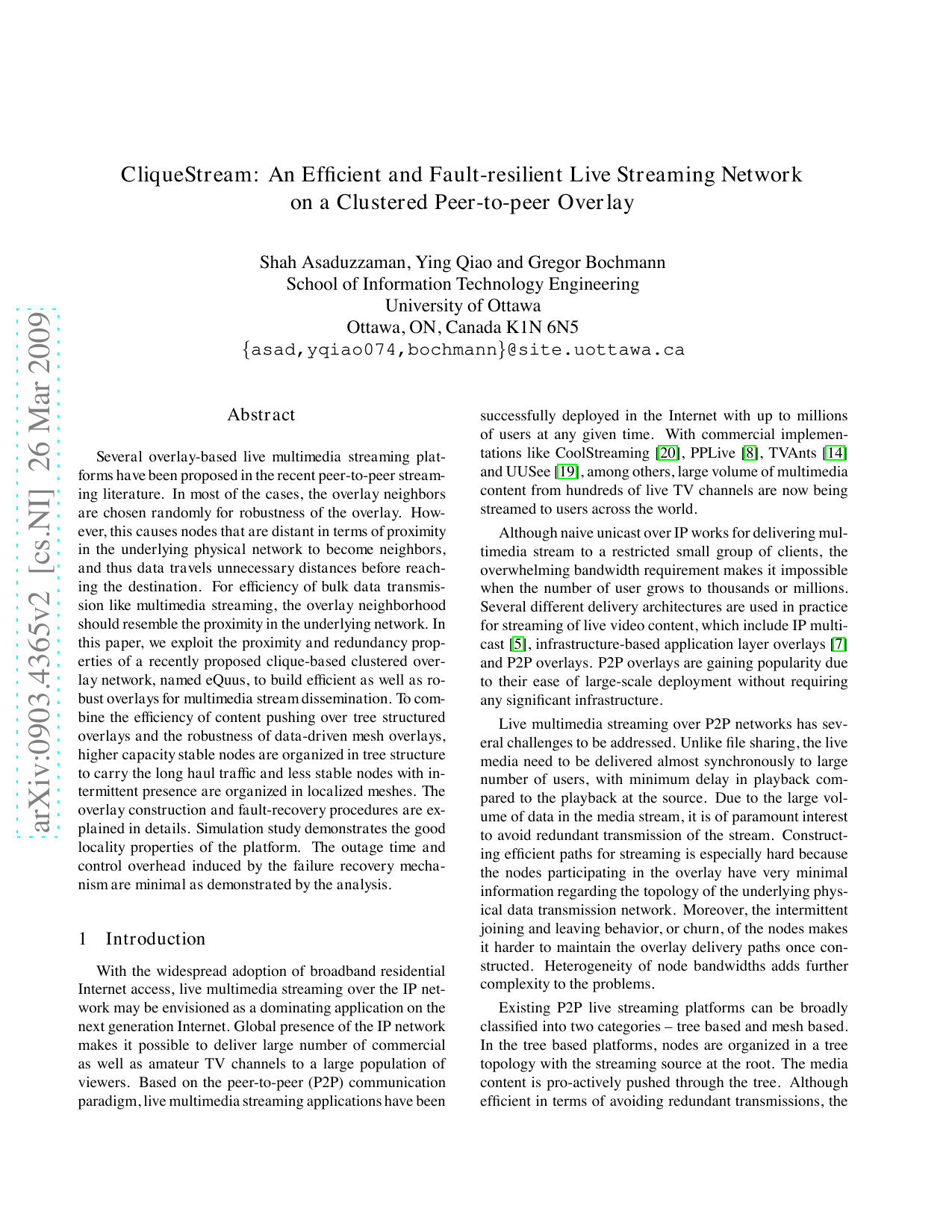
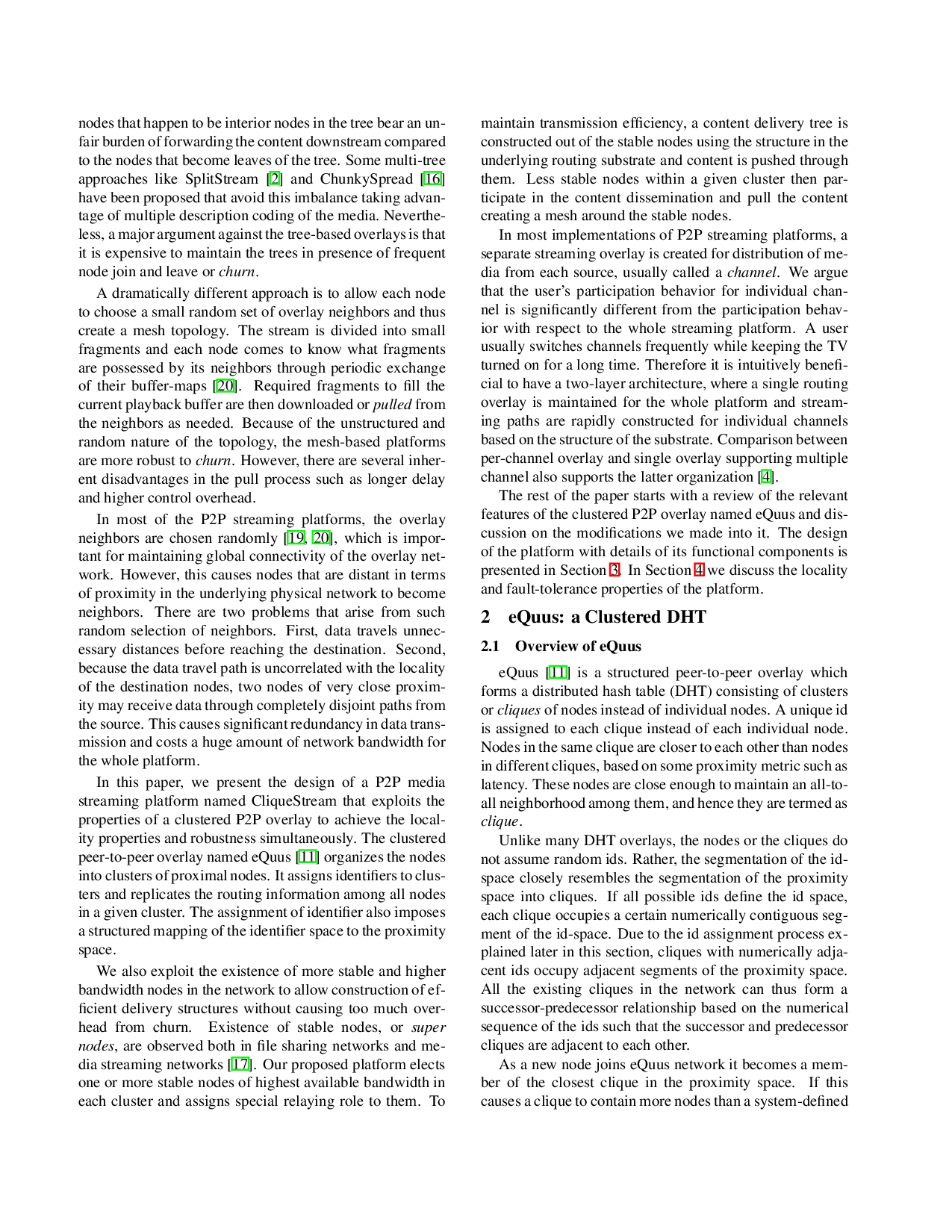
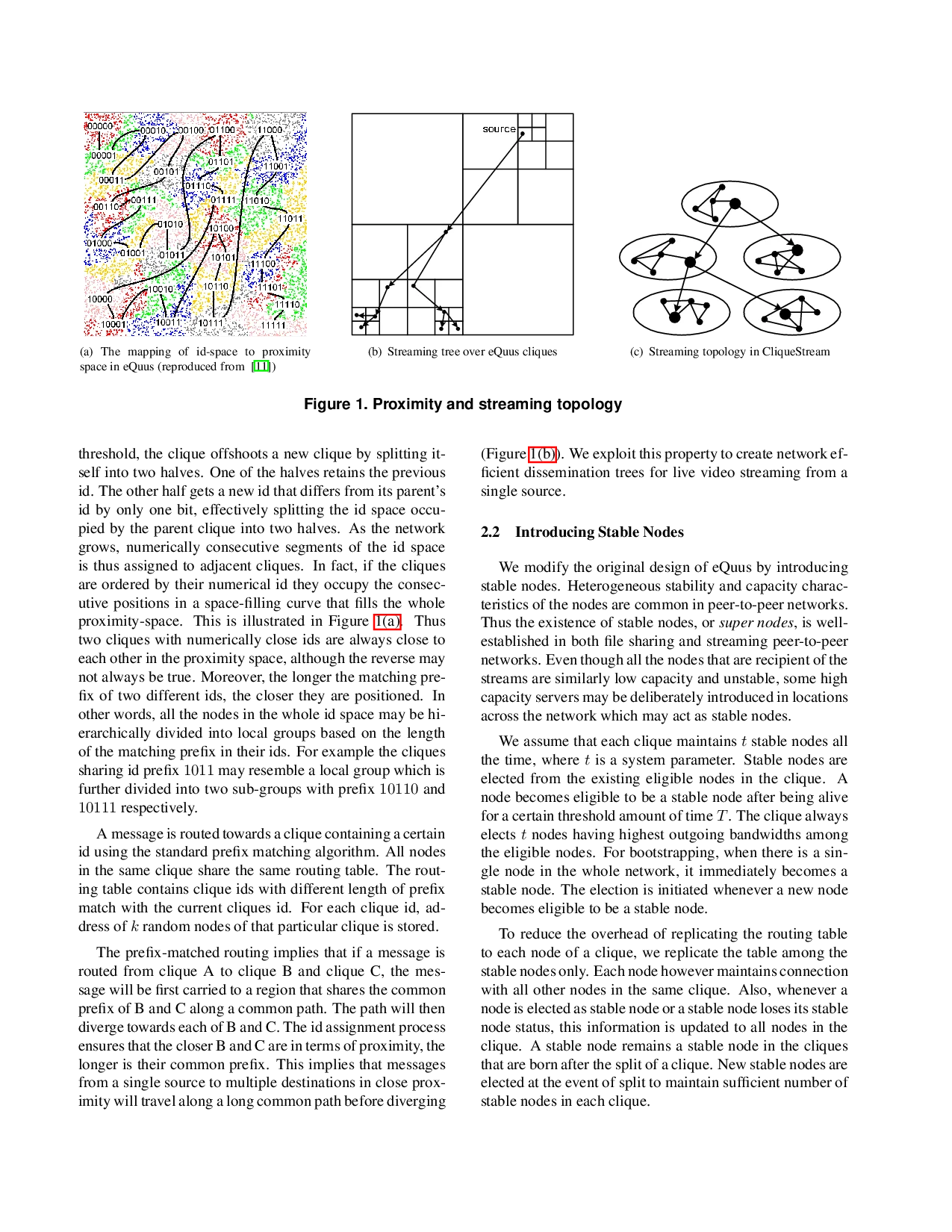
Several overlay-based live multimedia streaming platforms have been proposed in the recent peer-to-peer streaming literature. In most of the cases, the overlay neighbors are chosen randomly for robustness of the overlay. However, this causes nodes that are distant in terms of proximity in the underlying physical network to become neighbors, and thus data travels unnecessary distances before reaching the destination. For efficiency of bulk data transmission like multimedia streaming, the overlay neighborhood should resemble the proximity in the underlying network. In this paper, we exploit the proximity and redundancy properties of a recently proposed clique-based clustered overlay network, named eQuus, to build efficient as well as robust overlays for multimedia stream dissemination. To combine the efficiency of content pushing over tree structured overlays and the robustness of data-driven mesh overlays, higher capacity stable nodes are organized in tree structure to carry the long haul traffic and less stable nodes with intermittent presence are organized in localized meshes. The overlay construction and fault-recovery procedures are explained in details. Simulation study demonstrates the good locality properties of the platform. The outage time and control overhead induced by the failure recovery mechanism are minimal as demonstrated by the analysis.
Deep Dive into CliqueStream: an efficient and fault-resilient live streaming network on a clustered peer-to-peer overlay.
Several overlay-based live multimedia streaming platforms have been proposed in the recent peer-to-peer streaming literature. In most of the cases, the overlay neighbors are chosen randomly for robustness of the overlay. However, this causes nodes that are distant in terms of proximity in the underlying physical network to become neighbors, and thus data travels unnecessary distances before reaching the destination. For efficiency of bulk data transmission like multimedia streaming, the overlay neighborhood should resemble the proximity in the underlying network. In this paper, we exploit the proximity and redundancy properties of a recently proposed clique-based clustered overlay network, named eQuus, to build efficient as well as robust overlays for multimedia stream dissemination. To combine the efficiency of content pushing over tree structured overlays and the robustness of data-driven mesh overlays, higher capacity stable nodes are organized in tree structure to carry the long ha
With the widespread adoption of broadband residential Internet access, live multimedia streaming over the IP network may be envisioned as a dominating application on the next generation Internet. Global presence of the IP network makes it possible to deliver large number of commercial as well as amateur TV channels to a large population of viewers. Based on the peer-to-peer (P2P) communication paradigm, live multimedia streaming applications have been successfully deployed in the Internet with up to millions of users at any given time. With commercial implementations like CoolStreaming [20], PPLive [8], TVAnts [14] and UUSee [19], among others, large volume of multimedia content from hundreds of live TV channels are now being streamed to users across the world.
Although naive unicast over IP works for delivering multimedia stream to a restricted small group of clients, the overwhelming bandwidth requirement makes it impossible when the number of user grows to thousands or millions. Several different delivery architectures are used in practice for streaming of live video content, which include IP multicast [5], infrastructure-based application layer overlays [7] and P2P overlays. P2P overlays are gaining popularity due to their ease of large-scale deployment without requiring any significant infrastructure.
Live multimedia streaming over P2P networks has several challenges to be addressed. Unlike file sharing, the live media need to be delivered almost synchronously to large number of users, with minimum delay in playback compared to the playback at the source. Due to the large volume of data in the media stream, it is of paramount interest to avoid redundant transmission of the stream. Constructing efficient paths for streaming is especially hard because the nodes participating in the overlay have very minimal information regarding the topology of the underlying physical data transmission network. Moreover, the intermittent joining and leaving behavior, or churn, of the nodes makes it harder to maintain the overlay delivery paths once constructed. Heterogeneity of node bandwidths adds further complexity to the problems.
Existing P2P live streaming platforms can be broadly classified into two categories -tree based and mesh based. In the tree based platforms, nodes are organized in a tree topology with the streaming source at the root. The media content is pro-actively pushed through the tree. Although efficient in terms of avoiding redundant transmissions, the nodes that happen to be interior nodes in the tree bear an unfair burden of forwarding the content downstream compared to the nodes that become leaves of the tree. Some multi-tree approaches like SplitStream [2] and ChunkySpread [16] have been proposed that avoid this imbalance taking advantage of multiple description coding of the media. Nevertheless, a major argument against the tree-based overlays is that it is expensive to maintain the trees in presence of frequent node join and leave or churn.
A dramatically different approach is to allow each node to choose a small random set of overlay neighbors and thus create a mesh topology. The stream is divided into small fragments and each node comes to know what fragments are possessed by its neighbors through periodic exchange of their buffer-maps [20]. Required fragments to fill the current playback buffer are then downloaded or pulled from the neighbors as needed. Because of the unstructured and random nature of the topology, the mesh-based platforms are more robust to churn. However, there are several inherent disadvantages in the pull process such as longer delay and higher control overhead.
In most of the P2P streaming platforms, the overlay neighbors are chosen randomly [19,20], which is important for maintaining global connectivity of the overlay network. However, this causes nodes that are distant in terms of proximity in the underlying physical network to become neighbors. There are two problems that arise from such random selection of neighbors. First, data travels unnecessary distances before reaching the destination. Second, because the data travel path is uncorrelated with the locality of the destination nodes, two nodes of very close proximity may receive data through completely disjoint paths from the source. This causes significant redundancy in data transmission and costs a huge amount of network bandwidth for the whole platform.
In this paper, we present the design of a P2P media streaming platform named CliqueStream that exploits the properties of a clustered P2P overlay to achieve the locality properties and robustness simultaneously. The clustered peer-to-peer overlay named eQuus [11] organizes the nodes into clusters of proximal nodes. It assigns identifiers to clusters and replicates the routing information among all nodes in a given cluster. The assignment of identifier also imposes a structured mapping of the identifier space to the proximity space.
We also exploit the ex
…(Full text truncated)…
This content is AI-processed based on ArXiv data.