Composite fabrication technologies now provide the means for producing high-strength, low-weight panels, plates, spars and other structural components which use embedded fiber optic sensors and piezoelectric transducers. These materials, often referred to as smart structures, make it possible to sense internal characteristics, such as delaminations or structural degradation. In this effort we use neural network based techniques for modeling and analyzing dynamic structural information for recognizing structural defects. This yields an adaptable system which gives a measure of structural integrity for composite structures.
Deep Dive into Structural Health Monitoring Using Neural Network Based Vibrational System Identification.
Composite fabrication technologies now provide the means for producing high-strength, low-weight panels, plates, spars and other structural components which use embedded fiber optic sensors and piezoelectric transducers. These materials, often referred to as smart structures, make it possible to sense internal characteristics, such as delaminations or structural degradation. In this effort we use neural network based techniques for modeling and analyzing dynamic structural information for recognizing structural defects. This yields an adaptable system which gives a measure of structural integrity for composite structures.
Composite fabrication technologies now provide a means for producing high-strength, low weight structural components with structural and material properties which can be tailored to use in specific target environments (e.g. stiffness con-straints, durability, temperature and corrosion resistance). However, these composite structures may degrade due to improper manufacture (improper cure cycle, fiber misalignment, foreign object debris, delaminations, etc.), duty cycle wear, impacts, and material corrosion (e.g. due to moisture, fuel or chemical absorption). This structural degradation may not be detectable through visual inspection.
Fiber optic sensing technology provides a means for sensing various structural properties such as stress, strain, and elasticity when these sensors are mounted on, or embedded within, a material structure. Current composite fabrication methods have been demonstrated which allow fiber optic sensors to be embedded within a composite structure during manufacture of that structure. These sensors maintain their viability throughout the cure cycle and various other production stages, and thereafter may potentially be used for structural health monitoring. Although a large variety of embedded fiber optic sensors have been explored, we focus on perhaps the simplest and most reliable method: the fiber optic strain sensor.
Another class of devices which may be embedded in, or mounted on, composite structures is piezoelectric transducers, or PZTs. A composite which uses a number of embedded PZTs may utilize them for vibration sensing or generation, but any given transducer may be used only for one of these purposes at a given time. Other than for exciting the vibrational modes of a structure, the use of PZTs for vibrational control is beyond the scope of this paper.
The key to understanding how embedded fiber optic sensors (in particular, strain sensors) may be used to determine structural integrity is the understanding of how various types of degradation correlate with changes in the structural dynamics of the localized area of the composite structure. Impacts, material defects, and wear all affect the structural dynamics of the composite (hence the need for structural integrity monitoring) in a fashion which is measurable based upon the response of the structure to normal everyday use. Neural networks may be trained to recognize the symptoms of structural degradation based upon changes in the dynamic response of the composite part, and to correlate these symptoms with their root causes (e.g. impact damage, delaminations, duty cycle wear).
Therefore, the task for determining structural integrity using embedded fiber optic sensors may be cast as (1) determine the structural dynamics of the localized area, (2) correlate dynamic information to local structural degradation, and (3) integrate this knowledge (in real time) over the entire vehicle to provide input to a vehicle health monitoring system. The first task has long been studied from the viewpoint of systems theory, controls, and system identification theory.
Existing tactical combat aircraft (e.g. F-15E Eagle) have rudimentary overload warning systems which provide an audible tone to the pilot when he exceeds the design limit load of the structure. What is required for health monitoring in smart structures for high performance aircraft is a much more general, sophisticated, and automated system which provides quantitative analysis of the overall structure’s state.
Additionally, periodic nondestructive inspection (NDI) inspections of the structure (ultrasonic imaging, thermography, eddy current, etc) are time/labor consuming, result in decreased vehicle survivability, and may not even provide coverage of inaccessible areas. In terms of inspection, smart structure technology would greatly reduce NDI inspection requirements by reducing the frequency of NDI and by detecting new problem areas autonomously.
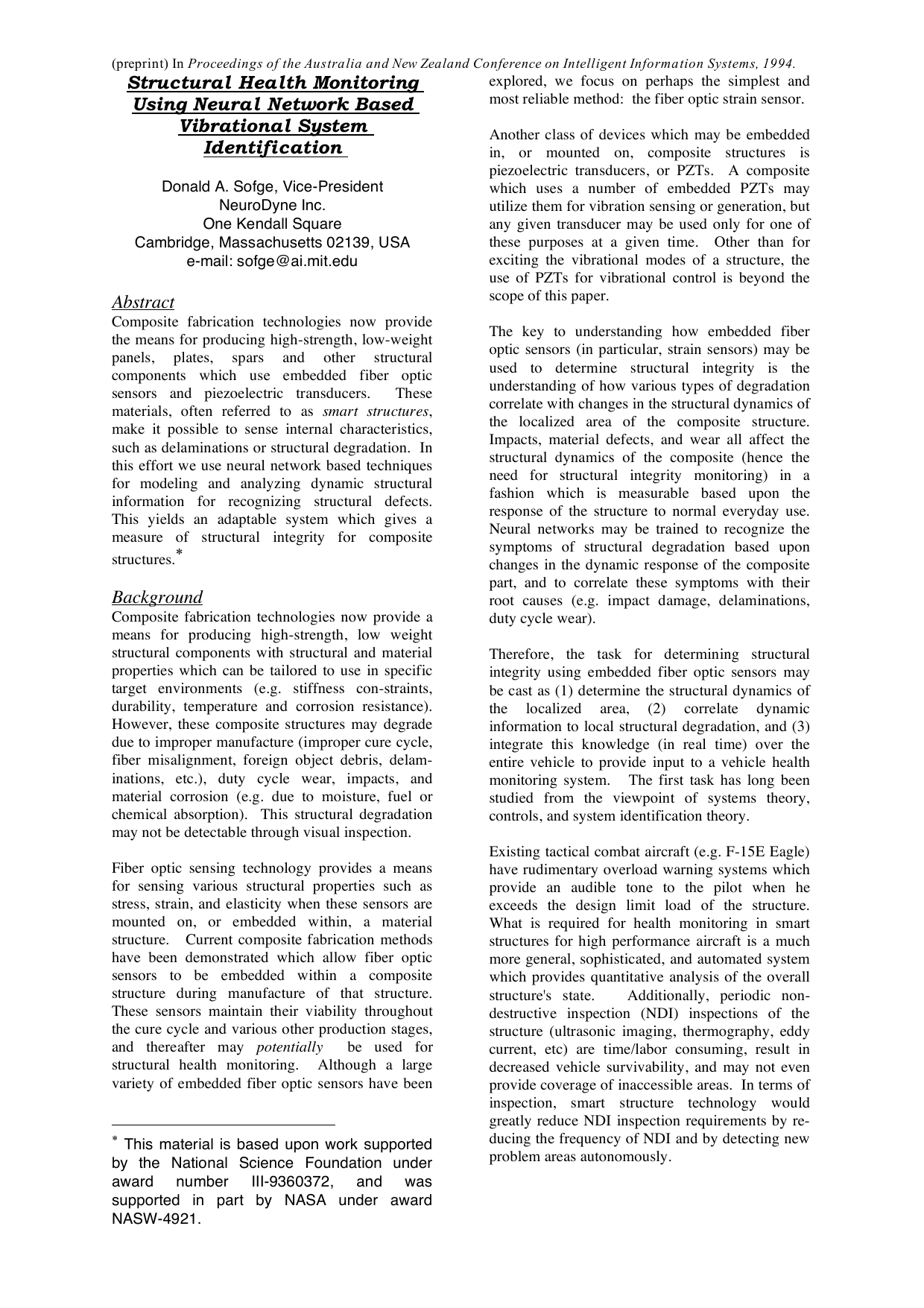
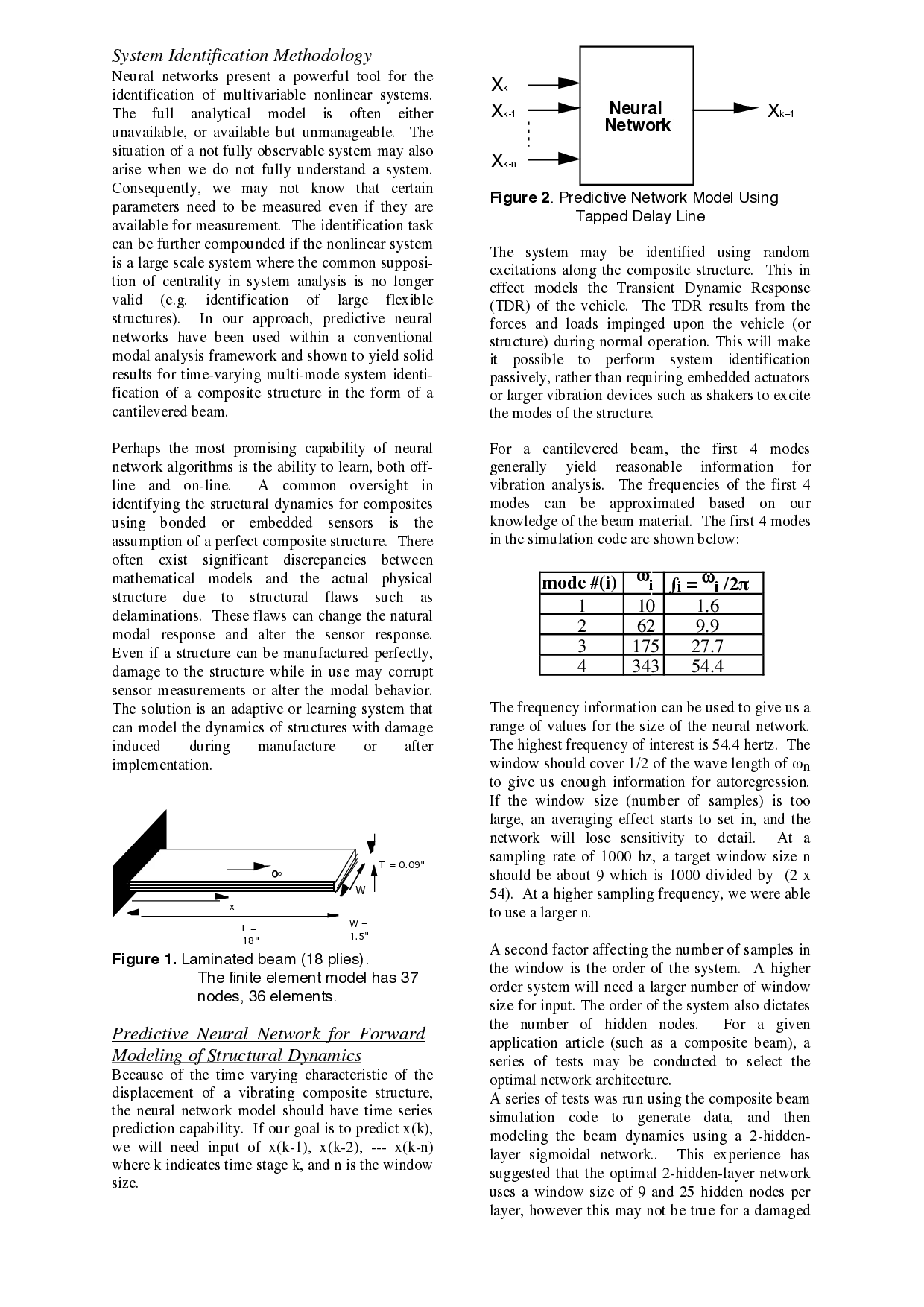
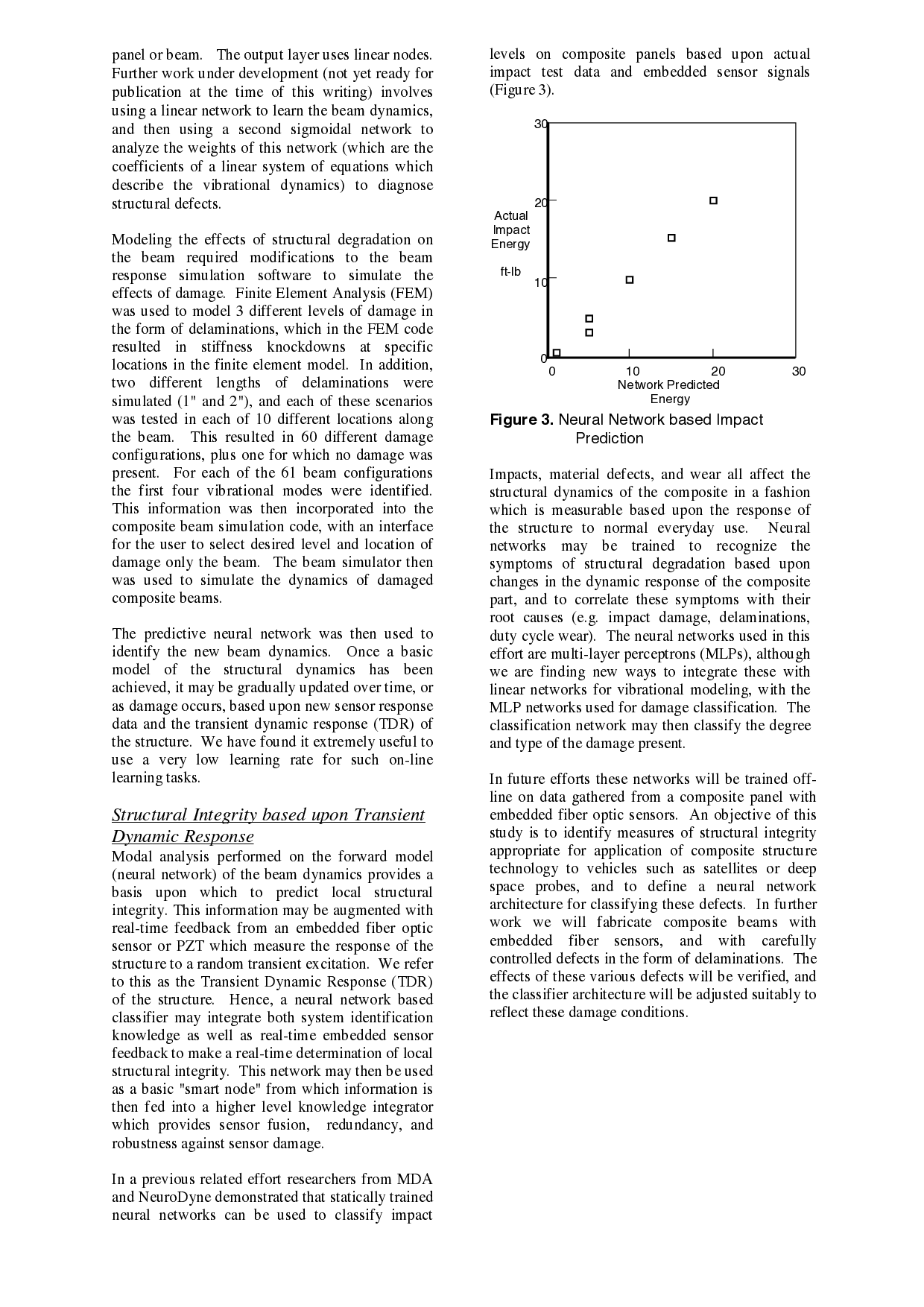
Neural networks present a powerful tool for the identification of multivariable nonlinear systems. The full analytical model is often either unavailable, or available but unmanageable. The situation of a not fully observable system may also arise when we do not fully understand a system. Consequently, we may not know that certain parameters need to be measured even if they are available for measurement. The identification task can be further compounded if the nonlinear system is a large scale system where the common supposition of centrality in system analysis is no longer valid (e.g. identification of large flexible structures). In our approach, predictive neural networks have been used within a conventional modal analysis framework and shown to yield solid results for time-varying multi-mode system identification of a composite structure in the form of a cantilevered beam.
Perhaps the most promising capability of neural network algorithms is the ability to learn, both offline and on-line.
A common oversight in identifying the
…(Full text truncated)…
This content is AI-processed based on ArXiv data.