Mapping Generative Models onto a Network of Digital Spiking Neurons
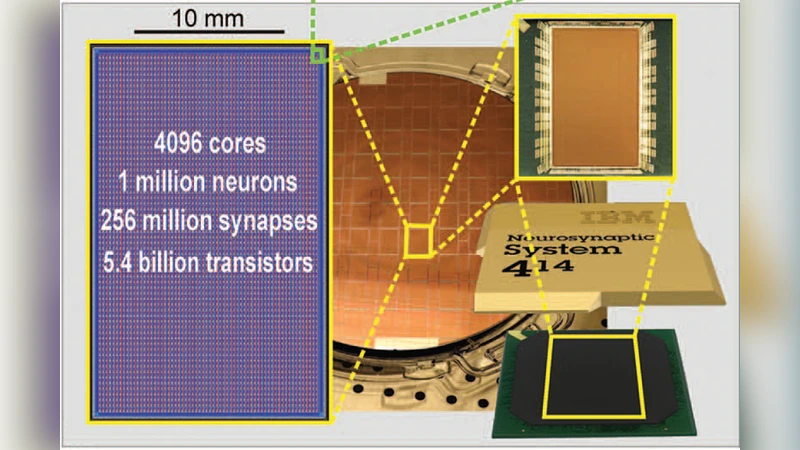
Stochastic neural networks such as Restricted Boltzmann Machines (RBMs) have been successfully used in applications ranging from speech recognition to image classification. Inference and learning in these algorithms use a Markov Chain Monte Carlo procedure called Gibbs sampling, where a logistic function forms the kernel of this sampler. On the other side of the spectrum, neuromorphic systems have shown great promise for low-power and parallelized cognitive computing, but lack well-suited applications and automation procedures. In this work, we propose a systematic method for bridging the RBM algorithm and digital neuromorphic systems, with a generative pattern completion task as proof of concept. For this, we first propose a method of producing the Gibbs sampler using bio-inspired digital noisy integrate-and-fire neurons. Next, we describe the process of mapping generative RBMs trained offline onto the IBM TrueNorth neurosynaptic processor – a low-power digital neuromorphic VLSI substrate. Mapping these algorithms onto neuromorphic hardware presents unique challenges in network connectivity and weight and bias quantization, which, in turn, require architectural and design strategies for the physical realization. Generative performance metrics are analyzed to validate the neuromorphic requirements and to best select the neuron parameters for the model. Lastly, we describe a design automation procedure which achieves optimal resource usage, accounting for the novel hardware adaptations. This work represents the first implementation of generative RBM inference on a neuromorphic VLSI substrate.
💡 Research Summary
This paper presents a complete methodology for implementing a generative Restricted Boltzmann Machine (RBM) on a digital spiking neuromorphic substrate, specifically the IBM TrueNorth processor. The authors first derive a hardware‑friendly Gibbs sampler by exploiting the stochastic properties of integrate‑and‑fire (I&F) neurons available on TrueNorth. Each neuron’s membrane potential is initialized to the logistic argument (a linear combination of weights, biases, and neighboring unit states). During each discrete time step the neuron experiences two independent stochastic events: a “leak” that adds a fixed integer L with probability 0.5, and a “threshold” drawn uniformly from a range
Comments & Academic Discussion
Loading comments...
Leave a Comment