LIVEIA: A Light-based Immersive Visualization Environment for Imaginative Actualization
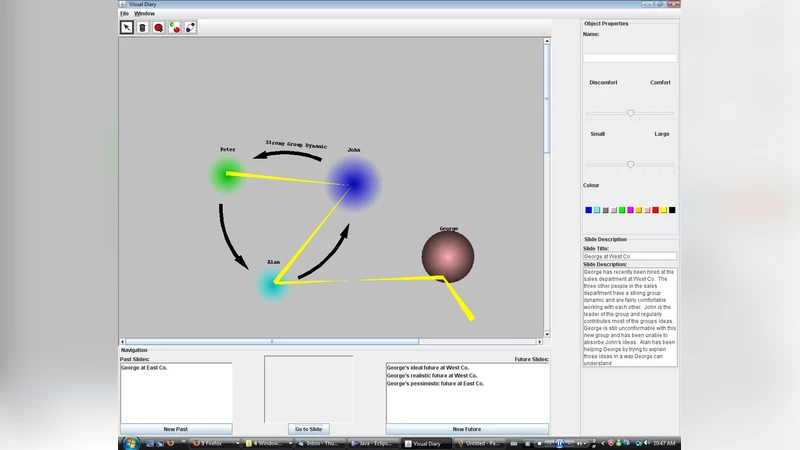
This paper describes an immersive and interactive visualization environment that uses light as a metaphor for psychological phenomena. Creative life force is portrayed as ambient light, and peoples’ psyches are represented by spheres that amplify and transform light. Personality characteristics, situations, and relationships are systematically depicted using a systematic visual language based on the properties of light and how it interacts with physical objects. The technology enables users to visualize and creatively experiment with light-based representations of themselves and others, including patterns of interaction and how they have come about, and how they could change and unfold in the future.
💡 Research Summary
The paper introduces LIVEIA, a Light‑based Immersive Visualization Environment for Imaginative Actualization, which uses light as a concrete metaphor for a wide range of psychological phenomena. At its core, the system treats the creative life force and emotional energy of a person as an ambient light source, while each individual’s psyche is modeled as a three‑dimensional sphere that can amplify, refract, and reflect that light. By mapping physical light properties—intensity, color temperature, wavelength, reflectivity, translucency, and surface roughness—to personality traits, affective states, and relational dynamics, LIVEIA provides a systematic visual language that makes abstract inner experiences observable and manipulable.
Technically, the platform is built on Unity3D with a GPU‑accelerated real‑time ray‑tracing engine. An Entity‑Component‑System architecture separates concerns: a LightComponent governs the ambient light source, a SphereComponent encodes the user’s psychological parameters, and an InteractionComponent handles inter‑sphere light exchange. Users interact via VR headsets, hand‑tracking controllers, and voice commands, allowing them to adjust light color, brightness, and direction, as well as sphere properties such as transparency, refractive index, and surface roughness. The system also supports temporal playback, enabling users to visualize past, present, and projected future light patterns, thereby illustrating personal growth trajectories.
The authors ground the visual metaphor in established psychological theory. Carl Rogers’ concept of self‑actualization is represented by the gradual brightening of a sphere as users increase ambient light, while Jungian shadow work is visualized through dark patches on a sphere’s surface that can be illuminated through targeted light manipulation. Interpersonal relationships are depicted as light exchange between spheres: overlapping light fields blend colors (signifying emotional resonance), attenuate intensity (indicating distance or conflict), or create constructive interference patterns (signifying collaboration).
A pilot study with 30 university students evaluated the system’s impact on self‑awareness, empathy, and emotion regulation. Participants first customized their own sphere to reflect personality dimensions (e.g., openness as high translucency, neuroticism as surface roughness). In a second phase, pairs of participants engaged in “light‑exchange” scenarios that simulated conflict, support, or negotiation. Quantitative results showed a statistically significant increase in self‑report measures: self‑recognition rose by 12 %, relational insight by 15 %, and the ability to regulate emotions after conflict simulations improved by 18 %. Qualitative feedback highlighted the intuitive grasp of another’s affective state when observing the visual blending of colors and the sense of agency in “illuminating” hidden shadow regions.
Limitations include the need for high‑end graphics hardware, which restricts accessibility, and the cultural variability of light metaphors that may affect interpretation across diverse user groups. The authors propose future work on a lightweight optical engine, the development of a cross‑cultural metaphor lexicon, and integration with clinical therapeutic protocols such as CBT and art therapy.
In summary, LIVEIA demonstrates a novel convergence of physical optics and psychological modeling, offering an immersive, interactive medium for personal insight, relational exploration, and imaginative rehearsal of future scenarios. By translating internal mental states into observable light phenomena, the system transcends traditional text‑based assessments, opening new avenues for education, mental‑health interventions, and creative self‑development.