Two-message quantum interactive proofs and the quantum separability problem
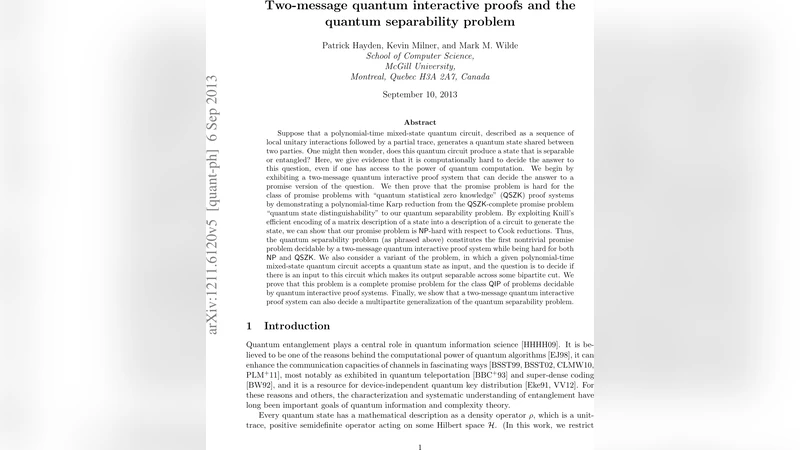
Suppose that a polynomial-time mixed-state quantum circuit, described as a sequence of local unitary interactions followed by a partial trace, generates a quantum state shared between two parties. One might then wonder, does this quantum circuit produce a state that is separable or entangled? Here, we give evidence that it is computationally hard to decide the answer to this question, even if one has access to the power of quantum computation. We begin by exhibiting a two-message quantum interactive proof system that can decide the answer to a promise version of the question. We then prove that the promise problem is hard for the class of promise problems with “quantum statistical zero knowledge” (QSZK) proof systems by demonstrating a polynomial-time Karp reduction from the QSZK-complete promise problem “quantum state distinguishability” to our quantum separability problem. By exploiting Knill’s efficient encoding of a matrix description of a state into a description of a circuit to generate the state, we can show that our promise problem is NP-hard with respect to Cook reductions. Thus, the quantum separability problem (as phrased above) constitutes the first nontrivial promise problem decidable by a two-message quantum interactive proof system while being hard for both NP and QSZK. We also consider a variant of the problem, in which a given polynomial-time mixed-state quantum circuit accepts a quantum state as input, and the question is to decide if there is an input to this circuit which makes its output separable across some bipartite cut. We prove that this problem is a complete promise problem for the class QIP of problems decidable by quantum interactive proof systems. Finally, we show that a two-message quantum interactive proof system can also decide a multipartite generalization of the quantum separability problem.
💡 Research Summary
The paper investigates the computational difficulty of deciding whether a quantum state produced by a polynomial‑time mixed‑state quantum circuit is separable or entangled. The authors focus on a promise version of the problem: given a description of a circuit that outputs a bipartite state ρ_AB, either ρ_AB is ε‑close to a separable state or it is at least δ‑far (in trace distance) from every separable state. Their first contribution is a two‑message quantum interactive proof system (QIP(2)) that decides this promise problem with completeness and soundness errors bounded by a constant (e.g., 1/3). The prover sends a quantum register together with a classical description of the circuit; the verifier then applies a combination of SWAP‑tests, multipartite fidelity tests, and a Positive‑Partial‑Transpose (PPT) check to certify separability or detect entanglement. This shows that the problem lies in QIP(2), the smallest non‑trivial class of quantum interactive proofs.
Next, the authors establish QSZK‑hardness. They reduce the QSZK‑complete Quantum State Distinguishability (QSD) problem to their separability promise problem. In QSD, two circuits C0 and C1 generate states σ0 and σ1; the task is to decide whether ‖σ0−σ1‖₁ is large or negligible. By embedding σ0 and σ1 into opposite halves of a bipartite system, adding ancilla qubits, and applying a controlled‑SWAP operation, they construct a new circuit C′ whose output is separable exactly when σ0 and σ1 are indistinguishable, and entangled otherwise. This polynomial‑time Karp reduction proves that the separability promise problem is QSZK‑hard.
To show NP‑hardness, the paper leverages Knill’s efficient encoding of a density matrix into a polynomial‑time quantum circuit. Any matrix description of a state ρ can be turned into a circuit C_ρ that generates ρ. Using this encoding, the authors reduce the classic NP‑hard “Separable‑State Existence” problem (given a matrix, decide if it is separable) to their promise problem via a Cook reduction. Consequently, deciding separability of a circuit‑generated state is at least as hard as any problem in NP.
The paper also studies a variant where the circuit accepts an arbitrary input state and the question is whether there exists an input that makes the output separable across a specified bipartite cut. They prove this problem is QIP‑complete. The reduction works both ways: any QIP protocol can be encoded as a circuit‑input separability instance, and conversely a QIP(2) protocol can be built for the problem by having the prover supply the desired input and the verifier performing a PPT test after running the circuit. Thus the problem captures the full power of general quantum interactive proofs.
Finally, the authors extend their two‑message protocol to the multipartite setting. For an n‑partite state generated by a circuit, the prover provides auxiliary registers for each party, and the verifier runs generalized SWAP‑tests together with multipartite PPT checks. The same completeness and soundness guarantees hold, showing that multipartite separability remains in QIP(2).
In summary, the work demonstrates that the separability decision problem for circuit‑generated states is simultaneously in QIP(2), QSZK‑hard, and NP‑hard, making it the first non‑trivial promise problem with this combination of complexity properties. Moreover, the input‑selection variant is shown to be QIP‑complete, and the techniques naturally generalize to multipartite separability. These results deepen our understanding of the landscape of quantum proof systems and highlight the intrinsic computational hardness of quantum entanglement verification, even when powerful quantum resources are available.