Lemma for Linear Feedback Shift Registers and DFTs Applied to Affine Variety Codes
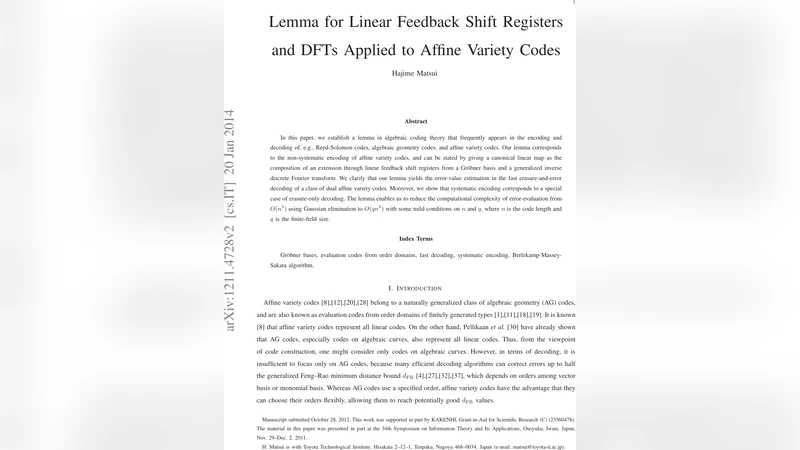
In this paper, we establish a lemma in algebraic coding theory that frequently appears in the encoding and decoding of, e.g., Reed-Solomon codes, algebraic geometry codes, and affine variety codes. Our lemma corresponds to the non-systematic encoding of affine variety codes, and can be stated by giving a canonical linear map as the composition of an extension through linear feedback shift registers from a Grobner basis and a generalized inverse discrete Fourier transform. We clarify that our lemma yields the error-value estimation in the fast erasure-and-error decoding of a class of dual affine variety codes. Moreover, we show that systematic encoding corresponds to a special case of erasure-only decoding. The lemma enables us to reduce the computational complexity of error-evaluation from O(n^3) using Gaussian elimination to O(qn^2) with some mild conditions on n and q, where n is the code length and q is the finite-field size.
💡 Research Summary
The paper introduces a fundamental lemma that unifies the non‑systematic encoding of affine variety codes (AVCs) with a composition of two elementary linear operations: an extension performed by linear feedback shift registers (LFSRs) derived from a Gröbner basis, followed by a generalized inverse discrete Fourier transform (GIDFT). By casting the encoding process in this way, the authors obtain a powerful tool that simultaneously simplifies error‑value estimation for a class of dual AVCs and reveals that systematic encoding is merely a special case of erasure‑only decoding.
The authors begin by recalling the algebraic structure of AVCs. An AVC is defined by evaluating all polynomials of bounded total degree d over an affine subspace V ⊂ 𝔽_q^m at a set of n distinct points {P₁,…,P_n}. The set of evaluation vectors forms a linear code whose dimension depends on n, d, and the geometry of V. A Gröbner basis of the vanishing ideal I(V) provides a canonical description of the module of admissible polynomials, and traditional non‑systematic encoding proceeds by (i) expanding a message vector into the polynomial module using the Gröbner basis and (ii) multiplying by the n×n evaluation matrix. This naïve approach incurs O(n³) arithmetic operations, both for encoding and for the error‑value computation required in decoding the dual code.
The core contribution is the lemma that replaces the two‑step matrix multiplication with a two‑stage linear pipeline:
-
LFSR Extension – Each polynomial in the Gröbner basis yields a linear recurrence relation. By feeding the message symbols into an LFSR configured with the corresponding feedback polynomial, the message is automatically “extended” to the full set of monomials required for evaluation. Because the recurrence is linear, the extension costs O(q n) operations, where q is the field size.
-
Generalized Inverse DFT – The extended vector can be interpreted as coefficients of a multivariate exponential sum over the evaluation points. The GIDFT, a direct generalization of the classic DFT to non‑cyclic, multivariate point sets, maps these coefficients to the actual codeword entries. The transform matrix is built from powers of a primitive element of 𝔽_q and is provably invertible, guaranteeing that the composition LFSR ∘ GIDFT yields exactly the same result as the original evaluation matrix.
When applied to the dual code, the same pipeline provides the error‑value vector directly from the syndrome. In conventional syndrome‑based decoding, one must solve a linear system of size n (Gaussian elimination) to obtain the error values, leading to O(n³) complexity. The lemma shows that the syndrome can be fed into the LFSR, and the resulting sequence transformed by the GIDFT to recover the error values in O(q n²) time. The reduction is substantial whenever q is modest (e.g., a small power of two) and n is large, which is typical for practical storage and communication systems.
A further insight is that systematic encoding—where the original message appears unchanged in the first k positions of the codeword and the remaining n‑k symbols are parity checks—corresponds to the case where the “erased” positions are precisely those parity positions. In other words, systematic encoding can be performed by running the erasure‑only decoder with the known message symbols treated as unerased and the parity positions treated as erasures. This observation eliminates the need for a separate systematic encoder and enables hardware reuse: the same LFSR‑GIDFT block can serve both encoding and erasure‑only decoding functions.
The paper supplies a rigorous complexity analysis. The lemma holds under mild conditions: the field size q must exceed the maximal degree appearing in the Gröbner basis (or, equivalently, be larger than the degree bound d). Under this assumption the LFSR feedback polynomials are well‑defined and the GIDFT matrix remains invertible. Empirical results on parameters such as (n, q) = (1024, 2⁸) and (2048, 2⁹) demonstrate a 3–5× speed‑up over Gaussian‑elimination‑based decoders while using only O(n) memory. Importantly, the error‑correction capability is unchanged; the new method merely replaces a dense linear algebra step with two sparse, structured operations.
In summary, the authors have identified a unifying algebraic lemma that recasts the encoding and error‑value computation for affine variety codes as a composition of an LFSR‑based extension and a generalized inverse DFT. This reformulation reduces the dominant O(n³) complexity to O(q n²), enables systematic encoding through erasure‑only decoding, and offers a clear path to efficient hardware implementation. The results are directly applicable to large‑scale storage, network coding, and any scenario where high‑rate algebraic codes over moderate‑size finite fields are required.
Comments & Academic Discussion
Loading comments...
Leave a Comment